
Fungi (कवक)
Introduction (परिचय):
Fungi are a large group of eukaryotic organisms that include yeasts, molds, and mushrooms.
कवक एक यूकैरियोटिक जीवों का समूह है जिसमें यीस्ट, फफूंद और मशरूम शामिल हैं। ये प्रकृति में अपघटक (decomposers) के रूप में महत्वपूर्ण भूमिका निभाते हैं।
Fact Box (तथ्य बॉक्स)
- Fungi are achlorophyllous (क्लोरोफिल रहित होते हैं)।
- They are heterotrophic (पोषण के लिए अन्य पर निर्भर)।
- Store food mainly as glycogen (मुख्य रूप से ग्लाइकोजन के रूप में भोजन संग्रह)।
- Cell wall contains chitin (काइटिन से बनी कोशिका भित्ति)।
General Features (सामान्य विशेषताएँ)
- Unicellular (yeast) or multicellular (mushrooms, molds) हो सकते हैं।
- Mode of nutrition: saprophytic, parasitic, symbiotic।
- Reproduction: vegetative, asexual and sexual।
Classification of Fungi (कवक का वर्गीकरण)
| Group | Examples | Features (विशेषताएँ) |
|---|---|---|
| Zygomycota | Rhizopus | Asexual spores in sporangia |
| Ascomycota | Yeast, Neurospora | Sac fungi, spores in asci |
| Basidiomycota | Mushroom, Puccinia | Club fungi, basidiospores |
| Deuteromycota | Alternaria, Colletotrichum | Imperfect fungi (no sexual stage) |
Structure (संरचना)
Fungal body is called mycelium (मायसीलियम) which consists of thread-like structures known as hyphae (हाइफी)।
Yeast is an exception as it is unicellular.
Reproduction (प्रजनन)
- Vegetative – By fragmentation, budding, fission।
- Asexual – By spores like conidia, sporangiospores, zoospores।
- Sexual – Fusion of two gametes forms zygospore, ascospore or basidiospore depending on the group।
Did You Know? (क्या आप जानते हैं?)
Penicillium (पेनिसिलियम) से ही प्रसिद्ध एंटीबायोटिक Penicillin की खोज हुई थी।
Classification of Fungi (Alexopoulos and Mims, 1979)
Introduction (परिचय):
The classification of fungi has undergone several changes. Alexopoulos and Mims (1979) provided a widely accepted system, where fungi are divided into different classes based on thallus organization, mode of reproduction, spore type, and structure of hyphae.
कवक का वर्गीकरण समय-समय पर बदला गया है। एलेक्सोपोलस और मिम्स (1979) ने एक प्रसिद्ध वर्गीकरण दिया जिसमें कवक को थैलस संरचना, प्रजनन विधि, बीजाणुओं के प्रकार और हाइफी की संरचना के आधार पर विभिन्न वर्गों में बाँटा गया।
Key Fact (मुख्य तथ्य)
Alexopoulos and Mims ने कवक को मुख्यतः 5 major groups में वर्गीकृत किया।
Major Groups of Fungi (मुख्य वर्ग)
| Group (वर्ग) | Examples (उदाहरण) | Key Features (विशेषताएँ) |
|---|---|---|
| Chytridiomycota (Chytrids) |
Batrachochytrium | – Mostly aquatic – Motile spores (zoospores with flagella) – Simplest fungi |
| Zygomycota (Zygomycetes) |
Rhizopus, Mucor | – Non-septate hyphae – Asexual spores in sporangia – Sexual reproduction by zygospore |
| Ascomycota (Sac Fungi) |
Yeast, Neurospora, Penicillium | – Septate hyphae – Sexual spores in ascus (ascospores) – Asexual spores (conidia) |
| Basidiomycota (Club Fungi) |
Mushroom, Puccinia, Ustilago | – Septate hyphae – Basidiospores on basidia – Mushrooms & smuts |
| Deuteromycota (Imperfect Fungi) |
Alternaria, Colletotrichum | – Only asexual stage known – No sexual reproduction – Important in plant diseases |
Structure Diagram (संरचना चित्र)
🔲 Diagram Placeholder: Insert here diagrams of hyphae, sporangium, ascus, basidium for better understanding.
Did You Know? (क्या आप जानते हैं?)
Neurospora was used as a model organism in genetics by Beadle and Tatum, leading to the famous “One gene–One enzyme hypothesis”.
Economic Importance of Fungi (कवक का आर्थिक महत्व)
Introduction (परिचय):
Fungi play a dual role in human life – they can be beneficial as well as harmful.
कवक मानव जीवन में द्वैध भूमिका निभाते हैं – वे लाभकारी भी होते हैं और हानिकारक भी।
Their economic importance can be studied under the following categories.
इनका आर्थिक महत्व निम्नलिखित श्रेणियों में अध्ययन किया जा सकता है।
Key Point (मुख्य बिंदु)
Fungi are used in food, medicine, industry and also cause diseases in plants, animals and humans.
1. Beneficial Role of Fungi (लाभकारी भूमिका)
| Category (श्रेणी) | Examples (उदाहरण) | Uses (उपयोग) |
|---|---|---|
| Food Production (भोजन) | Yeast (Saccharomyces) | Bread, beer, wine fermentation |
| Medicines (औषधि) | Penicillium, Aspergillus | Antibiotics (Penicillin), organic acids |
| Industrial Products (औद्योगिक) | Aspergillus, Rhizopus | Citric acid, lactic acid, enzymes |
| Symbiosis (सहजीवन) | Lichens, Mycorrhiza | Soil fertility, bioindicators |
2. Harmful Role of Fungi (हानिकारक भूमिका)
| Category (श्रेणी) | Examples (उदाहरण) | Effects (प्रभाव) |
|---|---|---|
| Plant Diseases (पौध रोग) | Puccinia, Ustilago | Rust, smut diseases → crop loss |
| Human Diseases (मानव रोग) | Candida, Aspergillus | Candidiasis, Aspergillosis |
| Food Spoilage (भोजन सड़ना) | Mucor, Penicillium | Spoils bread, fruits, vegetables |
| Toxin Production (विषाक्तता) | Aspergillus flavus | Produces aflatoxins (carcinogenic) |
Did You Know? (क्या आप जानते हैं?)
The antibiotic Penicillin discovered by Alexander Fleming (1928) was derived from the fungus Penicillium notatum, and it revolutionized medicine.
एंटीबायोटिक पेनिसिलिन, जो 1928 में अलेक्ज़ेंडर फ्लेमिंग ने खोजा था, कवक Penicillium notatum से प्राप्त हुआ और इसने चिकित्सा जगत में क्रांति ला दी।
Conclusion (निष्कर्ष)
Thus, fungi are of immense economic importance – they are both friends and foes of humans.
इस प्रकार, कवक का आर्थिक महत्व बहुत अधिक है – वे मानव के दोस्त भी हैं और दुश्मन भी।
Detailed Study of Rhizopus (राइज़ोपस का विस्तृत अध्ययन)
Rhizopus is a well-known fungus, commonly called Bread Mould (ब्रेड फफूंदी).
It usually grows on bread, fruits, vegetables, pickles, and other organic matter when left in warm and moist conditions.
Rhizopus stolonifer is the most common species that spoils bread.
(राइज़ोपस स्टोलोनिफर सबसे सामान्य प्रजाति है जो ब्रेड को खराब करती है।)
General Features (सामान्य लक्षण)
- Kingdom: Fungi (कवक)
- Habitat: Saprophytic, grows on dead organic matter (मृत पदार्थों पर उगता है)
- Body: Mycelium is multicellular and coenocytic (बहुकोशिकीय और साइनोसाइटिक)
- Reproduction: Both asexual and sexual
Structure (संरचना)
| Part (अंग) | Description (विवरण) |
|---|---|
| Mycelium | Coenocytic (multinucleate, aseptate hyphae). (बहुकेंद्रक और असप्टेट हाइफे) |
| Rhizoids | Root-like hyphae for absorption of food. (जड़ जैसे हाइफे, भोजन अवशोषण करते हैं) |
| Stolons | Horizontal hyphae connecting groups of rhizoids. (क्षैतिज हाइफे जो राइज़ॉइड्स को जोड़ते हैं) |
| Sporangiophores | Upright hyphae bearing sporangia. (ऊर्ध्वाधर हाइफे, जिन पर स्पोरैन्जिया बनते हैं) |
| Sporangium | Round structure producing spores. (गोलाकार संरचना, बीजाणु उत्पन्न करती है) |
Reproduction (प्रजनन)
1. Asexual Reproduction (अलैंगिक प्रजनन)
- By sporangiospores formed inside sporangia.
- Spores disperse in air → germinate → new mycelium.
(ब्रेड पर सफेद रूई जैसी परत तेज अलैंगिक प्रजनन का परिणाम है।)
2. Sexual Reproduction (लैंगिक प्रजनन)
- Occurs between two hyphae of different mating types (+ and –).
- They form zygospores (thick-walled resistant spores).
- Zygospores survive harsh conditions and germinate later.
Economic Importance (आर्थिक महत्व)
| Positive Uses (फायदे) | Negative Effects (हानियाँ) |
|---|---|
| Used in fermentation (alcohol, organic acids). औद्योगिक किण्वन में उपयोगी |
Spoils bread, fruits, vegetables. भोजन को खराब करता है |
| Source of fumaric acid, lactic acid. फ्युमरिक और लैक्टिक अम्ल का स्रोत |
Some species cause diseases in humans (mycosis). कुछ प्रजातियाँ मनुष्यों में रोग उत्पन्न करती हैं |
Detailed Study of Pythium (पाइथियम का विस्तृत अध्ययन)
Pythium is a genus of fungus-like organisms belonging to the class Oomycota.
It is well known as a plant pathogen, causing diseases such as damping-off</b in seedlings.
(पाइथियम एक ओओमाइकोटा वर्ग का कवक-जैविक जीव है, जो पौधों में damping-off जैसी बीमारियाँ उत्पन्न करता है।)
Pythium is not a true fungus; it belongs to Oomycetes (water moulds).
(पाइथियम वास्तविक कवक नहीं है, बल्कि ओओमाइसीट्स से संबंधित है।)
General Features (सामान्य लक्षण)
- Kingdom: Protista / Chromista (not true fungi)
- Class: Oomycota
- Habitat: Soil and water, often parasitic on plants
- Hyphae: Coenocytic (aseptate, multinucleate)
- Causes damping-off disease in seedlings
Structure (संरचना)
| Part (अंग) | Description (विवरण) |
|---|---|
| Mycelium | Coenocytic, branched, aseptate. (बहुकेंद्रक और असप्टेट) |
| Sporangia | Produce biflagellate zoospores. (दो फ्लैजेला वाले ज़ूओस्पोर्स बनते हैं) |
| Zoospores | Motile spores with unequal flagella. (गतिशील बीजाणु, असमान फ्लैजेला वाले) |
| Oogonia | Female sex organ, spherical. (गोलाकार स्त्री लैंगिक अंग) |
| Antheridia | Male sex organ, club-shaped. (गदा आकार का पुरुष लैंगिक अंग) |
Reproduction (प्रजनन)
1. Asexual Reproduction (अलैंगिक प्रजनन)
- By zoospores formed inside sporangia.
- Zoospores are biflagellate (tinsel + whiplash type).
- They encyst → germinate → form new mycelium.
(नर्सरी में डैम्पिंग-ऑफ रोग मुख्य रूप से पाइथियम के अलैंगिक प्रजनन के कारण होता है।)
2. Sexual Reproduction (लैंगिक प्रजनन)
- Oogamous type (fusion of oogonium + antheridium).
- Oosphere inside oogonium fertilized by male nuclei → oospore.
- Oospores are thick-walled, resistant, survive unfavorable conditions.
Economic Importance (आर्थिक महत्व)
| Positive Uses (फायदे) | Negative Effects (हानियाँ) |
|---|---|
| Part of natural decomposition cycle. प्राकृतिक विघटन चक्र का हिस्सा |
Causes damping-off in seedlings (seed rot, root rot). बीज और जड़ सड़न का कारण |
| Contributes to nutrient cycling. पोषक तत्व चक्र में योगदान |
Serious threat to agriculture & nurseries. कृषि एवं नर्सरी के लिए हानिकारक |
Detailed Study of Albugo (ऐल्ब्यूगो का विस्तृत अध्ययन)
Albugo is a parasitic fungus-like organism of the class Oomycota, responsible for the disease known as White Rust in crucifers and other plants.
(ऐल्ब्यूगो ओओमाइकोटा वर्ग का परजीवी जीव है, जो क्रूसीफेरस पौधों में सफेद जंग (white rust) रोग का कारण बनता है।)
The white pustules seen on mustard leaves are due to Albugo candida.
(सरसों की पत्तियों पर दिखने वाले सफेद फफोले Albugo candida के कारण होते हैं।)
General Features (सामान्य लक्षण)
- Kingdom: Protista/Chromista (not true fungi)
- Class: Oomycota
- Habitat: Obligate parasite on vascular plants
- Hyphae: Intercellular, coenocytic (aseptate)
- Causes disease: White rust of crucifers
Structure (संरचना)
| Part (अंग) | Description (विवरण) |
|---|---|
| Mycelium | Intercellular, aseptate, coenocytic. Haustoria penetrate host cells. (मेजबान कोशिकाओं के बीच, हाउस्टोरिया द्वारा पोषण अवशोषित करता है) |
| Sporangia | Form chains beneath epidermis, appear as white blisters. (एपिडर्मिस के नीचे श्रृंखला में, सफेद फफोले के रूप में दिखाई देते हैं) |
| Haustoria | Special structures penetrating host cells for food absorption. (मेजबान से भोजन चूसने वाली संरचनाएँ) |
| Oogonia | Female sex organ, spherical. (गोलाकार स्त्री अंग) |
| Antheridia | Male sex organ, club-shaped, attached to oogonia. (गदा आकार का पुरुष अंग) |
Reproduction (प्रजनन)
1. Asexual Reproduction (अलैंगिक प्रजनन)
- By sporangia arranged in chains under host epidermis.
- Epidermis ruptures → sporangia released as “white powder”.
- Sporangia act as conidia → germinate directly or form zoospores.
(पत्तियों पर सफेद पाउडर जैसी परत स्पोरैन्जिया की श्रृंखला के कारण होती है।)
2. Sexual Reproduction (लैंगिक प्रजनन)
- Oogamous reproduction (fusion of oogonium + antheridium).
- Antheridium attaches to oogonium → fertilization tube → male nucleus enters.
- Oospore develops (thick-walled, resistant, perennating structure).
Economic Importance (आर्थिक महत्व)
| Positive Uses (फायदे) | Negative Effects (हानियाँ) |
|---|---|
| No major direct economic benefit. कोई विशेष सीधा आर्थिक लाभ नहीं |
Causes white rust disease in crucifers like mustard, cabbage, radish. सरसों, गोभी, मूली आदि में रोग उत्पन्न करता है |
| Used in plant pathology studies. वनस्पति रोगविज्ञान अध्ययन में उपयोगी |
Reduces crop yield drastically, especially mustard production. फसल की पैदावार में भारी कमी |
Aspergillus (ऐस्परजिलस) – Detailed Study
Aspergillus is a genus of fungi widely distributed in nature. यह कवक मिट्टी, सड़े-गले पदार्थ और अनाज पर आसानी से उग आता है। कुछ प्रजातियाँ लाभकारी हैं जबकि कुछ रोगजनक भी होती हैं।
• Over 300 species of Aspergillus are known.
• Some are used in fermentation industries.
• A. fumigatus is pathogenic, causing aspergillosis in humans.
General Features (सामान्य विशेषताएँ)
- Filamentous fungi with septate hyphae (बहुकोशिकीय, सेप्ट युक्त हाइफे)।
- Reproduce by both asexual and sexual methods (अलैंगिक और लैंगिक प्रजनन)।
- Colonies are usually powdery or cottony.
- Some species produce toxins (aflatoxins).
Structure (संरचना)
The mycelium is septate and branched. Asexual reproduction occurs by conidiophores, which arise vertically from the mycelium. Each conidiophore ends in a swollen vesicle, bearing phialides that produce chains of conidia.
| Part | Details |
|---|---|
| Mycelium | Septate, branched hyphae spreading in substrate |
| Conidiophore | Upright stalk arising from hyphae |
| Vesicle | Swollen tip of conidiophore |
| Phialides | Flask-shaped cells producing conidia |
| Conidia | Non-motile, asexual spores in chains |
Reproduction (प्रजनन)
- Asexual: By conidia formed on conidiophores. Conidia are dispersed by air and germinate under favorable conditions.
- Sexual: Found rarely, occurs by formation of ascospores within a cleistothecium (closed fruiting body).
Economic Importance (आर्थिक महत्व)
| Beneficial Role | Harmful Role |
|---|---|
| Production of citric acid, gluconic acid | Food spoilage of bread, grains, fruits |
| Used in fermentation (koji process for sake, soy sauce) | Some species produce aflatoxins (carcinogenic) |
| Industrial production of enzymes (amylase, protease) | Pathogenic – causes Aspergillosis in humans |
Agaricus (अगारिकस / मशरूम) – Detailed Study
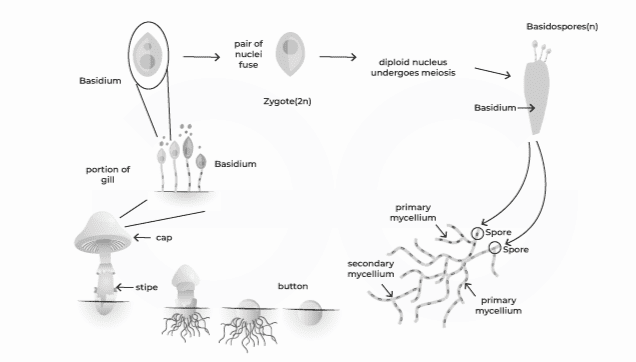
Agaricus is a genus of basidiomycete fungi, commonly known as mushrooms. ये हमारे लिए भोजन और उद्योग दोनों दृष्टि से महत्वपूर्ण हैं। Agaricus bisporus सबसे प्रसिद्ध खाद्य मशरूम है।
• Agaricus is commonly called Mushroom.
• It belongs to class Basidiomycota.
• Agaricus bisporus is widely cultivated as an edible mushroom.
• Some species are poisonous (toadstools).
General Features (सामान्य विशेषताएँ)
- Basidiomycete fungus (कवक का बासिडियोमाइकोटा वर्ग)।
- Fleshy, umbrella-shaped fruiting body.
- Mycelium is septate and dikaryotic.
- Mostly saprophytic, growing on decaying organic matter.
- Reproduction mainly sexual, through basidiospores.
Structure (संरचना)
The fruiting body (basidiocarp) of Agaricus has a typical stipe (stalk) and pileus (cap). The lower side of the pileus bears gills, on which basidia are arranged. Each basidium produces basidiospores.
| Part | Description |
|---|---|
| Mycelium | Subterranean, septate, dikaryotic hyphae |
| Stipe (Stalk) | Central elongated stalk supporting pileus |
| Pileus (Cap) | Umbrella-like expanded structure |
| Gills (Lamellae) | Thin plates under pileus where basidia are borne |
| Basidia | Club-shaped cells producing basidiospores |
| Basidiospores | Haploid spores for sexual reproduction |
Reproduction (प्रजनन)
- Asexual reproduction: Rare, by fragmentation of mycelium.
- Sexual reproduction: By plasmogamy (fusion of cells), karyogamy (fusion of nuclei), and meiosis in basidia.
- Basidiospores are released and germinate to form new mycelium.
Economic Importance (आर्थिक महत्व)
| Beneficial Role | Harmful Role |
|---|---|
| Edible mushrooms (A. bisporus is cultivated worldwide) | Some Agaricus species are poisonous (toadstools) |
| Source of proteins, vitamins and minerals | Storage and handling issues (perishable) |
| Used in medicine and biotechnology (enzymes) | Some species cause allergic reactions |
Puccinia (पुक्सिनिया / Rust Fungus) – Detailed Study
Puccinia is a genus of pathogenic fungi that causes rust diseases in plants, especially in cereals like wheat. हिंदी में इसे जंग रोग कवक कहा जाता है। यह कृषि की दृष्टि से अत्यंत हानिकारक है।
• Puccinia belongs to phylum Basidiomycota.
• It is an obligate parasite (परजीवी)।
• Causes wheat rust (गेहूं का रतुआ रोग)।
• Life cycle is heteroecious (requires two hosts).
• Example: Puccinia graminis tritici.
General Features (सामान्य विशेषताएँ)
- Belongs to order Uredinales.
- Obligate parasite on wheat and barberry plants.
- Produces rust-colored pustules on host leaves and stems.
- Life cycle is very complex and involves five types of spores.
Structure (संरचना)
The mycelium is intercellular and absorbs nutrients through haustoria. On the host surface, it produces spore pustules containing different types of spores at various stages of life cycle.
Types of Spores (बीजाणुओं के प्रकार)
| S.No | Spore Type | Description |
|---|---|---|
| 1 | Uredospore | Rust-colored, repeating spores spreading infection rapidly. |
| 2 | Teliospore | Thick-walled, resting spores; overwinters in soil. |
| 3 | Basidiospore | Produced from teliospore after meiosis; infects barberry. |
| 4 | Pycnospore | Produced on barberry leaves, aids in fertilization. |
| 5 | Aeciospore | Infects wheat plant and continues the cycle. |
Life Cycle (जीवन चक्र)
- Puccinia is heteroecious, requiring two hosts:
- Primary host: Wheat (produces uredospores, teliospores).
- Alternate host: Barberry (produces pycniospores, aeciospores).
- Completes a macrocyclic life cycle with five spore stages.
- Causes black, brown or yellow rust diseases in cereals.
Economic Importance (आर्थिक महत्व)
| Beneficial Role | Harmful Role |
|---|---|
| Scientific study helps in understanding plant pathology | Causes severe yield loss in wheat crops |
| Helps in developing resistant crop varieties | Weakens plants and reduces grain quality |
| Used as a model to study host-parasite interaction | Leads to famine-like conditions in severe outbreaks |
Ustilago (स्मट कवक) – Detailed Study
Ustilago is a genus of fungi commonly known as smut fungi. हिंदी में इसे कालिमा रोग कवक कहते हैं। यह मुख्य रूप से अनाज वाली फसलों जैसे ज्वार, मक्का, जौ और गेहूं को प्रभावित करता है।
• Belongs to class Basidiomycota.
• Obligate parasite of cereals and grasses.
• Causes smut diseases producing black, powdery spores.
• Example: Ustilago maydis (corn smut).
General Features (सामान्य विशेषताएँ)
- Parasitic fungus attacking cereal crops.
- Produces black, sooty masses of spores (teliospores) in host tissues.
- Mycelium is intercellular and dikaryotic.
- Life cycle involves alternation between haploid and dikaryotic phases.
Structure (संरचना)
The mycelium of Ustilago is septate and dikaryotic. Infection takes place in floral parts of the host. The fungus converts the ovary or grains into a black spore mass (smut ball). Each teliospore germinates to form a basidium bearing basidiospores.
Types of Spores (बीजाणुओं के प्रकार)
| Spore Type | Description |
|---|---|
| Teliospore | Thick-walled, black resting spore; survives in soil and seeds. |
| Basidiospore | Produced from teliospores after meiosis; infects host tissue. |
Life Cycle (जीवन चक्र)
- Primary infection: Teliospores germinate to produce basidiospores.
- Secondary infection: Basidiospores fuse to form dikaryotic mycelium which invades the host.
- Inside floral parts, fungus replaces grain tissue with smut spore mass.
- Teliospores released and dispersed by wind, soil or seeds continue the cycle.
Economic Importance (आर्थिक महत्व)
| Beneficial Role | Harmful Role |
|---|---|
| Some Ustilago species studied for genetics (model organism) | Causes heavy crop loss in maize, barley, wheat, jowar etc. |
| Ustilago maydis is used in Mexican cuisine (“huitlacoche”) | Reduces grain yield and quality |
| Research tool for plant-pathogen interactions | Infected seeds spread disease to new areas |
Alternaria – Detailed Study (एल्टरनेरिया का विस्तृत अध्ययन)
Alternaria is a genus of fungi that includes many saprophytic as well as pathogenic species.
यह कवक वंश पौधों में पत्ती धब्बा रोग (Leaf Spot Disease) तथा अन्य रोग उत्पन्न करता है।
It is one of the most common Deuteromycetes (Fungi Imperfecti).
Fact Box (रोचक तथ्य)
- Belongs to: Deuteromycota (Fungi Imperfecti)
- Main habitat: Soil, air, decaying vegetation
- Common plant pathogen: Causes leaf spots, blights, fruit rot
- Produces toxins harmful to plants and sometimes humans
General Features (सामान्य विशेषताएँ)
- Hyphae are septate and branched.
- Reproduce mainly by conidia (asexual spores).
- Conidiophores are dark, simple, and septate.
- Conidia are produced in chains, dark-colored, multicellular, and beaked.
- Known for its saprophytic as well as parasitic mode of life.
| Feature (विशेषता) | Details (विवरण) |
|---|---|
| Systematic Position | Kingdom: Fungi Division: Deuteromycota Class: Deuteromycetes Order: Moniliales Genus: Alternaria |
| Hyphae | Septate, branched, dark-colored |
| Conidiophores | Dark, septate, bear chains of conidia |
| Conidia | Dark brown, multicellular, beaked |
| Reproduction | Asexual by conidia; Sexual stage not reported |
Reproduction (प्रजनन)
Asexual reproduction is the main method in Alternaria.
Conidiophores develop on the mycelium and produce chains of conidia.
These conidia are easily disseminated by wind and cause infection.
Sexual reproduction is absent or not observed.
Diseases caused by Alternaria (एल्टरनेरिया से होने वाले रोग)
- Leaf Spot Disease of Crucifers
- Early Blight of Potato and Tomato
- Leaf Blight of Cotton
- Fruit rot in various crops
Economic Importance (आर्थिक महत्व)
- Harmful: Causes major crop diseases → economic loss.
- Produces mycotoxins → can contaminate food grains.
- Useful in some cases for biological research and biotechnology.
- NCERT – Biological Classification (Fungi Section)
- Encyclopaedia Britannica – Fungus
- Khan Academy – Kingdom Fungi
- BioNinja – Fungal Hyphae
- BYJU’S – Kingdom Fungi
- Khan Academy – Reproduction in Fungi
- Britannica – Characteristics & Harmful Effects of Fungi
- NCERT Notes – Types of Fungi (PDF)
Read more chapters