
animal kingdom ncert notes
ANIMALS IN KINGDOM
जब हम अपने चारों ओर देखते हैं तो हम विभिन्न animal के विभिन्न structure और form को observe करते हैं।
अब तक लगभग 10 लाख से अधिक animal species का वर्णन किया जा चुका है। अतः classification इसके लिए अधिक महत्त्वपूर्ण आधार है।
Classification नयी खोजी गयी species को systematic position पर रखने में सहायता प्रदान करता है।
4.1 Basis of Classification
Animals में structure और form में भिन्नताओं के अलावा भी उनमें arrangement of cell, body symmetry, nature of coelom, pattern of digestive, circulatory या reproductive system में fundamental समानता पाई जाती है।
इन्हीं लक्षणों को हम animal classification का आधार मानते हैं और इनमें से कुछ का वर्णन यहाँ किया जा रहा है।
4.1.1 Levels of Organisation
Animal kingdom के सभी सदस्य multicellular होते हैं, लेकिन सभी same pattern के cells organisation को प्रदर्शित नहीं करते। उदाहरण:
| Cellular Level of Organisation | |
|---|---|
| Characteristics | इनमें cells का arrangement अधिक loose होता है; जैसे sponges में। Cell के मध्य कुछ division of labour पाया जाता है। |
animal kingdom ncert notes
| Tissue Level of Organisation | |
|---|---|
| Characteristics | इसमें cells का arrangement अधिक complex होता है। एक समान कार्य करने वाली cells मिलकर tissue का निर्माण करती हैं; जैसे coelenterates। |
animal kingdom ncert notes
| Organ Level of Organisation | |
|---|---|
| Characteristics | Tissues मिलकर organs का निर्माण करते हैं और प्रत्येक organ एक particular कार्य करता है। यह Platyhelminthes तथा अन्य higher phyla में पाया जाता है। Animals जैसे annelids, arthropods, molluscs, echinoderms, और chordates में organs मिलकर organ system बनाते हैं। प्रत्येक organ system अलग-अलग physiological function करता है। Incomplete digestive system: Platyhelminthes में केवल एक opening होती है। Complete digestive system: दो openings होती हैं: mouth और anus। Circulatory system:
|
4.1.2 Symmetry
Animal को symmetry के आधार पर categorised किया जाता है।
| Asymmetrical | |
|---|---|
| Definition | Body को किसी भी central axis से गुजरने वाली line द्वारा दो बराबर भागों में विभाजित नहीं किया जा सकता। |
| Example | Sponges mostly asymmetrical होते हैं। |
animal kingdom ncert notes
| Radial Symmetry | |
|---|---|
| Definition | किसी भी central axis से गुजरने वाली line प्राणी के शरीर को दो समरूप भागों में divide करती है। इसे अरीय सममिति कहते हैं। |
| Example | Coelenterates, Ctenophore, Echinoderms |
Diploblastic और Triploblastic Organisation
Animals के embryonic development के आधार पर उन्हें Diploblastic और Triploblastic में classify किया जाता है। यह classification germ layers की संख्या पर आधारित है।
| Diploblastic Organisation | |
|---|---|
| Definition | ऐसे animals जिनमें केवल दो primary germ layers पाई जाती हैं। |
| Germ Layers |
|
| Mesoderm | Absent (मध्य layer नहीं होती)। |
| Body Cavity | Coelom नहीं होता (acoelomate)। |
| Examples | Coelenterates (Cnidaria), Ctenophora |
| Body Symmetry | Mostly radial symmetry, कुछ asymmetric भी हो सकते हैं। |
| Triploblastic Organisation | |
|---|---|
| Definition | ऐसे animals जिनमें तीन primary germ layers पाई जाती हैं। |
| Germ Layers |
|
| Body Cavity | Coelom present (Coelomate) या pseudocoelomate हो सकते हैं। |
| Examples | Platyhelminthes, Nematoda, Annelida, Arthropoda, Mollusca, Echinodermata, Chordata |
| Body Symmetry | Mostly bilateral symmetry। |
| Complexity | Organ systems well developed; higher physiological functions possible। |
| Summary | |
|---|---|
| Diploblastic | 2 germ layers, no mesoderm, radial symmetry, simple body, examples: Cnidaria |
| Triploblastic | 3 germ layers, mesoderm present, bilateral symmetry, complex body, examples: Annelida, Arthropoda, Chordata |
Coelom (शरीर गुहा)
Coelom एक fluid-filled body cavity है जो triploblastic animals में mesoderm के भीतर स्थित होती है। यह internal organs को support और protection प्रदान करती है।
Coelom के प्रकार
| Types of Coelom | ||
|---|---|---|
| Type | Definition | Examples |
| Acoelomate | Coelom absent; body cavity filled with mesodermal tissue. | Platyhelminthes |
| Pseudocoelomate | Body cavity partially lined with mesoderm (between endoderm and mesoderm). | Nematoda, Rotifera |
| Coelomate (Eucoelomate) | True coelom; body cavity completely lined with mesoderm. | Annelida, Arthropoda, Mollusca, Echinodermata, Chordata |
Coelom के लाभ
| Advantages of Coelom | |
|---|---|
| 1. | Internal organs के लिए सुरक्षित जगह प्रदान करता है। |
| 2. | Organs के free movement की अनुमति देता है। |
| 3. | Body shape को maintain करने में मदद करता है। |
| 4. | Circulatory और excretory system के लिए स्थान उपलब्ध कराता है। |
| 5. | Hydrostatic skeleton का कार्य करता है, जिससे movement आसान होता है। |
Summary of Coelom
| Coelom Types Summary | |
|---|---|
| Acoelomate | No coelom, mesoderm fills body cavity, example: Platyhelminthes |
| Pseudocoelomate | Partial coelom, between endoderm and mesoderm, example: Nematoda |
| Coelomate | True coelom fully lined with mesoderm, example: Annelida, Arthropoda, Chordata |
Segmentation (Metamerism) – खंडन / Segmentation
Segmentation या Metamerism वह स्थिति है जिसमें animal body को समान आकार और संरचना वाले segments (खंडों) में विभाजित किया जाता है।
विशेषताएँ (Characteristics of Segmentation)
| Characteristics | |
|---|---|
| 1. | Body longitudinally repeated segments (metameres) में विभाजित होती है। |
| 2. | हर segment में muscles, nerves, excretory structures और coelomic cavity का हिस्सा होता है। |
| 3. | Segments externally similar होते हैं लेकिन internally slightly अलग हो सकते हैं। |
| 4. | Movement अधिक efficient होता है। |
| 5. | Body flexibility और organ specialization में मदद करता है। |
Segmentation के प्रकार
| Type | Definition | Examples |
|---|---|---|
| External Segmentation | Segments शरीर की बाहरी सतह पर दिखाई देते हैं। | Earthworm, Leech |
| Internal Segmentation | Segments शरीर के अंदर coelom, muscles और organs में दिखाई देते हैं। | Annelida, Arthropoda |
Advantages of Segmentation
| Advantages | |
|---|---|
| 1. | Movement और locomotion अधिक coordinated और efficient होता है। |
| 2. | Damage होने पर एक segment को नुकसान से बचाया जा सकता है। |
| 3. | Organ specialization की सुविधा मिलती है। |
| 4. | Body flexibility बढ़ती है। |
Examples of Segmented Animals
| Phylum | Examples |
|---|---|
| Annelida | Earthworm, Leech |
| Arthropoda | Scorpion, Centipede |
| Chordata | Vertebral column is segmented (humans, fish) |
Notochord (नॉटोकॉर्ड) – Animal Kingdom
Notochord एक flexible, rod-like structure है जो Chordates में पाए जाने वाले embryos और कुछ adults में होती है। यह शरीर का मुख्य supporting axis प्रदान करती है।
विशेषताएँ (Characteristics)
| Characteristics of Notochord | |
|---|---|
| 1. | Flexible, rod-like structure located dorsal to the digestive tract और ventral to nerve cord। |
| 2. | Embryonic support प्रदान करती है। |
| 3. | Mostly made of cells filled with fluid surrounded by sheath of fibrous tissue। |
| 4. | Axial skeleton का primitive form। |
| 5. | In higher vertebrates, adult stage में vertebral column द्वारा replace कर दी जाती है। |
Functions of Notochord
| Functions | |
|---|---|
| 1. | Body को flexible support प्रदान करना। |
| 2. | Nervous system (dorsal nerve cord) के लिए structural guide। |
| 3. | Muscle attachment और movement में मदद। |
| 4. | Embryo development में signalling center का कार्य। |
Occurrence of Notochord
| Group | Examples | Stage |
|---|---|---|
| Protochordates | Amphioxus (Branchiostoma), Ascidian larva | Adult और Larva |
| Vertebrates | Fish, Amphibians, Reptiles, Birds, Mammals | Embryo stage में present, adult में replaced by vertebral column |
Summary
| Notochord Summary | |
|---|---|
| Definition | Flexible, rod-like dorsal support structure found in chordates. |
| Function | Support, muscle attachment, guidance for nervous system, embryonic development. |
| Occurrence | Protochordates: adult and larva; Vertebrates: embryo stage |
Coelom, Segmentation और Notochord का सारांश
| Feature | Definition | Types / Details | Examples | Key Facts |
|---|---|---|---|---|
| Coelom (शरीर गुहा) | Fluid-filled body cavity, mesoderm के भीतर, internal organs को support करता है। |
|
Platyhelminthes (Acoelomate), Nematoda (Pseudocoelomate), Annelida, Arthropoda, Chordata (Coelomate) | Provides space for organ movement, hydrostatic skeleton, body shape maintenance |
| Segmentation (Metamerism) | Body divided into repeated segments (metameres) along longitudinal axis. |
|
Earthworm, Leech, Scorpion, Centipede, Vertebrates (vertebral column) | Improves movement, flexibility, organ specialization, and damage resistance |
| Notochord (नॉटोकॉर्ड) | Flexible, rod-like supporting structure along dorsal side of body. |
|
Protochordates: Amphioxus, Ascidian larva; Vertebrates: Fish, Amphibians, Reptiles, Birds, Mammals (embryo) | Supports body, provides site for muscle attachment, guides nervous system development |
Classification of Animal Kingdom (Compressed)
| Phylum | Level of Organisation | Symmetry | Body Cavity / Coelom | Digestive System | Examples |
|---|---|---|---|---|---|
| Porifera | Cellular | Asymmetrical | Acoelomate | None (Intracellular digestion) | Sponges |
| Coelenterata (Cnidaria) | Tissue | Radial | Acoelomate | Incomplete | Hydra, Jellyfish |
| Platyhelminthes | Organ | Bilateral | Acoelomate | Incomplete | Planaria, Liver fluke |
| Nematoda | Organ | Bilateral | Pseudocoelomate | Complete | Ascaris, Roundworm |
| Annelida | Organ System | Bilateral | Coelomate | Complete | Earthworm, Leech |
| Arthropoda | Organ System | Bilateral | Coelomate | Complete | Insects, Spider, Scorpion |
| Mollusca | Organ System | Bilateral | Coelomate | Complete | Snail, Octopus |
| Echinodermata | Organ System | Radial (adult), Bilateral (larva) | Coelomate | Complete | Starfish, Sea urchin |
| Chordata | Organ System | Bilateral | Coelomate | Complete | Fishes, Amphibians, Reptiles, Birds, Mammals |
Phylum Porifera (स्पंज)
Phylum Porifera के जीव सबसे primitive multicellular animals हैं। इन्हें “Pore bearing animals” भी कहा जाता है क्योंकि इनके शरीर पर छोटे-छोटे pores (छिद्र) पाए जाते हैं।
विशेषताएँ (Characteristics)
| Characteristics of Porifera | |
|---|---|
| Organisation | Cellular level of organisation (tissues absent) |
| Symmetry | Mostly asymmetrical, कुछ radially symmetrical भी |
| Body Wall | 3 layers: Outer pinacoderm, Middle mesohyl, Inner choanoderm |
| Skeleton | Spicules (calcareous/siliceous) और spongin fibers |
| Coelom | Absent (Acoelomate) |
| Digestive System | Intracellular digestion (choanocytes digest food) |
| Circulatory & Excretory | Diffusion द्वारा |
| Nervous & Muscular System | Absent |
| Reproduction | Asexual: Budding, Fragmentation, Gemmules Sexual: Monoecious, internal fertilization, larva free-swimming (amphiblastula or parenchymula) |
| Habitat | Mostly marine, some freshwater |
Body Structure Types (Morphology)
| Body Type | Characteristics |
|---|---|
| Ascon | Simple tube-like body, small size, choanocytes in spongocoel |
| Sycon | Body wall folded into radial canals, choanocytes in canals, medium size |
| Leucon | Most complex, choanocytes in chambers, large size, commonest type |
Skeleton Types
| Type | Material | Example |
|---|---|---|
| Calcareous | Calcium carbonate | Sycon, Leucosolenia |
| Siliceous | Silica | Euplectella, Spongilla |
| Spongin | Protein fibers | Bath sponge |
Fun Facts / Quick Facts
| Facts About Porifera | |
|---|---|
| 1. | Porifera are the only multicellular animals without true tissues. |
| 2. | Sponges can regenerate their whole body from fragments. |
| 3. | Gemmules help freshwater sponges survive harsh conditions. |
| 4. | Most sponges are asymmetrical; some show radial symmetry. |
| 5. | Bath sponges are commercially harvested for cleaning and crafts. |
Phylum Cnidaria (Coelenterata) – जेलीफ़िश और हाइड्रा जैसे जीव
Phylum Cnidaria (पूर्व में Coelenterata) में soft-bodied, mostly aquatic animals आते हैं। इनका नाम “Cnidocytes” से पड़ा है क्योंकि इनके cells में stinging organelles पाए जाते हैं।
विशेषताएँ (Characteristics)
| Characteristics of Cnidaria | |
|---|---|
| Organisation | Tissue level (diploblastic: Ectoderm + Endoderm; Mesoglea in between) |
| Symmetry | Radial symmetry |
| Body Wall | Two layers: Epidermis (ectoderm), Gastrodermis (endoderm) with gelatinous mesoglea |
| Coelom | Absent (Acoelomate) |
| Digestive System | Incomplete, single opening serves as mouth and anus |
| Circulatory & Excretory | Diffusion द्वारा |
| Nervous System | Nerve net, no brain |
| Reproduction | Asexual: Budding, Fragmentation, Pedal laceration Sexual: Dioecious, external fertilization, planula larva |
| Habitat | Mostly marine, few freshwater species |
Body Forms
| Body Form | Characteristics | Example |
|---|---|---|
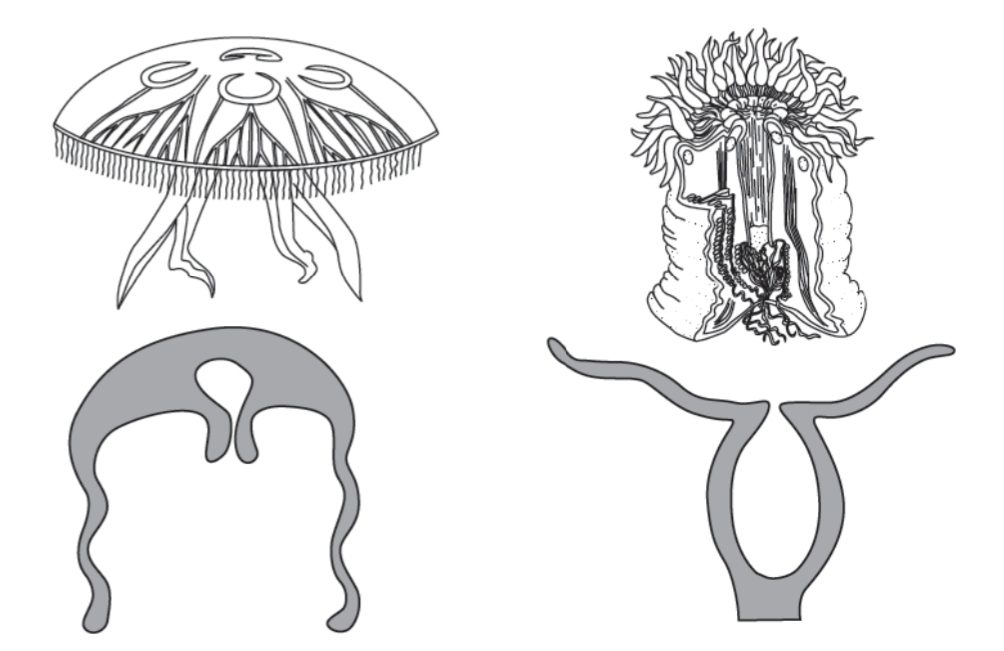
| Polyp | Cylindrical, sessile, mouth & tentacles upward | Hydra, Obelia (polyp colony) |
| Medusa | Umbrella-shaped, free-swimming, mouth & tentacles downward | Jellyfish, Aurelia |
Special Features
| Feature | Description |
|---|---|
| Cnidocytes | Stinging cells containing nematocysts for defense and prey capture |
| Mesoglea | Jelly-like non-cellular layer between epidermis and gastrodermis |
| Hydrostatic Skeleton | Body support is provided by water pressure inside gastrovascular cavity |
| Nerve Net | Primitive nervous system for coordination of movements |
Fun / Quick Facts
| Facts About Cnidaria | |
|---|---|
| 1. | All cnidarians are aquatic, mostly marine. |
| 2. | Diploblastic: no mesoderm, only ectoderm & endoderm. |
| 3. | Have cnidocytes with nematocysts for stinging and defense. |
| 4. | Body has radial symmetry; polyp form is sessile, medusa form is motile. |
| 5. | Reproduce both sexually and asexually; planula larva is free-swimming. |
Phylum Ctenophora (Comb Jellies) – कंघी जेली
Phylum Ctenophora में marine, transparent, gelatinous animals आते हैं, जिन्हें Comb jellies कहा जाता है। इनके शरीर पर cilia के comb plates पाए जाते हैं जो locomotion में मदद करते हैं।
विशेषताएँ (Characteristics)
| Characteristics of Ctenophora | |
|---|---|
| Organisation | Tissue level, diploblastic (Ectoderm + Endoderm) with mesoglea |
| Symmetry | Biradial or radial symmetry |
| Coelom | Absent (Acoelomate) |
| Digestive System | Complete, mouth and anal pores present |
| Nervous System | Nerve net, statocyst for balance |
| Locomotion | By 8 rows of ciliary comb plates (ctenes) |
| Reproduction | Mostly sexual, hermaphrodite, external fertilization |
| Habitat | Marine, free-swimming |
Body Structure
| Feature | Description |
|---|---|
| Body Shape | Transparent, gelatinous, elongated or oval |
| Comb Plates | 8 rows of fused cilia for locomotion |
| Adhesive Tentacles | Used for capturing prey (colloblast cells) |
| Mesoglea | Thick gelatinous layer between ectoderm and endoderm |
Fun / Quick Facts
| Facts About Ctenophora | |
|---|---|
| 1. | Called “comb jellies” because of rows of ciliary plates (ctenes). |
| 2. | Biradial symmetry distinguishes them from cnidarians. |
| 3. | They use colloblasts (sticky cells) instead of cnidocytes to capture prey. |
| 4. | Mostly pelagic, floating freely in the ocean. |
| 5. | Statocyst helps maintain orientation and balance in water. |
Phylum Platyhelminthes (Flatworms) – फ्लैटवर्म्स
Phylum Platyhelminthes में soft-bodied, bilaterally symmetrical और triploblastic animals आते हैं। ये mostly parasitic या free-living होते हैं। शरीर dorso-ventrally flattened होता है, इसलिए इन्हें Flatworms कहा जाता है।
विशेषताएँ (Characteristics)
| Characteristics of Platyhelminthes | |
|---|---|
| Organisation | Organ level; Triploblastic (Ectoderm, Mesoderm, Endoderm) |
| Symmetry | Bilateral symmetry |
| Body Cavity | Acoelomate (no true coelom) |
| Digestive System | Incomplete (single opening serves as mouth and anus), absent in some parasites |
| Circulatory & Excretory | Diffusion; Protonephridia with flame cells for excretion |
| Nervous System | Ladder-like with paired cerebral ganglia and longitudinal nerve cords |
| Reproduction | Hermaphrodite; sexual (internal fertilization) and asexual (regeneration) |
| Habitat | Freshwater, marine, terrestrial, and parasitic in animals |
Classification / Classes
| Class | Characteristics | Examples |
|---|---|---|
| Turbellaria | Free-living, ciliated, mostly aquatic, gut branched | Planaria, Dugesia |
| Trematoda | Parasitic, suckers for attachment, incomplete digestive system | Fasciola (liver fluke), Clonorchis |
| Cestoda | Endoparasitic, no digestive system, body in proglottids, scolex for attachment | Taenia (tapeworm), Diphyllobothrium |
Special Features
| Feature | Description |
|---|---|
| Flame Cells | Excretory cells helping in osmoregulation |
| Regeneration | Ability to regrow lost parts, especially in Turbellarians |
| Parasitism Adaptations | Suckers, hooks, thick tegument for protection in Trematoda & Cestoda |
| Triploblastic | Presence of three germ layers: ectoderm, mesoderm, endoderm |
Fun / Quick Facts
| Facts About Platyhelminthes | |
|---|---|
| 1. | Flatworms are the first bilaterally symmetrical animals. |
| 2. | They are acoelomate but triploblastic. |
| 3. | Flame cells help in excretion and osmoregulation. |
| 4. | Some species can regenerate completely from fragments. |
| 5. | Trematodes and Cestodes are important parasites of humans and animals. |
Phylum Aschelminthes (Nematoda / Roundworms) – राउंडवर्म्स
Phylum Aschelminthes में cylindrical, bilaterally symmetrical, triploblastic और pseudocoelomate animals आते हैं। इनमें कई free-living और parasitic forms पाए जाते हैं।
विशेषताएँ (Characteristics)
| Characteristics of Aschelminthes | |
|---|---|
| Organisation | Organ system level; Triploblastic |
| Symmetry | Bilateral symmetry |
| Body Cavity | Pseudocoelomate (body cavity partially lined with mesoderm) |
| Digestive System | Complete, mouth and anus present |
| Circulatory & Excretory | Diffusion; Excretory canals or renette cells |
| Nervous System | Dorsal and ventral nerve cords with anterior nerve ring |
| Reproduction | Sexual, dioecious; internal fertilization |
| Habitat | Soil, freshwater, marine; many parasitic in plants & animals |
Important Examples
| Type | Host / Habitat | Example |
|---|---|---|
| Free-living | Soil / freshwater | Ascaris megalocephala (soil), Turbatrix aceti (vinegar eel) |
| Parasitic in humans | Intestine | Ascaris lumbricoides, Enterobius vermicularis (pinworm) |
| Parasitic in animals | Intestine / tissue | Wuchereria bancrofti, Brugia malayi |
| Parasitic in plants | Roots / stems | Heterodera, Meloidogyne |
Special Features
| Feature | Description |
|---|---|
| Body | Cylindrical, tapered at both ends, covered by tough cuticle |
| Pseudocoelom | Acts as hydrostatic skeleton for movement |
| Muscles | Longitudinal only, no circular muscles; whip-like movement |
| Reproduction | Dioecious, sexual dimorphism present; females larger |
Fun / Quick Facts
| Facts About Aschelminthes | |
|---|---|
| 1. | First group with complete digestive system (mouth and anus separate). |
| 2. | Body covered by cuticle, resistant to host digestive enzymes. |
| 3. | Pseudocoelom acts as hydrostatic skeleton. |
| 4. | Many are medically important parasites (e.g., Wuchereria, Ascaris). |
| 5. | Movement is whip-like due to longitudinal muscles. |
Phylum Annelida (Segmented Worms) – खंडित कृमि
Phylum Annelida में bilaterally symmetrical, triploblastic और coelomate animals आते हैं। ये segmented worms कहलाते हैं क्योंकि इनका शरीर externally और internally metamerically segmented होता है।
विशेषताएँ (Characteristics)
| Characteristics of Annelida | |
|---|---|
| Organisation | Organ system level; Triploblastic |
| Symmetry | Bilateral symmetry |
| Body Cavity | Coelomate (true coelom present) |
| Segmentation | Metamerically segmented; septa separate segments internally |
| Digestive System | Complete, mouth and anus present; specialized regions (pharynx, intestine) |
| Circulatory System | Closed type, dorsal and ventral blood vessels with segmental hearts |
| Excretory System | Nephridia in each segment |
| Nervous System | Ventral nerve cord, cerebral ganglia, segmental ganglia |
| Reproduction | Mostly sexual; some hermaphrodites (earthworm), asexual by regeneration in some |
| Habitat | Marine, freshwater, and terrestrial |
Classification / Classes
| Class | Characteristics | Examples |
|---|---|---|
| Polychaeta | Mostly marine, many setae per segment, parapodia present | Nereis, Aphrodite |
| Oligochaeta | Few setae per segment, no parapodia, terrestrial/freshwater | Earthworm (Lumbricus), Tubifex |
| Hirudinea | No setae, body flattened dorsoventrally, mostly parasitic (blood-sucking) | Leech (Hirudo medicinalis) |
Special Features
| Feature | Description |
|---|---|
| Segmentation (Metamerism) | Body divided into segments with repeated organs; allows better locomotion and specialization |
| Coelom | Acts as hydrostatic skeleton; helps in movement |
| Closed Circulatory System | Efficient transport of oxygen and nutrients |
| Nephridia | Segmental excretory organs for removal of nitrogenous waste |
Fun / Quick Facts
| Facts About Annelida | |
|---|---|
| 1. | First coelomate animals with metameric segmentation. |
| 2. | Closed circulatory system is highly efficient for active movement. |
| 3. | Earthworms are important for soil aeration and fertility. |
| 4. | Some leeches are used medicinally for bloodletting. |
| 5. | Metamerism allows specialization of segments for reproduction, locomotion, and excretion. |
Phylum Arthropoda – अर्थ्रोपोडा (Jointed-legged Animals)
Phylum Arthropoda में bilaterally symmetrical, triploblastic और coelomate animals आते हैं। ये सबसे diverse और abundant phylum है। इनका शरीर segmented होता है और jointed appendages पाई जाती हैं।
विशेषताएँ (Characteristics)
| Characteristics of Arthropoda | |
|---|---|
| Organisation | Organ system level; Triploblastic |
| Symmetry | Bilateral symmetry |
| Body Cavity | Coelomate (true coelom) |
| Body Segmentation | Metamerically segmented; head, thorax, abdomen |
| Exoskeleton | Chitinous exoskeleton, molted periodically (ecdysis) |
| Appendages | Paired, jointed appendages specialized for locomotion, feeding, reproduction |
| Digestive System | Complete, with mouth, stomach, intestine, anus |
| Circulatory System | Open type; dorsal heart pumps hemolymph |
| Excretory System | Green glands or Malpighian tubules depending on class |
| Nervous System | Ventral nerve cord, brain (cerebral ganglia), segmental ganglia |
| Reproduction | Mostly sexual, dioecious; internal fertilization in many |
| Habitat | Marine, freshwater, terrestrial; flying forms common (insects) |
Major Classes
| Class | Characteristics | Examples |
|---|---|---|
| Crustacea | Mostly aquatic, 2 pairs antennae, biramous appendages | Crab, Lobster, Prawn, Cyclops |
| Chelicerata (Arachnida) | No antennae, 4 pairs legs, body divided into cephalothorax and abdomen | Spider, Scorpion, Mite, Tick |
| Myriapoda | Body elongated with many segments, each segment with 1–2 pairs legs | Centipede, Millipede |
| Insecta | Body divided into head, thorax, abdomen; 3 pairs legs, usually 2 pairs wings | Grasshopper, Butterfly, Cockroach |
Special Features
| Feature | Description |
|---|---|
| Exoskeleton | Provides protection, prevents desiccation; molted periodically |
| Jointed Appendages | Specialized for walking, swimming, feeding, defense |
| Metamerism | Body segments fused into tagmata (head, thorax, abdomen) |
| Respiration | Gills in aquatic forms; tracheae in terrestrial insects; book lungs in spiders |
| Circulatory System | Open, hemolymph circulates nutrients and hormones |
Fun / Quick Facts
| Facts About Arthropoda | |
|---|---|
| 1. | Largest phylum in the animal kingdom in terms of species number. |
| 2. | Exoskeleton is made of chitin and provides mechanical support. |
| 3. | Tagmatization allows specialization of body segments. |
| 4. | Most insects can fly, making them highly adaptive and widespread. |
| 5. | Arthropods play crucial roles in ecology as pollinators, decomposers, and predators. |
Phylum Mollusca – मोलस्का (Soft-bodied Animals)
Phylum Mollusca में soft-bodied, bilaterally symmetrical, triploblastic और coelomate animals आते हैं। अधिकांश aquatic होते हैं, लेकिन कुछ terrestrial भी पाए जाते हैं। शरीर non-segmented होता है और कई में hard calcareous shell होती है।
विशेषताएँ (Characteristics)
| Characteristics of Mollusca | |
|---|---|
| Organisation | Organ system level; Triploblastic |
| Symmetry | Bilateral symmetry |
| Body Cavity | Coelomate |
| Segmentation | Absent externally; some internal organ repetition |
| Digestive System | Complete, mouth and anus present; radula present in most (except bivalves) |
| Circulatory System | Open type (except cephalopods which have closed system) |
| Excretory System | Paired nephridia |
| Nervous System | Cerebral ganglia with paired nerve cords; more developed in cephalopods |
| Reproduction | Mostly sexual, dioecious; external fertilization in some, internal in cephalopods |
| Habitat | Marine, freshwater, and terrestrial |
Body Structure
| Feature | Description |
|---|---|
| Body Parts | Head-foot (locomotion and feeding), visceral mass (organs), mantle (secretes shell) |
| Shell | External calcareous shell in many (e.g., snail, clam) |
| Radula | Chitinous toothed structure for scraping food (absent in bivalves) |
Major Classes
| Class | Characteristics | Examples |
|---|---|---|
| Polyplacophora | Marine, dorsal shell with 8 plates, ventral foot for locomotion | Chiton |
| Gastropoda | Univalve shell, coiled in most, head well developed, radula present | Snail, Slug, Limax |
| Bivalvia | Two valves, no radula, filter feeders, mostly aquatic | Clam, Oyster, Pinctada |
| Cephalopoda | Head-foot modified into tentacles, closed circulatory system, intelligent, predatory | Octopus, Squid, Nautilus |
Fun / Quick Facts
| Facts About Mollusca | |
|---|---|
| 1. | Second largest phylum after Arthropoda. |
| 2. | Radula is a unique feeding organ of mollusks. |
| 3. | Cephalopods are the most intelligent invertebrates. |
| 4. | Bivalves are important for pearls and food. |
| 5. | Mollusks exhibit great diversity in habitat, form, and behavior. |
Phylum Echinodermata – इकाइनोडर्मा (Spiny-skinned Animals)
Phylum Echinodermata में exclusively marine, bilaterally symmetrical larvae और radially symmetrical adults वाले coelomate, triploblastic animals आते हैं। शरीर spiny और calcareous endoskeleton से ढका होता है।
विशेषताएँ (Characteristics)
| Characteristics of Echinodermata | |
|---|---|
| Organisation | Organ system level; Triploblastic |
| Symmetry | Larvae bilateral, adults pentamerous radial symmetry |
| Body Cavity | Coelomate (true coelom) |
| Body Segmentation | No true segmentation |
| Skeleton | Endoskeleton of calcareous ossicles with spines |
| Digestive System | Complete in most; mouth on oral side, anus on aboral side |
| Circulatory System | Water vascular system; circulates coelomic fluid, aids in locomotion |
| Excretory System | Diffusion through coelomic fluid; no specialized excretory organs |
| Nervous System | No brain; nerve ring around mouth, radial nerve cords |
| Reproduction | Mostly sexual, dioecious; external fertilization, some regeneration |
| Habitat | Exclusively marine |
Major Classes
| Class | Characteristics | Examples |
|---|---|---|
| Asteroidea | Star-shaped, pentamerous symmetry, tube feet present | Starfish (Asterias) |
| Ophiuroidea | Slender, branched arms, central disc distinct, tube feet without suckers | Brittle star (Ophiura) |
| Echinoidea | Globular or disc-shaped, no arms, spines movable | Sea urchin (Echinus), Sand dollar |
| Holothuroidea | Cucumber-shaped, elongated body, reduced skeleton, tube feet | Sea cucumber (Holothuria) |
| Crinoidea | Feather-like arms, sessile or stalked, mouth on upper surface | Sea lilies, Feather stars |
Special Features
| Feature | Description |
|---|---|
| Water Vascular System | Used for locomotion, feeding, and respiration; includes tube feet |
| Endoskeleton | Calcareous ossicles embedded in dermis, provides support and protection |
| Regeneration | Can regenerate lost arms; some species can regenerate entire body from a part |
| Radial Symmetry in Adults | Allows adaptation to sessile or slow-moving life |
Fun / Quick Facts
| Facts About Echinodermata | |
|---|---|
| 1. | Exclusively marine invertebrates. |
| 2. | Water vascular system is unique to echinoderms. |
| 3. | Adults show pentamerous radial symmetry, larvae are bilateral. |
| 4. | Capable of remarkable regeneration. |
| 5. | Endoskeleton provides protection and support without limiting growth. |
Phylum Hemichordata – हेमिकॉर्डाटा
Phylum Hemichordata में bilaterally symmetrical, triploblastic, coelomate marine invertebrates आते हैं। ये chordates की तरह कुछ विशेष लक्षण जैसे dorsal nerve cord और pharyngeal gill slits दिखाते हैं।
विशेषताएँ (Characteristics)
| Characteristics of Hemichordata | |
|---|---|
| Organisation | Organ system level; Triploblastic |
| Symmetry | Bilateral symmetry |
| Body Cavity | Coelomate |
| Body Segmentation | No true segmentation |
| Skeleton | Absent; body soft and worm-like |
| Digestive System | Complete, mouth and anus present; pharyngeal gill slits present |
| Circulatory System | Closed type; heart absent, blood flows through dorsal and ventral vessels |
| Excretory System | Absent or by diffusion |
| Nervous System | Dorsal tubular nerve cord, some ventral nerve fibers |
| Reproduction | Mostly sexual, dioecious; external fertilization |
| Habitat | Marine, burrowing in sand or mud |
Body Structure
| Body Region | Characteristics |
|---|---|
| Proboscis | Anterior, used for burrowing and feeding |
| Collar | Middle region; bears mouth and sometimes nerve cord |
| Trunk | Posterior elongated region; contains digestive and reproductive organs |
Major Classes
| Class | Characteristics | Examples |
|---|---|---|
| Enteropneusta | Worm-like, burrowing, proboscis well developed | Saccoglossus, Balanoglossus |
| Pterobranchia | Colonial, tube-dwelling, small, sessile | Rhabdopleura, Cephalodiscus |
Special Features
| Feature | Description |
|---|---|
| Pharyngeal Gill Slits | Present; similar to chordates, used for filter feeding |
| Dorsal Nerve Cord | Partially tubular, a chordate-like feature |
| Coelom | Tripartite: protocoel, mesocoel, metacoel |
| Habitat | Marine, burrowing in sand or mud |
Fun / Quick Facts
| Facts About Hemichordata | |
|---|---|
| 1. | Bridge between invertebrates and chordates due to pharyngeal gill slits and dorsal nerve cord. |
| 2. | Mostly marine, sedentary or burrowing worms. |
| 3. | Coelom divided into three distinct cavities: protocoel, mesocoel, metacoel. |
| 4. | Reproduction is sexual with external fertilization. |
| 5. | Provide insights into evolution of chordates. |
Phylum Chordata – कर्डाटा (Chordates)
Phylum Chordata में bilaterally symmetrical, triploblastic, coelomate animals आते हैं जिनमें कुछ विशेष chordate features पाई जाती हैं। ये features embryonic या adult stage में मौजूद हो सकती हैं।
विशेषताएँ (Characteristics)
| Characteristics of Chordata | |
|---|---|
| Organisation | Organ system level; Triploblastic |
| Symmetry | Bilateral symmetry |
| Body Cavity | Coelomate (true coelom) |
| Segmentation | Metamerism present in muscles and vertebrae |
| Digestive System | Complete, mouth and anus present; specialized organs |
| Circulatory System | Closed type with heart; blood vessels with arteries, veins, capillaries |
| Excretory System | Paired nephrons or kidneys |
| Nervous System | Dorsal tubular nerve cord; brain present in most; paired sense organs |
| Reproduction | Mostly sexual; dioecious; external or internal fertilization |
| Habitat | Marine, freshwater, and terrestrial |
Chordate Features
| Feature | Description |
|---|---|
| Notochord | Flexible rod-like structure along dorsal side; replaced by vertebral column in vertebrates |
| Dorsal Tubular Nerve Cord | Forms spinal cord and brain in vertebrates |
| Pharyngeal Gill Slits | Present in pharynx; used for filter feeding in invertebrate chordates or respiration in vertebrates |
| Post-anal Tail | Extension of body beyond anus; aids in locomotion in aquatic forms |
| Endoskeleton | Cartilaginous or bony; provides support and protection |
Major Subphyla
| Subphylum | Characteristics | Examples |
|---|---|---|
| Urochordata | Marine, sessile as adult, notochord in larva only | Tunicates, Sea squirts |
| Cephalochordata | Marine, fish-like, notochord persists in adult, segmented muscles | Lancelets (Branchiostoma) |
| Vertebrata (Craniata) | Notochord replaced by vertebral column, well-developed brain and sense organs | Fishes, Amphibians, Reptiles, Birds, Mammals |
Fun / Quick Facts
| Facts About Chordata | |
|---|---|
| 1. | Phylum Chordata is divided into three subphyla: Urochordata, Cephalochordata, Vertebrata. |
| 2. | Notochord is a defining feature, present at least in embryonic stage. |
| 3. | Dorsal nerve cord develops into spinal cord and brain in vertebrates. |
| 4. | Post-anal tail is retained in aquatic vertebrates, reduced in humans. |
| 5. | Vertebrates have a well-developed endoskeleton that supports large body size and movement. |
Difference between Chordata and Non-Chordata (कॉर्डेटा और नॉन-कॉर्डेटा में अंतर)
Animal Kingdom is broadly divided into Chordata and Non-Chordata.
Chordates have a notochord, while non-chordates do not. Below is a comparison:
| Fact: लगभग 90-95% जानवर Non-Chordata में आते हैं। Chordata की संख्या अपेक्षाकृत कम है। |
| Feature (विशेषता) | Chordata (कॉर्डेटा) | Non-Chordata (नॉन-कॉर्डेटा) |
|---|---|---|
| Notochord | Present in embryonic stage (नोटोकोर्ड पाया जाता है) | Absent (नोटोकोर्ड नहीं पाया जाता) |
| Nerve Cord | Dorsal, hollow nerve cord (पृष्ठीय खोखला) | Ventral, solid nerve cord (निचला और ठोस) |
| Pharyngeal gill slits | Present at some stage (कभी न कभी मौजूद) | Absent |
| Heart | Ventral side (ह्रदय पृष्ठीय भाग में) | Dorsal side (ह्रदय ऊपरी भाग में) |
| Coelom | True coelomate (सच्चा कोएलम) | Acoelomate / Pseudocoelomate / Coelomate (विभिन्न प्रकार) |
| Example | Fishes, Amphibians, Reptiles, Birds, Mammals | Porifera, Cnidaria, Annelida, Arthropoda, Mollusca, etc. |
| Key Point: नोटोकोर्ड की उपस्थिति ही Chordata और Non-Chordata के बीच सबसे बड़ा अंतर है। |
Class Cyclostomata (कक्षा सायक्लोस्टोमा)
Cyclostomata are jawless, eel-like aquatic vertebrates. They are the most primitive living chordates under superclass Agnatha. इनका शरीर लंबा और बेलनाकार होता है तथा मुँह गोलाकार चूषण कप जैसा होता है।
| Fact: Cyclostomes को “Living Fossils” भी कहा जाता है क्योंकि ये सबसे प्राचीन जबड़ा-रहित कशेरुकी हैं। |
General Characteristics (सामान्य लक्षण)
- Body elongated, cylindrical and eel-like (लंबा और बेलनाकार शरीर)।
- No jaws, mouth is circular and sucking type (जबड़े नहीं, मुँह गोलाकार और चूषण कप जैसा)।
- Endoskeleton is cartilaginous (आंतरिक कंकाल उपास्थीय)।
- No paired fins, only median fins are present (युग्मित पंख अनुपस्थित)।
- Respiration through 6–15 pairs of gill pouches (श्वसन 6–15 युग्म गिल थैली से)।
- Closed circulatory system with two-chambered heart (बंद रक्त परिसंचरण और द्विकक्षीय ह्रदय)।
- They are ectoparasitic on fishes (ये परजीवी रूप से मछलियों के शरीर से चिपककर खून चूसते हैं)।
- Fertilization is external (निषेचन बाहरी)।
- Development is indirect with larval stage (विकास अप्रत्यक्ष, लार्वा सहित)।
Classification Table (वर्गीकरण सारणी)
| Feature (विशेषता) | Cyclostomata |
|---|---|
| Body Shape | Elongated, cylindrical (eel-like) |
| Jaws | Absent (Jawless) |
| Skeleton | Cartilaginous (उपास्थीय) |
| Fins | Unpaired (median only) |
| Respiration | Through gill pouches |
| Heart | Two-chambered |
| Habitat | Marine (but migrate to freshwater for spawning) |
| Examples | Petromyzon (Lamprey), Myxine (Hagfish) |
| Key Point: सभी Cyclostomes Marine होते हैं लेकिन प्रजनन (spawning) के लिए Freshwater में प्रवास करते हैं। |
Class Chondrichthyes (कक्षा कॉन्ड्रिकथीज़)
Chondrichthyes are cartilaginous fishes. इनका आंतरिक कंकाल पूरी तरह उपास्थि (cartilage)</b से बना होता है। ये समुद्री जलचर होते हैं और अधिकतर शिकारी (predatory) प्रवृत्ति के होते हैं।
| Fact: Sharks, skates और rays इस वर्ग के प्रमुख सदस्य हैं। इनमें तैरने के लिए swim bladder अनुपस्थित होता है। |
General Characteristics (सामान्य लक्षण)
- Skeleton made of cartilage (कंकाल उपास्थीय)।
- Body is streamlined and laterally compressed (शरीर सुडौल व पार्श्व से दबा हुआ)।
- Jaws are well developed (जबड़े विकसित)।
- Mouth is ventral in position (मुख निचले भाग में स्थित)।
- Skin tough, covered with placoid scales (त्वचा मोटी और प्लाकोइड स्केल्स से ढकी)।
- Teeth are modified placoid scales (दांत प्लाकोइड स्केल्स से बने)।
- Caudal fin is heterocercal (पूंछ का पंख विषमपक्षीय)।
- Gills are 5–7 pairs, uncovered by operculum (गिल आवरण रहित)।
- Heart is two-chambered (auricle + ventricle)।
- Cold-blooded (शीत-रुधिरजीवी)।
- Swim bladder absent (swimming के लिए निरंतर सक्रिय रहना पड़ता है)।
- Fertilization internal (निषेचन आंतरिक)।
- Many are viviparous (अधिकतर शिशुजन्मी)।
Classification Table (वर्गीकरण सारणी)
| Feature (विशेषता) | Chondrichthyes |
|---|---|
| Skeleton | Cartilaginous (उपास्थीय) |
| Scales | Placoid scales |
| Mouth | Ventral |
| Caudal Fin | Heterocercal |
| Respiration | By 5–7 pairs of gills (without operculum) |
| Heart | Two-chambered |
| Reproduction | Internal fertilization, many viviparous |
| Examples | Shark, Dogfish (Scoliodon), Sting ray, Torpedo (Electric ray) |
| Key Point: Sharks के शरीर में liver oil (squalene) होता है जो buoyancy (तैरने की क्षमता) बनाए रखने में मदद करता है। |
Class Osteichthyes (कक्षा ऑस्टिकथीज़)
Osteichthyes are commonly called bony fishes. इनका आंतरिक कंकाल पूरी तरह हड्डियों (bone)</b से बना होता है। ये सबसे बड़ा वर्ग है जिसमें लगभग 30,000 से अधिक प्रजातियाँ शामिल हैं।
| Fact: Bony fishes ही वह वर्ग है जो मानव भोजन के लिए सबसे अधिक उपयोगी है। |
General Characteristics (सामान्य लक्षण)
- Skeleton is made of bones (कंकाल हड्डी का)।
- Body is streamlined and spindle-shaped (शरीर सुडौल और धुरी आकार का)।
- Skin covered with cycloid or ctenoid scales (त्वचा स्केल्स से ढकी)।
- Mouth is usually terminal (मुख अग्र भाग में)।
- Gills are covered by a bony operculum (गिल्स पर हड्डी का ढक्कन होता है)।
- Caudal fin is homocercal (पूंछ का पंख समपक्षीय)।
- Air bladder present, helps in buoyancy (एयर ब्लैडर तैरने में सहायक)।
- Heart two-chambered (auricle + ventricle)।
- Cold-blooded (शीत-रुधिरजीवी)।
- Fertilization external (निषेचन बाहरी)।
- Most are oviparous with direct development (अधिकतर अंडज और प्रत्यक्ष विकास)।
Classification Table (वर्गीकरण सारणी)
| Feature (विशेषता) | Osteichthyes |
|---|---|
| Skeleton | Bony (हड्डीयुक्त) |
| Scales | Cycloid या Ctenoid |
| Mouth | Terminal |
| Caudal Fin | Homocercal |
| Respiration | By gills covered with operculum |
| Heart | Two-chambered |
| Reproduction | External fertilization, mostly oviparous |
| Examples | Labeo (Rohu), Catla, Clarias (Magur), Hippocampus (Sea horse), Exocoetus (Flying fish) |
| Key Point: Osteichthyes की सबसे प्रसिद्ध मछली है Hippocampus (Sea horse), जिसमें शरीर का आकार घोड़े जैसा होता है। |
Class Amphibia (कक्षा उभयचर)
Amphibians are the first vertebrates that can live both on land and in water. इन्हें उभयचर कहा जाता है क्योंकि ये दो प्रकार के वातावरण – जलीय और स्थलीय – दोनों में रह सकते हैं।
| Fact: Amphibians are considered as first land vertebrates because they evolved adaptations to live on land as well as water. |
General Characteristics (सामान्य लक्षण)
- Body is divisible into head and trunk (शरीर सिर और धड़ में विभाजित)।
- Skin is moist, glandular, and without scales (त्वचा नम, ग्रंथियुक्त और बिना स्केल्स के)।
- They have two pairs of limbs; digits without claws (दो जोड़े पैर, उंगलियों पर नाखून नहीं)।
- Respiration occurs through gills, lungs, skin, and buccopharyngeal cavity (श्वसन गलफड़ों, फेफड़ों, त्वचा और मुखगुहा द्वारा)।
- Heart is three-chambered (2 auricles + 1 ventricle)।
- Cold-blooded (शीत-रुधिरजीवी)।
- External fertilization (निषेचन बाहरी)।
- Development indirect with larval stage (अप्रत्यक्ष विकास, लार्वा सहित – टेडपोल)।
- They are oviparous (अंडज)।
Classification Table (वर्गीकरण सारणी)
| Feature (विशेषता) | Amphibia |
|---|---|
| Habitat | Both land and water |
| Skin | Moist, glandular, scaleless |
| Limbs | Two pairs, digits without claws |
| Respiration | By gills (larva), lungs, skin |
| Heart | Three-chambered |
| Fertilization | External |
| Reproduction | Oviparous |
| Examples | Frog (Rana), Toad (Bufo), Salamander, Ichthyophis (Caecilian) |
| Key Point: Amphibians का larval stage (जैसे टेडपोल) जलीय और वयस्क अवस्था स्थलीय होती है – यह amphibians की विशेषता है। |
Class Reptilia (कक्षा सरीसृप)
Reptiles are cold-blooded vertebrates that are adapted to live on land.
इनका शरीर शुष्क और कड़ा होता है, और ये जल पर निर्भर नहीं रहते। Reptiles की त्वचा scaly होती है और ये अंडज (oviparous) होते हैं।
| Fact: Reptiles were the first vertebrates to be fully adapted to life on land without depending on water for reproduction. |
General Characteristics (सामान्य लक्षण)
- Body covered with dry, keratinized scales (त्वचा सूखी और कठोर, केरेटिनयुक्त)।
- Body divisible into head, neck, trunk and tail (सिर, गर्दन, धड़ और पूंछ)।
- Limbs well developed, usually pentadactyl (पैर व हाथ विकसित, 5 उंगलियाँ)।
- Respiration by lungs (श्वसन फेफड़ों द्वारा)।
- Heart mostly three-chambered (2 auricles + 1 ventricle), crocodiles have four-chambered heart (4 कक्ष)।
- Cold-blooded (शीत-रुधिरजीवी)।
- Fertilization internal (निषेचन आंतरिक)।
- Reproduction mostly oviparous with leathery eggs (अंडज, त्वचा जैसी खोल वाली अंडियाँ)।
- Metanephric kidneys (उच्च विकसित वृक्क)।
Classification Table (वर्गीकरण सारणी)
| Feature (विशेषता) | Reptilia |
|---|---|
| Habitat | Land (mostly), some aquatic |
| Skin | Dry, scaly |
| Limbs | Two pairs, pentadactyl |
| Respiration | Lungs |
| Heart | 3-chambered (except crocodiles – 4-chambered) |
| Fertilization | Internal |
| Reproduction | Oviparous with leathery eggs |
| Examples | Crocodile, Lizard, Snake, Turtle, Chameleon |
| Key Point: Reptiles are the first vertebrates fully adapted to terrestrial life with internal fertilization and shelled eggs. |
Class Aves (कक्षा पक्षी)
Aves are warm-blooded vertebrates adapted for flight.
इनकी त्वचा पर पंख (feathers) होते हैं और शरीर हल्का और शक्तिशाली उड़ान के लिए अनुकूल होता है।
| Fact: Birds are the only vertebrates with feathers, which help in flight, insulation, and courtship displays. |
General Characteristics (सामान्य लक्षण)
- Body covered with feathers, skin with scales on legs (पंख और त्वचा पर स्केल)।
- Forelimbs modified as wings (अग्र पैरों का रूप पंख के रूप में)।
- Hollow bones reduce weight (हड्डियाँ खोखली और हल्की)।
- Beak without teeth (दांत नहीं, चोंच)।
- Respiration by lungs with air sacs (फेफड़े और वायु थैले)।
- Heart is four-chambered (चार-कक्षीय)।
- Warm-blooded (गर्म-रुधिरजीवी)।
- Fertilization internal (निषेचन आंतरिक)।
- Oviparous, eggs with hard calcareous shell (अंडज, कठोर खोल वाली अंडियाँ)।
Classification Table (वर्गीकरण सारणी)
| Feature (विशेषता) | Aves |
|---|---|
| Body covering | Feathers, scales on legs |
| Forelimbs | Modified as wings |
| Skeleton | Light, hollow bones |
| Mouth | Beak without teeth |
| Heart | Four-chambered |
| Respiration | Lungs with air sacs |
| Fertilization | Internal |
| Reproduction | Oviparous, hard-shelled eggs |
| Examples | Parrot, Crow, Pigeon, Eagle, Owl, Peacock |
| Key Point: Birds are warm-blooded vertebrates uniquely adapted for flight with feathers and hollow bones. |
Class Mammalia (कक्षा स्तनधारी)
Mammals are warm-blooded vertebrates that feed their young with milk produced by mammary glands.
ये जटिल और विकसित शारीरिक संरचना वाले जानवर होते हैं और शरीर पर बाल (hair) पाए जाते हैं।
| Fact: Mammals are the most advanced vertebrates, with complex nervous system and parental care. |
General Characteristics (सामान्य लक्षण)
- Body covered with hair or fur (बाल या फर से ढका हुआ)।
- Mammary glands present for milk secretion (स्तन ग्रंथियाँ दूध निकालने के लिए)।
- Heart four-chambered (चार-कक्षीय)।
- Warm-blooded (गर्म-रुधिरजीवी)।
- Lungs for respiration with diaphragm (फेफड़े और डायाफ्राम के साथ)।
- Internal fertilization (निषेचन आंतरिक)।
- Mostly viviparous, some oviparous like Monotremes (अधिकतर जीवजन्मी, कुछ अंडज)।
- Well-developed brain and sensory organs (विकसित मस्तिष्क और इंद्रियाँ)।
Classification Table (वर्गीकरण सारणी)
| Feature (विशेषता) | Mammalia |
|---|---|
| Body covering | Hair or fur |
| Reproductive glands | Mammary glands present |
| Heart | Four-chambered |
| Respiration | Lungs with diaphragm |
| Fertilization | Internal |
| Reproduction | Mostly viviparous, Monotremes oviparous |
| Brain | Highly developed |
| Examples | Human, Lion, Tiger, Elephant, Bat, Whale, Kangaroo |
| Key Point: Mammals are warm-blooded, have hair, produce milk, and show parental care, making them the most advanced vertebrates. |
External Links for Animal Kingdom (बाहरी लिंक)
यहाँ कुछ महत्वपूर्ण बाहरी स्रोत दिए गए हैं जहाँ से विद्यार्थी Animal Kingdom के बारे में और गहराई से अध्ययन कर सकते हैं:
- NCERT Official Textbooks – कक्षा 11 Biology की आधिकारिक NCERT किताब।
- Byju’s – Animal Kingdom (NEET Notes) – NEET तैयारी के लिए सरल नोट्स।
- Toppr – Animal Kingdom Guide – विस्तृत गाइड और प्रश्न अभ्यास।
- Embibe – Animal Kingdom – MCQs, क्विज़ और प्रैक्टिस।
- Khan Academy – Animal Diversity – अंग्रेज़ी में सरल व्याख्या।
- Wikipedia – Animal – जानवरों का सामान्य विश्वकोशीय लेख।
| Read more:-
Class 10th NCERT Science notes in hindi
|