
In this chapter we will discuss about morphology of flowering plants ncert notes , stem , stem modifications , root , root modifications, etc.
morphology of flowering plants
Morphology of flowering plants, stem , root , leaves, flowers
Morphology of flowering plants पौधों के बाह्य ढाँचे (external structure) का अध्ययन है।
इसमें पौधे के विभिन्न अंग — जैसे root (जड़), stem (तना), leaf (पत्ती), flower (फूल), fruit (फल) और seed (बीज) — की आकृति, स्थान, आकार और कार्य का वर्णन किया जाता है।
Morphology न सिर्फ पहचान (identification) और वर्गीकरण (classification) में मदद करता है, बल्कि पौधों की पर्यावरण के साथ अनुकूलनशक्ति (adaptations) और उपयोगिताएँ (economic importance) समझने में भी आवश्यक है।
| What this chapter covers / इस अध्याय में क्या-क्या होगा | |
|---|---|
| Basic organs | Root, Stem, Leaf — structure, types and modifications (जड़, तना, पत्ती — संरचना, प्रकार और रूपांतर) |
| Reproductive structures | Flower structure, inflorescence, fruit and seed formation (फूल, पुष्पसमूह, फल और बीज निर्माण) |
| Anatomical notes | External features linked to internal structure (brief) (बाह्य संरचना का संक्षिप्त संबंध आंतरिक संरचना से) |
| Adaptive modifications | Vegetative and reproductive modifications for adaptation (जैविक और प्रजननात्मक रूपांतरण) |
| Economic importance | Useful plants, edible parts, medicinal aspects (आर्थिक उपयोगिता: खाद्य व औषधीय महत्व) |
| Quick Fact / त्वरित तथ्य |
|---|
| Fact: Flowering plants (Angiosperms) are the most diverse group of plants — वे पृथ्वी पर सबसे विविध और वर्चस्वशाली पौधों का समूह हैं, जिनका reproduction largely depends on flowers and fruits. |
Study tip: आकृति-विज्ञान पढ़ते समय वास्तविक पौधे, चित्र और सुक्ष्मदर्शी (microscope) की मदद लें — बाह्य लक्षणों को पहचानना और स्केच बनाना याददाश्त को मजबूत करता है।
Root (जड़) — पूर्ण विवरण morphology of flowering plants, stem , root , leaves, flowers
परिभाषा (Definition): जड़ वह पौधे का अंग है जो सामान्यत: मिट्टी के भीतर स्थित होता है और पौधे को anchor, जल एवं लवण (minerals) सोखने तथा पोषक पदार्थों को संग्रहीत करने का कार्य करता है। (Root: the subterranean organ for anchorage, absorption and storage.)
| Quick Facts / त्वरित तथ्य |
|---|
| Roots generally lack nodes and internodes, leaves and buds. वे साधारणतः nodes / internodes तथा पत्तियाँ व कोंपल नहीं रखते। |
| Roots synthesize plant hormones (e.g., auxins) and some secondary metabolites. |
morphology of flowering plants, stem , root , leaves, flowers
1. प्रकार (Types of Roots)
| Type | Description (विवरण) | Examples (उदाहरण) |
|---|---|---|
| Primary root (प्राथमिक जड़) | Embryo का radicle विकसित होकर बनने वाली मुख्य जड़। | Bean seedlings (किडनी बीज), many dicots |
| Tap root (टैप रूट) | Primary root का लंबा, प्रमुख विकास; बारीक lateral roots निकलते हैं। | Carrot (गाजर), Radish (मूली), Mango (आम) |
| Fibrous root (फाइब्रस रूट) | Primary root अल्प विकसित; many adventitious roots समान रूप से निकलकर जाल बनाते हैं। | Grass (घास), Wheat (गेहूँ), Monocots like rice (चावल) |
| Adventitious root (उपादानिक/एड्वेंटीशियस) | Stem या leaf से निकलने वाली जड़ें (root from non-radicle origin)। | Maize prop roots, Banyan aerial roots (बरगद की हवाई जड़ें) |
| Lateral root (पार्श्व जड़) | Pericycle से निकलकर मुख्य जड़ की शाखाएँ बनाती हैं। | General feature of tap & fibrous systems |
2. बाह्य आकृति (External Morphology)
| Region | Description (विवरण) |
|---|---|
| Root cap (root cap / calyptra) — जड़ टोपी | Root apex का protective layer; mucilage secretion; gravity sensing (statocytes) होते हैं। |
| Meristematic zone (apical meristem) | Cell division का क्षेत्र; नयी कोशिकाएँ बनती हैं—यहाँ से root growth होता है। |
| Zone of elongation (वृद्धि क्षेत्र) | Cells लंबाई में बढ़ती हैं; root लंबा होता है। |
| Zone of maturation / root hair zone (अपरिवर्तनीय/रूट-हैयर क्षेत्र) | Cells differentiate; root hairs निकलते हैं जो absorption surface बढ़ाते हैं। |
| Root hairs (रूट हैयर्स) | Single-celled outgrowths from epidermis; surface area बढ़ाते हैं, water & mineral absorption के लिए मुख्य स्थल। |
3. आंतरिक रचना (Internal Anatomy of Root)
Transverse section (T.S.) of typical dicot root (e.g., pea) में निम्न दिखते हैं:
| Layer / Tissue | Location & Function (स्थिति और कार्य) |
|---|---|
| Epidermis (त्वचा) | Outer single-layered; root hairs arise from here; protection & absorption. |
| Cortex (कोर्टेक्स) | Multiple layers of parenchyma; food storage; large intercellular spaces in roots aid diffusion. |
| Endodermis (एंडोडर्मिस) | Inner cortical layer; Casparian strip (suberin band) in cell walls forces symplastic movement — controls uptake into vascular cylinder. |
| Pericycle (परिसाइकिल) | Just inside endodermis; origin of lateral roots and contributes to secondary growth (forms vascular cambium in dicots). |
| Vascular cylinder / Stele (वेस्कुलर सिलिंडर / स्टेल) | Contains xylem & phloem; arrangement varies in dicots & monocots (see नीचे)। |
| Pith (यदि मौजूद) | Usually absent or small in many roots (monocot roots may have central pith). |
Vascular arrangement: Dicot vs Monocot root
| Feature | Dicot root | Monocot root |
|---|---|---|
| Xylem pattern | Typically X-shaped or radial (star shaped) in centre; alternate phloem patches between arms. | Many discrete vascular bundles arranged in a ring; xylem & phloem form vascular bundles with pith often present. |
| Secondary growth | Common — vascular cambium forms and secondary xylem/phloem produced. | Rare — most monocot roots lack significant secondary growth. |
morphology of flowering plants, stem , root , leaves, flowers
4. Root Growth and Secondary Growth
- Primary growth — apical meristem द्वारा length में वृद्धि (root elongation)।
- Secondary growth (द्वितीयक वृद्धि) — dicot roots में pericycle से vascular cambium बनता है जो secondary xylem और phloem बनाता है; cork cambium (phellogen) बनकर protective periderm देता है।
- Secondary growth के कारण root का परिधि बढ़ता है और woody roots बनते हैं।
5. Root Modifications (रूपान्तर / Adaptations)
| Modification | Description | Examples |
|---|---|---|
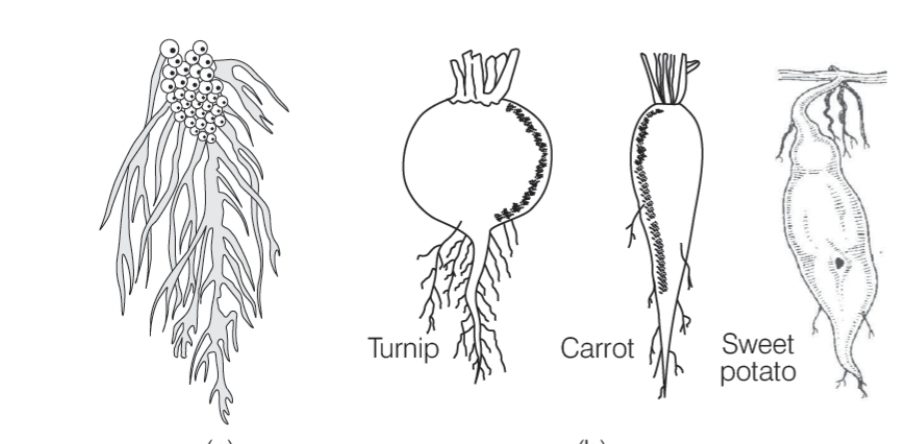
| Storage root | Food (starch, sugars) संग्रहीत करने के लिए मोटी एवं संचित जड़ें। | Carrot (Daucus), Radish (Raphanus), Beetroot |
| Tuberous root | Enlarged fleshy root storing food (root tubers are adventitious roots). | Sweet potato (Ipomoea batatas) — ध्यान दें: Potato stem tuber है; sweet potato is root tuber. |
| Prop roots (सहायक जड़) | Stem से निकल कर supporting props provide करते हैं। | Maize (ज़ाइल), Banyan (बरगद) — aerial prop roots |
| Pneumatophores / breathing roots | उभरी हुई spongy roots for gaseous exchange in waterlogged soils. | Avicennia, Rhizophora |
| Buttress roots | Surface-spreading roots giving stability to tall trees in shallow soil. | Tropical trees (Ficus, Ceiba) |
| Contractile roots | Roots that pull plant deeper into soil (bulbs/corms). Important in geophytes. | Lily, Dandelion |
| Parasitic / Haustorial roots | Roots or organs penetrating host tissues to extract nutrients. | Striga, Orobanche, Cuscuta (note: Cuscuta mainly stem parasite) |
| Rhizosphere roots / root nodules | Modified roots associated with nitrogen-fixing bacteria forming nodules. | Legumes: Pea, Gram, Soybean (Rhizobium nodules) |
6. Functions of Root (कार्य)
- Anchorage: पौधे को मिट्टी में स्थिर करना।
- Absorption: Water & dissolved minerals का uptake (root hairs मुख्य भूमिका)।
- Conduction: Xylem और phloem द्वारा upward और downward conduction।
- Storage: Carbohydrates और अन्य पदार्थों का भंडारण (storage roots)।
- Vegetative propagation: कुछ पौधों में जड़ से नए पौधे बनते हैं (e.g., sweet potato slips)।
- Symbiotic interactions: Root nodules में Rhizobium nitrogen fixation; mycorrhizae के माध्यम से enhanced nutrient uptake।
- Hormone synthesis: Auxins, cytokinins आदि का उत्पादन।
7. Economic Importance (आर्थिक महत्व)
- Food sources: Carrot, Beetroot, Sweet potato, Radish — खाद्य जड़ें।
- Spices & condiments: Ginger, Turmeric (note: these are rhizomes — stem modifications; पर कुछ root-derived spices भी हैं)।
- Medicinal roots: Ginseng, Licorice (अश्वगंधा root भी आयुर्वेद में उपयोगी है)।
- Soil binding & erosion control: Roots hold soil and prevent erosion.
- Commercial products: Dyes, tannins, resins derived from roots in some species.
8. Quick Comparison: Tap root vs Fibrous root
| Feature | Tap root | Fibrous root |
|---|---|---|
| Origin | Radicle persists as main root | Radicle short-lived; many adventitious roots from stem base |
| Occurrence | Dicots (most) | Monocots (grasses) |
| Function | Deep anchorage and storage | Soil binding, quick absorption from surface |
9. Short MCQs for Practice (संक्षिप्त प्रश्न)
- Root hairs primarily function in — Ans: Absorption of water and minerals.
- Which tissue gives rise to lateral roots? — Ans: Pericycle.
- Casparian strip is found in — Ans: Endodermis.
- Example of storage root — Ans: Carrot / Radish.
10. References / Further Reading
- NCERT Class 11 Biology — Chapter: Morphology of Flowering Plants
- Campbell Biology — Plant structure sections
- Any standard botany textbook for detailed diagrams (e.g., Eames & MacDaniels)
The Stem (तना)
तना पौधे का प्रमुख shoot system अंग है जो जमीन के ऊपर (generally aerial) पाया जाता है।
यह plumule से विकसित होता है और पत्तियों, फूलों, फलों एवं बीजों को सहारा देता है।
| Fact: तना हमेशा पत्तियों की कक्ष से निकलने वाली शाखाओं और कलियों को धारण करता है। |
Characteristics of Stem (तने के लक्षण)
- पत्तियों को सहारा देता है।
- शाखाओं, फूलों और फलों का उत्पादन करता है।
- Nodes और Internodes में विभाजित होता है।
- Apical bud एवं axillary buds उपस्थित रहते हैं।
- सामान्यतः यह हरा होता है और प्रकाश संश्लेषण कर सकता है (प्रारंभिक अवस्था में)।
Functions of Stem (तने के कार्य)
- पौधे को mechanical support प्रदान करना।
- जल, खनिज और खाद्य पदार्थ का संवहन करना।
- पत्तियों और फूलों को उचित दिशा में व्यवस्थित करना।
- कभी-कभी भोजन, पानी और रक्षात्मक संरचना संग्रहित करना।
Modifications of Stem (तने के रूपांतर)
1. Underground Stem Modifications (भूमिगत तना रूपांतर)
- Rhizome – जैसे अदरक (Ginger), हल्दी।
- Tuber – जैसे आलू (Potato)।
- Bulb – जैसे प्याज (Onion), लहसुन।
- Corm – जैसे अरवी (Colocasia), केसर (Saffron)।
2. Aerial Stem Modifications (वायवीय तना रूपांतर)
- Tendrils – सहारा चढ़ने में मदद करते हैं; जैसे लौकी, अंगूर।
- Thorns – सुरक्षा प्रदान करते हैं; जैसे नींबू, बोगनवेलिया।
3. Subaerial Stem Modifications (अर्ध-भूमिगत तना रूपांतर)
- Runner – जैसे दूब घास।
- Stolon – जैसे जमीकंद।
- Sucker – जैसे पुदीना।
- Offset – जैसे जलकुंभी।
Underground Stem Types – Comparison
| Type | Example | Main Function |
|---|---|---|
| Rhizome | Ginger, Turmeric | Food storage & Vegetative propagation |
| Tuber | Potato | Food storage & propagation (eyes) |
| Bulb | Onion, Garlic | Food storage in fleshy leaves |
| Corm | Colocasia, Saffron | Food storage & perennation |
| याद रखिये: आलू (Potato) एक तना (Stem Tuber) है, जड़ (Root) नहीं। |
The Leaf (पत्ती)
पत्ती पौधे का एक महत्वपूर्ण vegetative organ है, जिसे पौधे का food factory भी कहा जाता है।
यह तने के node से उत्पन्न होती है और आमतौर पर हरी, चपटी एवं पतली संरचना होती है।
पत्ती प्रकाश संश्लेषण, वाष्पोत्सर्जन और श्वसन जैसे कार्यों में सहायक होती है।
| Fact: एक सामान्य पत्ती तीन भागों से बनी होती है – Leaf base, Petiole और Lamina। |
Characteristics of Leaf (पत्ती के लक्षण)
- यह तने के node से उत्पन्न होती है और axillary bud के opposite में पाई जाती है।
- इसमें leaf base, petiole और lamina पाए जाते हैं।
- लैमिना पर veins और veinlets पाए जाते हैं।
- Veins का pattern पत्ती का venation कहलाता है।
Functions of Leaf (पत्ती के कार्य)
- प्रकाश संश्लेषण के द्वारा भोजन का निर्माण।
- वाष्पोत्सर्जन के द्वारा जल संतुलन बनाए रखना।
- श्वसन की क्रिया में सहायक।
- कभी-कभी भोजन एवं पानी का संग्रहण।
Parts of a Typical Leaf (सामान्य पत्ती के भाग)
- Leaf base – तने से जुड़ने वाला भाग। इसमें कभी-कभी stipules पाए जाते हैं।
- Petiole – डंठल जो पत्ती को सहारा देता है।
- Lamina (Leaf blade) – हरा, चपटा भाग जो प्रकाश संश्लेषण करता है।
Venation (शिरा विन्यास)
- Reticulate venation – Veins और veinlets जाल जैसी आकृति बनाते हैं; जैसे – डिकॉट पौधों में।
- Parallel venation – Veins समानांतर होते हैं; जैसे – मोनोकॉट पौधों में।
Types of Leaves (पत्तियों के प्रकार)
- Simple leaf – Lamina अखंड होती है; जैसे – आम, गुआवा।
- Compound leaf – Lamina कई leaflets में विभाजित होती है; जैसे – नीम, गुलमोहर।
Phyllotaxy (पत्तियों की व्यवस्था)
- Alternate – एक node पर एक पत्ती; जैसे – सूरजमुखी।
- Opposite – एक node पर दो पत्तियाँ विपरीत दिशा में; जैसे – गुआवा।
- Whorled – एक node पर तीन या अधिक पत्तियाँ; जैसे – अलस्टोनिया।
Modification of Leaves (पत्तियों के रूपांतर)
- Tendrils – सहारा चढ़ने के लिए; जैसे – मटर।
- Spines – सुरक्षा के लिए; जैसे – कैक्टस।
- Fleshy leaves – भोजन संग्रहण के लिए; जैसे – प्याज।
- Insectivorous leaves – कीट पकड़ने के लिए; जैसे – पिचर प्लांट, वीनस फ्लाई ट्रैप।
Comparison Table: Simple vs Compound Leaf
| Feature | Simple Leaf | Compound Leaf |
|---|---|---|
| Lamina | Undivided | Divided into leaflets |
| Examples | Mango, Guava | Neem, Gulmohar |
| Note: Parallel venation हमेशा monocot पौधों में और reticulate venation हमेशा dicot पौधों में पाई जाती है। |
morphology of flowering plants, stem , root , leaves, flowers
The Inflorescence (पुष्पक्रम)
Inflorescence एक तने या शाखा पर फूलों के व्यवस्थित समूह को कहते हैं।
यह पौधे के reproductive system का महत्वपूर्ण हिस्सा है और फूलों की वृद्धि, arrangement और flowering pattern का अध्ययन इसके अंतर्गत आता है।
| Fact: Inflorescence arrangement फूलों की संख्या और उनके blooming समय को प्रभावित करता है। |
Characteristics of Inflorescence (पुष्पक्रम के लक्षण)
- एक ही plant axis या branch से कई फूल उत्पन्न होते हैं।
- Flowers may be sessile (without pedicel) or pedicellate (with pedicel)।
- Inflorescence apex may continue to grow (indeterminate) or terminate in a flower (determinate)।
Types of Inflorescence (पुष्पक्रम के प्रकार)
1. Indeterminate Inflorescence (असिमित/Indeterminate)
In indeterminate inflorescence, the apex keeps growing and the oldest flowers are at the base, youngest at the top.
- Raceme (दांड पुष्पक्रम): Flowers on pedicels attached along the main axis; e.g., Mustard, Radish.
- Spike (कंद पुष्पक्रम): Flowers sessile along main axis; e.g., Sorghum, Wheat.
- Corymb (उभार पुष्पक्रम): Lower pedicels longer, upper shorter so all flowers at same level; e.g., Cauliflower.
- Umbel (छत्र पुष्पक्रम): Pedicels arise from same point; e.g., Coriander, Lemon.
- Head/Capitulum (मुकुट पुष्पक्रम): Sessile flowers on flat or slightly convex receptacle; e.g., Sunflower, Mustard.
- Spadix (स्तम्भ पुष्पक्रम): Thick fleshy axis with small flowers; usually surrounded by bract (spathe); e.g., Colocasia, Banana.
- Catkin / Ament (कटक पुष्पक्रम): Drooping, unisexual flowers; e.g., Sal, Poplar.
2. Determinate Inflorescence (सिमित/Determinate)
In determinate inflorescence, apex terminates in a flower, so oldest flowers at the top and youngest at base.
- Cyme (कुसुम पुष्पक्रम): Main axis ends with flower; lateral branches develop similarly; e.g., China rose, Jasmine.
- Scorpioid cyme (सर्प पुष्पक्रम): Alternate branching forming curved pattern; e.g., Heliotropium.
- Helicoid cyme (सर्पाकार पुष्पक्रम): Flowers on same side forming spiral; e.g., Borages.
Comparison Table: Indeterminate vs Determinate Inflorescence
| Feature | Indeterminate | Determinate |
|---|---|---|
| Apex growth | Continuous; keeps growing | Terminates in a flower |
| Oldest flowers | At the base | At the top / center |
| Youngest flowers | At the top | At the base / lateral branches |
| Examples | Mustard, Wheat, Sunflower | China rose, Jasmine |
Functions of Inflorescence (पुष्पक्रम के कार्य)
- Flowers की संख्या और arrangement को नियंत्रित करता है।
- Pollination में आसानी प्रदान करता है।
- Seed formation और dispersal में सहायक।
Economic Importance (आर्थिक महत्व)
- Food plants with edible flowers: Cauliflower, Broccoli
- Ornamental flowers: Jasmine, Hibiscus
- Medicinal plants: Marigold (Calendula)
References / Further Reading
- NCERT Class 11 Biology – Morphology of Flowering Plants
- Botany Textbooks: Eames & MacDaniels, Raven Biology
Types of Leaves (पत्तियों के प्रकार)
| Fact: Leaves can be simple or compound based on the lamina division. |
| Type of Leaf | Characteristics | Examples |
|---|---|---|
| Simple Leaf | Lamina is undivided; leaf arises singly from the node. | Mango, Guava, Hibiscus |
| Compound Leaf | Lamina divided into leaflets; petiole attached to all leaflets collectively. | Neem, Rose, Gulmohar |
| Phyllotaxy: Alternate | One leaf per node. | Sunflower, Cotton |
| Phyllotaxy: Opposite | Two leaves per node, opposite to each other. | Guava, Calotropis |
| Phyllotaxy: Whorled | Three or more leaves per node arranged in a whorl. | Alstonia, Algae |
| Leaf Venation: Reticulate | Veins form a net-like pattern; typical of dicots. | Mango, Hibiscus, Neem |
| Leaf Venation: Parallel | Veins run parallel to each other; typical of monocots. | Grass, Maize, Wheat |
The Flower (पुष्प)
Flower पौधे का reproductive organ है जो seed और fruit निर्माण में सहायक होता है।
यह पौधे की sexual reproduction की site होती है और फूलों की संरचना, arrangement और symmetry अध्ययन के अंतर्गत आती है।
| Fact: Flower is a modified shoot with specialized leaves called floral leaves. |
Characteristics of Flower (पुष्प के लक्षण)
- Flowers are usually borne on shoots or branches.
- Flowers are generally short-lived compared to vegetative parts.
- They are reproductive structures producing gametes.
- Flowers may be solitary or in inflorescence.
Parts of a Typical Flower (पुष्प के भाग)
- Receptacle: Modified stem tip where floral parts arise.
- Sepals (Calyx): Usually green, protective leaves; protect bud before opening.
- Petals (Corolla): Often colorful, attract pollinators.
- Stamens (Androecium): Male reproductive part producing pollen; made of anther and filament.
- Carpels / Pistils (Gynoecium): Female reproductive part; made of stigma, style, and ovary.
Flower Symmetry (पुष्प की सममिति)
- Actinomorphic (Radial Symmetry): Flower can be divided into equal halves by multiple planes; e.g., Mustard, Hibiscus.
- Zygomorphic (Bilateral Symmetry): Flower can be divided into equal halves by only one plane; e.g., Pea, Bean.
Types of Flowers (पुष्प के प्रकार)
- Complete Flower: Has all four whorls – Calyx, Corolla, Androecium, Gynoecium; e.g., Hibiscus.
- Incomplete Flower: Lacks one or more whorls; e.g., Maize (no petals).
- Unisexual Flower: Either stamens or carpels present; e.g., Cucumber (male/female separate).
- Bisexual Flower: Both stamens and carpels present; e.g., Mustard.
Inflorescence
Flowers may be solitary or arranged in groups called inflorescence. Types include:
- Raceme, Spike, Umbel, Corymb, Head, Spadix, Cyme, etc.
Functions of Flower (पुष्प के कार्य)
- Sexual reproduction of plants.
- Production of seeds and fruits.
- Attraction of pollinators for cross-pollination.
- Genetic variation through sexual reproduction.
Comparison Table: Complete vs Incomplete Flower
| Feature | Complete Flower | Incomplete Flower |
|---|---|---|
| Whorls | All four whorls present | One or more whorls absent |
| Examples | Hibiscus, Mustard | Maize, Cucumber |
Economic Importance
- Food plants: Tomato, Brinjal
- Ornamental flowers: Rose, Jasmine, Marigold
- Medicinal plants: Hibiscus, Aloe
- Spices and beverages: Cloves, Coffee flowers
Androecium (पुरुष पुष्पांग)
Androecium फूल का पुरुष reproductive part होता है, जो stamens से बना होता है।
Stamens में anther और filament शामिल होते हैं। यह फूल में pollen (male gametes) का उत्पादन करता है।
| Fact: Anther में microsporangia होते हैं जहाँ microspores (pollen grains) बनते हैं। |
Structure of Androecium
- Filament: Stalk that supports the anther.
- Anther: Terminal sac-like structure producing pollen grains.
- Microsporangia: Pollen sacs inside the anther.
Types of Androecium
- Monadelphous: Stamens united by filaments into one bundle; e.g., Hibiscus.
- Diadelphous: Stamens united in two bundles; e.g., Pea.
- Polyadelphous: Stamens united in more than two bundles; e.g., China rose.
- Synthecious: Stamens united by anthers; e.g., Calotropis.
- Free (Polyandrous): Stamens free and separate; e.g., Mustard.
Gynoecium (स्त्री पुष्पांग)
Gynoecium फूल का स्त्री reproductive part होता है, जो carpels / pistils से बना होता है।
यह फूल के ovules (female gametes) का निर्माण करता है और fruit formation में सहायक होता है।
| Fact: Each carpel consists of three main parts – stigma, style, and ovary. |
Structure of Gynoecium
- Stigma: Sticky tip that receives pollen grains.
- Style: Slender stalk connecting stigma and ovary.
- Ovary: Basal swollen part containing ovules.
- Ovules: Contain female gametophytes (egg cells).
Types of Gynoecium
- Monocarpous: Single carpel; e.g., Hibiscus.
- Apocarpous: Multiple free carpels; e.g., Rose.
- Syncarpous: Multiple fused carpels; e.g., Mustard, Tomato.
Comparison Table: Androecium vs Gynoecium
| Feature | Androecium | Gynoecium |
|---|---|---|
| Function | Produces male gametes (pollen) | Produces female gametes (ovules) and forms fruit |
| Main Parts | Stamens (Filament + Anther) | Carpels/Pistils (Stigma + Style + Ovary) |
| Example of Types | Monadelphous, Diadelphous, Polyandrous | Monocarpous, Apocarpous, Syncarpous |
| Position | Typically surrounds the gynoecium | Central part of flower |
morphology of flowering plants, stem , root , leaves, flowers
Placentation (बीजास्थि)
Placentation फूल के अंडाशय (ovary) में ovules (बीज) के arrangement को कहते हैं।
यह seed development और fertilization में महत्वपूर्ण भूमिका निभाता है।
| Fact: Placentation determines the number of seeds per fruit and their position inside the ovary. |
Types of Placentation (बीजास्थि के प्रकार)
| Type of Placentation | Description | Example |
|---|---|---|
| Marginal | Ovules develop along the margin of a single carpel; common in simple, unilocular ovary. | Pea, Beans |
| Axile | Ovules attached to central axis of compound ovary; ovary divided into locules by septa. | Tomato, China rose |
| Parietal | Ovules attached to inner wall of ovary; ovary usually unilocular. | Mustard, Cucumber |
| Free-central | Ovules attached to a central column; ovary without septa. | Primrose, Dianthus |
| Basal | Single ovule develops at the base of ovary. | Sunflower, Marigold |
| Superior / Apical | Single ovule develops at the apex of ovary. | Lotus |
Importance of Placentation
- Helps in identifying the type of ovary and fruit formation.
- Determines number of seeds per fruit.
- Important character for plant classification.
The Fruit (फल)
Fruit फूल के matured ovary से बनने वाला structure है, जो seeds को सुरक्षित रखता है और उनके dispersal में सहायक होता है।
फूल में pollination और fertilization के बाद ovary विकसित होकर fruit बनती है।
| Fact: Fruit protects seeds, helps in seed dispersal, and may store food in some cases (e.g., mango, apple). |
Structure of a Fruit
- Pericarp: Wall of the ovary that develops into fruit; consists of three layers – Exocarp, Mesocarp, Endocarp.
- Exocarp: Outer layer; may be thin or thick.
- Mesocarp: Middle fleshy layer; may store food.
- Endocarp: Inner layer surrounding seeds; may be hard (stone fruits) or soft.
- Seed: Developed from ovule inside ovary.
Types of Fruits (फल के प्रकार)
| Type | Description | Examples |
|---|---|---|
| Simple Fruit | Developed from a single ovary of a single flower. | Mango, Tomato, Pea |
| Aggregate Fruit | Developed from many carpels of a single flower. | Strawberry, Raspberry |
| Multiple Fruit | Developed from carpels of many flowers borne on a common axis. | Pineapple, Jackfruit |
Classification of Simple Fruits
| Type | Characteristic | Examples |
|---|---|---|
| Fleshy / Succulent | Pericarp is soft, juicy; seeds inside. | Mango (Drupe), Tomato (Berry), Grapes (Berry) |
| Dry Dehiscent | Pericarp dries at maturity and splits to release seeds. | Mustard (Siliqua), Pea (Pod) |
| Dry Indehiscent | Pericarp dry but does not split; seed dispersed with fruit. | Groundnut, Sunflower, Wheat |
Functions of Fruits
- Protect seeds until they mature.
- Assist in seed dispersal through wind, water, or animals.
- Provide food storage (fleshy fruits) for seeds.
- Play a role in reproduction and survival of plant species.
Economic Importance
- Food: Mango, Banana, Apple, Tomato
- Oil and spices: Groundnut, Mustard
- Timber and fiber: Jackfruit, Coconut
- Ornamental and medicinal: Hibiscus, Marigold
The Seed (बीज)
Seed फूल वाले पौधों (Angiosperms) में fertilization के बाद developed ovule होता है।
यह पौधे का reproductive unit है और next generation के growth और reproduction के लिए जिम्मेदार होता है।
| Fact: Seed contains embryo, stored food, and protective seed coat to ensure survival of the next generation. |
Structure of a Typical Seed (बीज की संरचना)
- Seed Coat (Testa and Tegmen): Protective outer layer derived from integuments of ovule.
- Embryo: Young plant inside the seed; consists of:
- Radicle: Embryonic root
- Plumule: Embryonic shoot
- Epicotyl: Part of plumule above cotyledons
- Hypocotyl: Part of axis below cotyledons
- Cotyledons: Seed leaves; store food in some seeds
- Endosperm / Stored Food: Provides nutrients for embryo during germination; may be present or absorbed by cotyledons.
Types of Seeds (बीज के प्रकार)
| Type of Seed | Characteristic | Examples |
|---|---|---|
| Monocotyledonous (Monocot) | Single cotyledon; usually endosperm present | Maize, Wheat, Rice |
| Dicotyledonous (Dicot) | Two cotyledons; endosperm may be absorbed by cotyledons | Pea, Gram, Mango |
| Albuminous Seed | Endosperm persists in mature seed | Maize, Castor |
| Exalbuminous Seed | Endosperm absorbed by cotyledons in mature seed | Pea, Bean |
Seed Germination (बीज अंकुरण)
- Process by which a seed develops into a young plant (seedling).
- Requires water, oxygen, and suitable temperature.
- Types of germination:
- Epigeal Germination: Cotyledons emerge above ground; e.g., Bean.
- Hypogeal Germination: Cotyledons remain below ground; e.g., Pea, Maize.
Functions of Seeds (बीज के कार्य)
- Ensure reproduction and continuation of plant species.
- Provide stored food to support embryo growth.
- Help in dispersal of plants to new locations.
- Can remain dormant under unfavorable conditions for future germination.
Economic Importance
- Food: Wheat, Rice, Maize, Pulses
- Oil: Groundnut, Mustard, Sunflower
- Spices and beverages: Coffee, Cacao, Mustard
- Timber and fiber: Cotton (seed fiber), Coconut
- Medicinal plants: Castor, Mustard
External Links for Further Study
Animal Kingdom
- NCERT Class 11 Biology – Animal Kingdom (PDF)
- Animal Kingdom Summary – BYJU’S
- Animal Kingdom Notes & MCQs – Toppr
- Animal Kingdom NEET Preparation – Embibe
Morphology of Flowering Plants
- NCERT Class 11 Biology – Morphology of Flowering Plants (PDF)
- Morphology of Flowering Plants – BYJU’S
- Morphology Notes & Questions – Toppr
- LearnCBSE – Morphology Class 11 Notes
General Biology Resources
- Biology Concepts – Khan Academy
- Biology Online Dictionary & Tutorials
- MCQs on Animal Kingdom – ExamVeda
- Morphology Class 11 Detailed Notes – EXCELLUP
Read more: