
Class 11 Biology – Chapter 6
Anatomy of Flowering Plants (फूलदार पौधों की शारीरिक रचना)
Anatomy of Flowering Plants (फूलदार पौधों की शारीरिक रचना) पौधों की internal structure या आंतरिक संरचना का अध्ययन है।
जहाँ morphology (रूप-विज्ञान) पौधे के बाहरी रूप और आकार का अध्ययन करती है, वहीं anatomy हमें जड़, तना, पत्ती और अन्य अंगों में कोशिकाओं और ऊतकों के संगठन और कार्यों को समझने में मदद करती है।
Importance (महत्त्व)
- यह समझने में मदद करती है कि विभिन्न ऊतक (tissues) मिलकर पौधे के जीवन-क्रियाओं (functions) को कैसे संचालित करते हैं।
- यह वास्कुलर ऊतक (xylem और phloem) की संरचना और कार्य को स्पष्ट करती है, जो पानी, खनिज और भोजन के परिवहन में सहायक हैं।
- पौधों की वृद्धि (growth), अंतर-विभेदन (differentiation) और विभिन्न पर्यावरणीय परिस्थितियों में अनुकूलन (adaptation) को समझने में मदद करती है।
- कृषि, वानिकी (forestry), और बायोटेक्नोलॉजी जैसे applied sciences में इसका महत्त्व है।
Key Topics (मुख्य विषय)
- Tissue System in Plants (पौधों में ऊतक प्रणाली)
- Types of Plant Tissues – Meristematic and Permanent (पौधों के ऊतक – meristematic और स्थायी)
- Internal Structure of Root, Stem, and Leaf (जड़, तना और पत्ती की आंतरिक संरचना)
- Secondary Growth in Plants (पौधों में द्वितीयक वृद्धि)
- Differences between Monocot and Dicot Anatomy (एकबीजपत्री और द्विबीजपत्री की संरचना में भिन्नताएँ)
Fact Box (तथ्य)
शब्द “Anatomy” ग्रीक शब्द anatome से आया है, जिसका अर्थ है “कटाई” या “विभाजन”।
पौधों में इसका अर्थ है उनके आंतरिक ऊतकों और संरचना का अध्ययन करना, जिससे उनके कार्य और विकास को समझा जा सके।
Plant Tissues (पौधों के ऊतक)
Plant Tissues (पौधों के ऊतक) पौधों में समान कार्य करने वाली कोशिकाओं (cells) का समूह होता है।
ऊतक पौधों के अंगों में संगठन (organization) और कार्य (function) सुनिश्चित करते हैं।
Plant tissues दो मुख्य प्रकार के होते हैं: Meristematic (विकासशील ऊतक) और Permanent (स्थायी ऊतक)।
1. Meristematic Tissues (विकासशील ऊतक)
ये ऊतक actively divide (क्रियाशील विभाजन) करते हैं और plant की वृद्धि में सहायक होते हैं।
कोशिकाओं में बहुत कम cytoplasm और छोटी vacuoles होती हैं। Cell walls पतली होती हैं और chloroplast नहीं होता।
Types of Meristematic Tissues (विकासशील ऊतक के प्रकार)
| Type (प्रकार) | Location (स्थान) | Function (कार्य) | Example (उदाहरण) |
|---|---|---|---|
| Apical Meristem (शिखर ऊतक) | Tip of root and shoot (जड़ और तने का सिरा) | Primary growth – बढ़ाई में सहायक | Shoot tip, Root tip |
| Lateral Meristem (पार्श्व ऊतक) | Along the sides of stem and root (तने और जड़ की भुजाओं में) | Secondary growth – जड़ और तने की मोटाई बढ़ाना | Cambium, Cork cambium |
| Intercalary Meristem (अंतरस्थ ऊतक) | Base of nodes or internodes (नोड्स के आधार में) | Lengthening of stem (तने की लंबाई बढ़ाना) | Grass, Sugarcane |
Fact Box (तथ्य)
Meristematic cells are small, thin-walled, dense cytoplasm cells with prominent nuclei.
वे differentiating होकर permanent tissues में बदल जाते हैं।
2. Permanent Tissues (स्थायी ऊतक)
ये ऊतक differentiation के बाद स्थायी रूप से विकसित हो जाते हैं।
Permanent tissues तीन प्रकार के होते हैं: Simple (सरल), Complex (संयोजित), Special (विशेष)।
A. Simple Permanent Tissues (सरल स्थायी ऊतक)
| Type (प्रकार) | Structure (संरचना) | Function (कार्य) | Example (उदाहरण) |
|---|---|---|---|
| Parenchyma (पैरेंकाइमा) | Thin-walled, living cells, loosely packed | Storage, photosynthesis, secretion | Leaf mesophyll, Cortex |
| Collenchyma (कोलेन्काइमा) | Thickened cell walls at corners, living cells | Support in growing regions | Petiole of leaves, Young stems |
| Sclerenchyma (स्क्लेरेन्काइमा) | Thick, lignified, dead cells | Mechanical support and strength | Stone cells of guava, Fibres like jute |
B. Complex Permanent Tissues (संयोजित स्थायी ऊतक)
These tissues are made of more than one type of cell and perform conduction:
| Type (प्रकार) | Components (घटक) | Function (कार्य) | Example (उदाहरण) |
|---|---|---|---|
| Xylem (जलवाहिनी) | Tracheids, Vessels, Xylem parenchyma, Xylem fibres | Water and mineral transport, mechanical support | Stem, Root |
| Phloem (सारवाहिनी) | Sieve tubes, Companion cells, Phloem parenchyma, Phloem fibres | Transport of food (organic nutrients) | Stem, Root |
C. Special Tissues (विशेष ऊतक)
- Idioblasts – Special cells like raphides (Calcium oxalate crystals)
- Glandular tissues – Secrete nectar, resin or latex
- Laticifers – Latex secreting tubes (e.g., Rubber plant)
Fact Box (तथ्य)
Simple tissues are mainly involved in storage and support, while complex tissues (xylem and phloem) are responsible for conduction in plants.
Complex Tissues (संयोजित ऊतक)
Complex Tissues (संयोजित ऊतक) ऐसे ऊतक होते हैं जो दो या दो से अधिक प्रकार की कोशिकाओं (cells) से मिलकर बने होते हैं।
इनका मुख्य कार्य conduction (परिवहन) और mechanical support (यांत्रिक सहारा) प्रदान करना है।
मुख्य Complex tissues हैं: Xylem (जलवाहिनी) और Phloem (सारवाहिनी)।
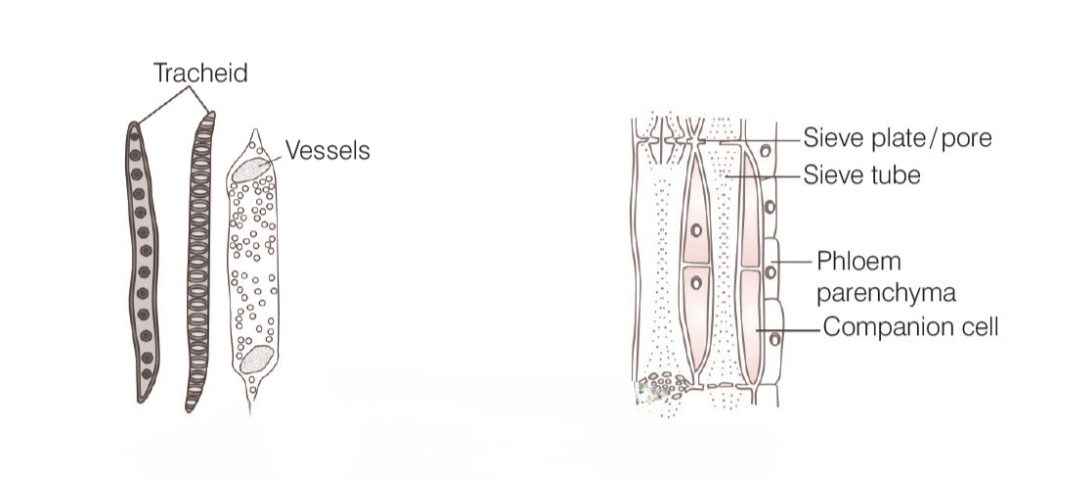
1. Xylem (जलवाहिनी)
Xylem मुख्य रूप से पानी (water) और खनिज (minerals) का conduction करता है।
यह dead और living cells का मिश्रण होता है।
Xylem tissue में निम्नलिखित घटक होते हैं:
| Component (घटक) | Structure (संरचना) | Function (कार्य) | Example (उदाहरण) |
|---|---|---|---|
| Tracheids | Long, tapered, dead cells with lignified walls | Water conduction and support | Gymnosperms |
| Vessels / Vessel elements | Short, wide, dead cells; form continuous tube | Efficient water transport | Angiosperms |
| Xylem Parenchyma | Living, thin-walled cells | Storage of food and lateral conduction | Stem and root |
| Xylem Fibres | Elongated, lignified, dead cells | Mechanical support | Wood fibers, Jute |
2. Phloem (सारवाहिनी)
Phloem मुख्य रूप से पौधे के विभिन्न भागों में organic food (photosynthates) का conduction करता है।
यह living cells और कुछ dead cells का मिश्रण होता है।
Phloem tissue में मुख्य घटक हैं:
| Component (घटक) | Structure (संरचना) | Function (कार्य) | Example (उदाहरण) |
|---|---|---|---|
| Sieve Tubes | Long, tube-like living cells; with sieve plates | Transport of organic nutrients (food) | Angiosperms |
| Companion Cells | Living cells with dense cytoplasm; attached to sieve tubes | Control and support sieve tube function | Leaf and stem phloem |
| Phloem Parenchyma | Thin-walled living cells | Storage and lateral conduction of food | Stem and root |
| Phloem Fibres | Elongated, thick-walled dead cells | Mechanical support | Jute, Coconut stem |
Fact Box (तथ्य)
Xylem और Phloem दोनों complex tissues हैं।
Xylem मुख्य रूप से पानी और खनिज का conduction करता है और mechanical support देता है, जबकि Phloem मुख्य रूप से food conduction करता है और living cells का mixture होता है।
ये ऊतक plants के growth और survival के लिए अत्यंत महत्वपूर्ण हैं।
Plant Tissue System (पौधों में ऊतक प्रणाली)
Plant Tissue System (पौधों में ऊतक प्रणाली) पौधे के विभिन्न ऊतकों (tissues) का समूह है, जो plant organ के growth, support और conduction को सुनिश्चित करता है।
मुख्य tissue systems हैं: Dermal (Epidermal), Ground और Vascular Tissue System।
1. Dermal / Epidermal Tissue System (त्वचा / एपिडर्मल ऊतक प्रणाली)
यह plant की बाहरी सुरक्षा प्रदान करता है।
| Component (घटक) | Structure (संरचना) | Function (कार्य) | Example (उदाहरण) |
|---|---|---|---|
| Epidermis (एपिडर्मिस) | Single layer, tightly packed, may have cuticle | Protection, prevents water loss | Leaf, Stem surface |
| Stomata (स्टोमाटा) | Special openings in epidermis with guard cells | Gas exchange, transpiration | Leaf |
| Trichomes / Hairs (तंतु) | Outgrowth of epidermal cells | Protection, reduce water loss | Sunflower, Cotton |
2. Ground Tissue System (मध्य ऊतक प्रणाली)
Plant body का अधिकांश हिस्सा ground tissue से बना होता है। यह storage, photosynthesis और support में सहायक है।
| Type (प्रकार) | Structure (संरचना) | Function (कार्य) | Example (उदाहरण) |
|---|---|---|---|
| Parenchyma (पैरेंकाइमा) | Thin-walled, living cells, loosely packed | Storage, Photosynthesis, Secretion | Leaf mesophyll, Cortex |
| Collenchyma (कोलेन्काइमा) | Thickened cell wall at corners, living cells | Support in growing regions | Petiole of leaves, Young stem |
| Sclerenchyma (स्क्लेरेन्काइमा) | Thick, lignified, dead cells | Mechanical support | Fibres like jute, Stone cells of guava |
3. Vascular Tissue System (वाहिकीय ऊतक प्रणाली)
Vascular tissue plant में conduction और mechanical support प्रदान करता है। इसमें Xylem और Phloem शामिल हैं।
| Type (प्रकार) | Component (घटक) | Function (कार्य) | Example (उदाहरण) |
|---|---|---|---|
| Xylem (जलवाहिनी) | Tracheids, Vessels, Xylem parenchyma, Xylem fibres | Water & Mineral conduction, Mechanical support | Stem, Root |
| Phloem (सारवाहिनी) | Sieve tubes, Companion cells, Phloem parenchyma, Phloem fibres | Transport of food, Storage | Stem, Root |
Fact Box (तथ्य)
Dermal system (त्वचा ऊतक) plant की बाहरी सुरक्षा करता है, Ground system (मध्य ऊतक) storage और photosynthesis में मदद करता है, और Vascular system (वाहिकीय ऊतक) conduction और mechanical support प्रदान करता है।
तीनों tissue systems मिलकर plant body का निर्माण और proper functioning सुनिश्चित करते हैं।
Vascular Bundles (वाहिकीय गुठलियाँ) of Stem and Root
Vascular bundles (वाहिकीय गुठलियाँ) plant में Xylem और Phloem के समूह होते हैं।
ये conduction (परिवहन) और support (सहारा) प्रदान करते हैं।
Vascular bundles मुख्यतः दो प्रकार की होती हैं: Radial (त्रिकर्ण) और Conjoint (संयुक्त)।
1. Radial Vascular Bundle (त्रिकर्ण वाहिकीय गुठली)
Radial vascular bundle में Xylem और Phloem अलग-अलग और alternate arrangement में पाए जाते हैं।
यह arrangement root में आम है।
| Feature (विशेषता) | Description (विवरण) | Example (उदाहरण) |
|---|---|---|
| Arrangement (व्यवस्था) | Xylem और Phloem अलग-अलग layers में, alternate arrangement | Root of Monocot and Dicot plants |
| Position (स्थान) | Radial – center से outward arrangement | Primary root |
| Function (कार्य) | Water, minerals और food conduction | Roots of Maize, Sunflower |
2. Conjoint Vascular Bundle (संयुक्त वाहिकीय गुठली)
Conjoint vascular bundle में Xylem और Phloem एक ही group में लगे रहते हैं।
यह arrangement stem और leaf में आम है।
Conjoint bundles दो प्रकार के होते हैं: Open (Cambium present) और Closed (No cambium)।
| Type (प्रकार) | Feature (विशेषता) | Example (उदाहरण) |
|---|---|---|
| Open Bundle (खुली गुठली) | Cambium present between xylem and phloem → secondary growth possible | Dicot stem (Sunflower, Hibiscus) |
| Closed Bundle (बंद गुठली) | No cambium → secondary growth absent | Monocot stem (Maize, Grass) |
Key Differences (मुख्य अंतर) – Radial vs Conjoint
| Feature (विशेषता) | Radial Bundle (त्रिकर्ण) | Conjoint Bundle (संयुक्त) |
|---|---|---|
| Arrangement (व्यवस्था) | Xylem और Phloem अलग-अलग, alternate | Xylem और Phloem एक ही group में |
| Location (स्थान) | Root | Stem, Leaf |
| Cambium Presence (कम्बियम) | Absent | Present in open, absent in closed |
| Secondary Growth (द्वितीयक वृद्धि) | Absent | Present in open type |
Fact Box (तथ्य)
Radial bundles primarily occur in roots, where xylem and phloem alternate, while conjoint bundles occur in stems and leaves with xylem and phloem together.
Open conjoint bundles have cambium and allow secondary growth; closed bundles do not.
Anatomy of Dicotyledonous Plant (Dicot पौधों की आंतरिक संरचना)
Dicotyledonous plants (Dicot पौधे) दो cotyledons (बीज पत्ती) के साथ विकसित होते हैं।
इनका internal structure (आंतरिक संरचना) study करने के लिए हम mainly Root, Stem और Leaf Anatomy को देखते हैं।
इनमें Tissue system, Vascular bundles, Xylem और Phloem के arrangement पर विशेष ध्यान दिया जाता है।
1. Root Anatomy (जड़ की संरचना)
Dicot root primary structure दिखाता है। Root में following tissue arrangement पाया जाता है:
| Part (भाग) | Structure (संरचना) | Function (कार्य) |
|---|---|---|
| Epidermis (एपिडर्मिस) | Outer single layer, root hairs present | Absorption of water & minerals |
| Cortex (कौर्टेक्स) | Parenchymatous cells, may store starch | Storage, support |
| Endodermis (एंडोडर्मिस) | Innermost cortex layer with Casparian strips | Regulates water and mineral movement |
| Pericycle (पेरिसाइकिल) | Layer of cells inside endodermis | Formation of lateral roots |
| Vascular Bundle (वाहिकीय गुठली) | Radial type, Xylem and Phloem alternate | Water & mineral conduction |
2. Dicot Stem Anatomy (तने की संरचना)
Dicot stem shows secondary growth in many plants. Stem structure includes Dermal, Ground and Vascular tissue system.
| Part (भाग) | Structure (संरचना) | Function (कार्य) |
|---|---|---|
| Epidermis | Outer protective layer, may have cuticle & trichomes | Protection, reduces water loss |
| Cortex | Parenchyma, Collenchyma near epidermis | Support, storage, photosynthesis |
| Vascular Bundles | Conjoint, open type; Xylem inner, Phloem outer, cambium present | Transport water, minerals, food; Secondary growth |
| Pith (मध्यक) | Central parenchymatous cells | Storage & support |
3. Dicot Leaf Anatomy (पत्ती की संरचना)
Dicot leaf shows dorsiventral structure with following tissue arrangement:
| Part (भाग) | Structure (संरचना) | Function (कार्य) |
|---|---|---|
| Epidermis | Upper & lower epidermis, with stomata & trichomes | Protection, gas exchange |
| Mesophyll | Palisade parenchyma (upper), Spongy parenchyma (lower) | Photosynthesis |
| Vascular Bundles / Veins | Conjoint, closed, surrounded by bundle sheath | Transport water, minerals & food |
| Cuticle | Waxy layer over epidermis | Reduces water loss |
Fact Box (तथ्य)
- Dicot root shows radial vascular bundles; stem and leaf show conjoint bundles.
- Open vascular bundles in stem allow secondary growth.
- Ground tissue (cortex, pith, mesophyll) provides support, storage, and photosynthesis.
- Dermal tissue protects against injury and water loss.
Anatomy of Monocotyledonous Plant (Monocot पौधों की आंतरिक संरचना)
Monocotyledonous plants (Monocots) में एक cotyledon (बीज पत्ती) होती है।
इनकी internal anatomy (आंतरिक संरचना) Dicot plants से भिन्न होती है।
मुख्य focus Root, Stem और Leaf anatomy पर होता है, जिसमें Tissue System और Vascular Bundles arrangement महत्वपूर्ण हैं।
1. Root Anatomy (जड़ की संरचना)
Monocot root में vascular bundle radial type होता है और xylem और phloem alternate arrangement में पाए जाते हैं।
| Part (भाग) | Structure (संरचना) | Function (कार्य) |
|---|---|---|
| Epidermis (एपिडर्मिस) | Single layer, root hairs present | Water & mineral absorption |
| Cortex (कौर्टेक्स) | Parenchymatous cells, may store starch | Storage, support |
| Endodermis (एंडोडर्मिस) | Innermost cortex layer with Casparian strips | Regulates water/mineral movement |
| Pericycle (पेरिसाइकिल) | Layer inside endodermis | Lateral root formation |
| Vascular Bundle (वाहिकीय गुठली) | Radial type, xylem & phloem alternate, no cambium | Water & mineral conduction |
2. Monocot Stem Anatomy (तने की संरचना)
Monocot stem shows primary structure only (secondary growth absent).
Vascular bundles are conjoint, scattered and closed (no cambium).
| Part (भाग) | Structure (संरचना) | Function (कार्य) |
|---|---|---|
| Epidermis | Outer protective layer, may have cuticle | Protection, reduces water loss |
| Cortex | Parenchyma and some sclerenchyma | Support and storage |
| Vascular Bundles | Conjoint, scattered, closed; Xylem inner, Phloem outer | Transport water, minerals & food |
| Ground Tissue / Fundamental tissue | Parenchymatous cells surrounding bundles | Support & storage |
3. Monocot Leaf Anatomy (पत्ती की संरचना)
Monocot leaf shows isobilateral structure (both surfaces similar).
Vascular bundles are conjoint, closed, and surrounded by bundle sheath.
| Part (भाग) | Structure (संरचना) | Function (कार्य) |
|---|---|---|
| Epidermis | Upper & lower epidermis, stomata usually on both surfaces | Protection, gas exchange |
| Mesophyll | Undifferentiated parenchyma (no distinct palisade/spongy) | Photosynthesis |
| Vascular Bundles / Veins | Conjoint, closed, bundle sheath present | Transport water, minerals & food |
| Cuticle | Waxy layer on epidermis | Reduces water loss |
Fact Box (तथ्य)
- Monocot root shows radial vascular bundles; stem and leaf have scattered, conjoint, closed bundles.
- Secondary growth absent in Monocot stem due to lack of cambium.
- Ground tissue provides storage and mechanical support.
- Leaves are isobilateral with stomata on both surfaces; mesophyll is undifferentiated.
Leaf Anatomy: Dorsiventral vs Isobilateral (पत्ती की संरचना)
Leaf anatomy (पत्ती की आंतरिक संरचना) को primarily दो types में classify किया जाता है:
Dorsiventral (दो-तरफा असमान) और Isobilateral (दोनों तरफ समान).
यह distinction mainly leaf surface और mesophyll differentiation पर आधारित है।
1. Dorsiventral Leaf (दो-तरफा असमान पत्ती)
- Definition: Leaf with distinct upper (adaxial) and lower (abaxial) surfaces.
- Mesophyll: Differentiated into Palisade parenchyma (upper) and Spongy parenchyma (lower).
- Epidermis: Upper epidermis thicker with cuticle; lower epidermis has more stomata.
- Vascular Bundles: Conjoint, closed, surrounded by bundle sheath.
- Examples: Sunflower, Hibiscus, Mango
2. Isobilateral Leaf (दोनों तरफ समान पत्ती)
- Definition: Leaf with both surfaces (adaxial & abaxial) similar in structure.
- Mesophyll: Uniform, undifferentiated parenchyma (no distinct palisade/spongy).
- Epidermis: Similar thickness on both surfaces; stomata may be present on both sides.
- Vascular Bundles: Conjoint, closed, bundle sheath present.
- Examples: Maize, Wheat, Coconut
Key Differences (मुख्य अंतर)
| Feature (विशेषता) | Dorsiventral Leaf (दो-तरफा असमान) | Isobilateral Leaf (दोनों तरफ समान) |
|---|---|---|
| Mesophyll (मेसोफिल) | Palisade (upper) + Spongy (lower) | Uniform parenchyma, no differentiation |
| Epidermis (एपिडर्मिस) | Upper thick, lower thin; stomata mainly lower | Similar on both surfaces; stomata on both sides |
| Leaf Type (पत्ती प्रकार) | Dorsiventral | Isobilateral |
| Examples (उदाहरण) | Sunflower, Hibiscus | Maize, Coconut |
Fact Box (तथ्य)
- Dorsiventral leaves are common in dicots; Isobilateral leaves are common in monocots.
- Mesophyll differentiation affects photosynthesis efficiency.
- Stomatal distribution helps in gas exchange and transpiration control.
Secondary Growth in Plants (पौधों में द्वितीयक वृद्धि)
Secondary growth (द्वितीयक वृद्धि) plant की girth (त्रिज्या) या thickness में वृद्धि है।
यह primarily woody dicot plants और gymnosperms में होता है।
Secondary growth का मुख्य कारण है lateral meristem, जैसे Vascular cambium और Cork cambium।
1. Definition (परिभाषा)
Secondary growth is the increase in thickness/girth of stem and root due to activity of lateral meristems.
(द्वितीयक वृद्धि पौधे की जड़ और तने की मोटाई बढ़ने की प्रक्रिया है, जो पार्श्व meristem की गतिविधि से होती है।)
2. Lateral Meristems (पार्श्व meristem)
- Vascular Cambium (वाहिकीय cambia): Responsible for secondary xylem and phloem formation.
- Cork Cambium / Phellogen (कर्क cambium): Responsible for secondary protective tissue (bark).
3. Mechanism of Secondary Growth (द्वितीयक वृद्धि की प्रक्रिया)
Secondary growth occurs due to activity of lateral meristems in two main ways:
- Secondary Xylem (Wood) Formation: Vascular cambium produces secondary xylem towards inside, contributing to wood formation.
- Secondary Phloem Formation: Vascular cambium produces secondary phloem towards outside, forming part of bark.
- Cork Formation: Cork cambium (phellogen) produces cork cells towards outside and phelloderm towards inside, forming periderm.
4. Types of Secondary Growth (द्वितीयक वृद्धि के प्रकार)
| Type (प्रकार) | Description (विवरण) | Examples (उदाहरण) |
|---|---|---|
| Axial (Longitudinal) Growth | Increase in height; primary growth | All plants (initial growth) |
| Radial / Secondary Growth | Increase in thickness/girth due to lateral meristem | Dicot stems & roots, Gymnosperms |
5. Features of Secondary Growth (मुख्य विशेषताएँ)
- Occurs in dicotyledonous plants and gymnosperms.
- Vascular cambium forms secondary xylem (wood) and phloem (bark).
- Cork cambium produces protective outer layer (periderm).
- Monocots generally lack secondary growth due to absence of vascular cambium.
- Annual rings in trees represent seasonal activity of cambium.
Fact Box (तथ्य)
- Secondary growth increases plant girth but not height.
- Secondary xylem (wood) and secondary phloem (part of bark) are produced by vascular cambium.
- Cork cambium replaces epidermis to form periderm for protection.
- Annual rings in trees indicate the rate of secondary growth.
Cambium (कम्बियम) in Plants
Cambium (कम्बियम) is a lateral meristem responsible for secondary growth in plants.
It produces secondary xylem (wood) and secondary phloem (bark), contributing to increase in girth (त्रिज्या) of stem and root.
1. Definition (परिभाषा)
Cambium is a layer of meristematic cells present between xylem and phloem in stems and roots that divides to form secondary xylem towards inside and secondary phloem towards outside.
(कम्बियम वह meristematic layer है जो तने और जड़ में xylem और phloem के बीच स्थित होती है और भीतर की ओर secondary xylem तथा बाहर की ओर secondary phloem बनाती है।)
2. Types of Cambium (कम्बियम के प्रकार)
| Type (प्रकार) | Description (विवरण) | Examples (उदाहरण) |
|---|---|---|
| Vascular Cambium (वाहिकीय कम्बियम) | Located between primary xylem and phloem; produces secondary xylem (wood) and phloem (bark). | Dicot stem and root (Hibiscus, Sunflower) |
| Cork Cambium / Phellogen (कर्क कम्बियम / फेलेजन) | Forms periderm; produces cork cells outward and phelloderm inward. | Dicot stem (Woody plants) |
3. Functions of Cambium (कम्बियम के कार्य)
- Produces secondary xylem (wood) towards inside.
- Produces secondary phloem (part of bark) towards outside.
- Contributes to increase in girth (thickness) of stem and root.
- Cork cambium replaces epidermis with periderm for protection.
- Forms annual rings in woody plants indicating seasonal growth.
4. Characteristics of Cambium (विशेषताएँ)
- Lateral meristem present in stems and roots.
- Responsible for secondary growth.
- Cells are thin-walled, actively dividing, and meristematic.
- Monocots generally lack vascular cambium; hence, no secondary growth.
Fact Box (तथ्य)
- Vascular cambium is bifacial: produces xylem inside, phloem outside.
- Cork cambium (phellogen) is responsible for formation of protective periderm.
- Activity of cambium is responsible for the thickness (girth) increase of dicot stems and roots.
- Annual rings in trees are formed due to seasonal cambial activity.
Heartwood and Sapwood (हृदयकाष्ठ और प्रोष्ठकाष्ठ)
In dicot woody plants, secondary xylem is differentiated into Heartwood (हृदयकाष्ठ) and Sapwood (प्रोष्ठकाष्ठ).
This differentiation helps in mechanical support and conduction of water.
1. Heartwood (हृदयकाष्ठ)
- Definition: Inner, older, non-conducting part of secondary xylem.
- Structure: Dark colored due to deposition of gums, resins, tannins; cells are dead.
- Function: Provides mechanical support and strength to the stem.
- Examples: Teak (Tectona), Rosewood (Dalbergia)
2. Sapwood (प्रोष्ठकाष्ठ)
- Definition: Outer, younger, conducting part of secondary xylem.
- Structure: Light colored, cells alive and functional; conducts water and minerals.
- Function: Conduction of water and minerals from roots to leaves.
- Examples: Outer layers of teak, mango stem
3. Differences between Heartwood and Sapwood (हृदयकाष्ठ और प्रोष्ठकाष्ठ में अंतर)
| Feature (विशेषता) | Heartwood (हृदयकाष्ठ) | Sapwood (प्रोष्ठकाष्ठ) |
|---|---|---|
| Position (स्थान) | Inner part of stem/root | Outer part of stem/root |
| Color (रंग) | Dark colored due to deposition of resins/gums | Light colored |
| Cells (कोशिकाएँ) | Dead | Living and functional |
| Function (कार्य) | Mechanical support | Conduction of water & minerals |
| Examples (उदाहरण) | Teak, Rosewood | Outer layers of teak, mango |
Fact Box (तथ्य)
- Heartwood is non-conducting and provides strength to the plant.
- Sapwood actively conducts water and minerals.
- Heartwood formation increases with age as older xylem loses conduction function.
- Sapwood gradually converts into heartwood over time.
Cork Cambium (पीलोजेन / कर्क कम्बियम)
Cork cambium, also called Phellogen, is a lateral meristem responsible for secondary protective tissue formation in plants.
It forms periderm which replaces the epidermis in woody stems and roots.
1. Definition (परिभाषा)
Cork cambium (Phellogen) is a lateral meristem that produces cork (phellem) cells towards the outside and phelloderm cells towards the inside, forming periderm.
(कर्क कम्बियम वह पार्श्व meristem है जो बाहर की ओर कॉर्क कोशिकाएँ (phellem) और अंदर की ओर phelloderm कोशिकाएँ बनाता है, जिससे periderm का निर्माण होता है।)
2. Structure (संरचना)
- Thin layer of meristematic cells located in cortex of stem or root.
- Cells are actively dividing and capable of differentiating into cork or phelloderm.
- Periderm consists of three layers: Cork (Phellem), Cork Cambium (Phellogen), Phelloderm.
3. Function (कार्य)
- Forms protective outer layer (cork) replacing epidermis.
- Prevents water loss and provides mechanical protection.
- Helps in gas exchange through lenticels in cork.
- Contributes to secondary growth by forming periderm in woody plants.
4. Examples (उदाहरण)
- Woody dicot stems: Teak (Tectona), Mango (Mangifera)
- Woody roots of dicot plants
5. Differences between Cork Cambium and Vascular Cambium (कर्क कम्बियम और वाहिकीय कम्बियम में अंतर)
| Feature (विशेषता) | Cork Cambium (कर्क कम्बियम) | Vascular Cambium (वाहिकीय कम्बियम) |
|---|---|---|
| Position (स्थान) | In cortex, near outer region | Between xylem and phloem |
| Function (कार्य) | Forms protective periderm | Forms secondary xylem and phloem |
| Cells Produced (कोशिकाएँ बनाना) | Cork (phellem) outside, Phelloderm inside | Secondary xylem inside, secondary phloem outside |
| Role in Secondary Growth (द्वितीयक वृद्धि में भूमिका) | Protection layer only | Thickness (girth) increase |
Fact Box (तथ्य)
- Cork cambium produces cork cells which are dead at maturity and suberized to prevent water loss.
- Periderm replaces epidermis in woody stems and roots.
- Lenticels in cork allow gaseous exchange.
- Cork cambium is a lateral meristem, whereas vascular cambium is responsible for secondary xylem and phloem formation.
Secondary Growth in Roots (जड़ों में द्वितीयक वृद्धि)
Secondary growth in roots increases the thickness (girth) of roots, mainly in dicotyledonous plants and gymnosperms.
It occurs due to activity of lateral meristems like vascular cambium and cork cambium (phellogen).
1. Definition (परिभाषा)
Secondary growth in roots is the increase in diameter due to the activity of lateral meristems.
(जड़ों में द्वितीयक वृद्धि lateral meristem की गतिविधि से व्यास में वृद्धि होती है।)
2. Lateral Meristems in Root (जड़ में पार्श्व meristem)
- Vascular Cambium: Forms secondary xylem (wood) towards inside and secondary phloem towards outside.
- Cork Cambium (Phellogen): Forms protective periderm by producing cork cells outward and phelloderm inward.
3. Mechanism (प्रक्रिया)
- Vascular cambium forms a continuous ring in the root by joining fascicular and inter-fascicular cambium.
- Secondary xylem (inner) and secondary phloem (outer) are produced, increasing root thickness.
- Cork cambium arises in the cortex and forms periderm replacing the epidermis.
- Medullary rays are formed from parenchyma cells between xylem and phloem to facilitate radial conduction.
4. Features (विशेषताएँ)
- Occurs mainly in dicot roots; monocot roots usually lack secondary growth.
- Vascular cambium is bifacial: secondary xylem inside, secondary phloem outside.
- Periderm formation replaces epidermis for protection.
- Secondary xylem forms wood; secondary phloem forms part of bark.
- Annual rings can be observed in woody roots.
5. Examples (उदाहरण)
- Dicot roots: Radish, Carrot, Hibiscus, Sunflower
- Woody roots of dicot trees: Mango, Teak
Fact Box (तथ्य)
- Secondary growth increases root thickness, not length.
- Vascular cambium produces secondary xylem and phloem in roots.
- Cork cambium forms periderm, replacing epidermis and providing protection.
- Medullary rays facilitate lateral conduction of water and nutrients.
🌐 External Links (बाहरी संदर्भ लिंक)
NCERT Official Website – Biology Textbooks
Toppr Guide – Anatomy of Flowering Plants
BYJU’S – Anatomy of Flowering Plants Notes
Vedantu – Anatomy of Flowering Plants (Detailed Explanation)
CareersToday – NCERT Solutions for Class 11 Biology Chapter 6
ExamVeda – MCQs on Anatomy of Flowering Plants
Read more about:-