
Mineral Nutrition in Plants (खनिज पोषण)
Plants की life processes जैसे growth, development, reproduction के लिए केवल
sunlight, CO₂ और water ही पर्याप्त नहीं होते।
इन्हें soil से विभिन्न mineral nutrients की भी आवश्यकता होती है।
इन essential minerals के बिना plants ना तो photosynthesis कर सकते हैं और ना ही
proteins, nucleic acids या chlorophyll बना सकते हैं।
Plant nutrition study में हम यह समझते हैं कि कौन से elements essential हैं,
उनका plant body में क्या role है और deficiency होने पर क्या symptoms दिखाई देते हैं।
Why Study Mineral Nutrition?
- Plants को survive और reproduce करने के लिए mineral elements चाहिए।
- Soil fertility और agriculture में nutrient management बहुत जरूरी है।
- हर element का plant metabolism में specific function होता है।
- Deficiency symptoms से हम soil और fertilizer requirements का अंदाज़ा लगा सकते हैं।
Major Topics Covered
इस chapter में हम सीखेंगे:
- Essential mineral elements और उनकी classification।
- Criteria for essentiality of elements।
- Macronutrients और Micronutrients।
- Deficiency symptoms in plants।
- Mechanism of absorption of mineral nutrients।
- Nitrogen metabolism और Biological Nitrogen Fixation।
इस प्रकार, Mineral Nutrition plants के जीवन का एक fundamental concept है,
जो हमें यह समझने में मदद करता है कि बिना minerals के plants जीवन क्रियाओं को कैसे पूरा नहीं कर सकते।
Methods to Study Mineral Requirements in Plants (पौधों में खनिज आवश्यकता का अध्ययन)
Plant nutrition की study में यह जानना जरूरी है कि कौन सा mineral element
plant growth और development के लिए आवश्यक है।
इसके लिए scientists ने विभिन्न methods develop किए हैं।
इनमें सबसे महत्वपूर्ण है Hydroponics (soilless culture technique).
के grow किया जाता है और उनके roots को एक nutrient solution में रखा जाता है।
1. Hydroponics (Soilless Culture)
- इस method में plants को soil की बजाय एक aerated nutrient solution में grow किया जाता है।
- Roots को continuously या intermittently nutrient solution supply किया जाता है।
- Nutrient solution में mineral salts का एक निश्चित concentration होता है।
- Different elements को add या remove करके उनकी आवश्यकता और function study किया जाता है।
2. Importance of Hydroponics
- Essential elements और उनके deficiency symptoms को identify करने में मदद करता है।
- Role of elements in metabolism को समझने में सहायक।
- Commercial level पर भी इसका उपयोग किया जाता है (जैसे – टमाटर, खीरा, सलाद पत्ता)।
3. Other Methods
Hydroponics के अलावा कुछ अन्य methods भी उपयोग किए जाते हैं:
- Sand culture: Plants को sterilized sand में grow करके nutrient solution provide किया जाता है।
- Solution culture: केवल liquid nutrient solution में plants को रखा जाता है।
- Aeroponics: Roots को air में रखा जाता है और nutrient mist spray किया जाता है।
4. Limitations
- यह method costlier और technically demanding है।
- Solution का pH और concentration maintain करना जरूरी है।
- Root diseases का खतरा रहता है।
Hydroponics और अन्य soilless methods ने plant physiology और mineral nutrition की understanding
को बहुत आगे बढ़ाया है। आज इसे agriculture और horticulture में भी व्यापक रूप से अपनाया जा रहा है।
Essential Mineral Elements (आवश्यक खनिज तत्त्व)
Plants की healthy growth और development के लिए कुछ mineral elements अनिवार्य (essential) होते हैं।
ऐसे elements को Essential Elements कहा जाता है।
कुल मिलाकर लगभग 17 essential elements plants के लिए आवश्यक हैं।
ये elements metabolic activities, structural components, enzymes और regulatory molecules के रूप में काम करते हैं।
Categories of Essential Elements:
- Macronutrients (मैक्रोन्यूट्रिएंट्स): Required in large quantities (C, H, O, N, P, K, Ca, Mg, S)
- Micronutrients (माइक्रोन्यूट्रिएंट्स): Required in small quantities (Fe, Mn, Cu, Zn, B, Mo, Cl, Ni)
Criteria for Essentiality (अनिवार्यता के मापदंड)
Arnon और Stout (1939) ने essentiality के तीन मुख्य criteria दिए:
| Criteria | Explanation (व्याख्या) |
|---|---|
| 1. Deficiency Criterion | यदि किसी element की अनुपस्थिति में plant अपना normal life cycle (growth और reproduction) complete नहीं कर सकता, तो वह element essential माना जाता है। |
| 2. Specificity Criterion | Element की deficiency को केवल उसी element द्वारा correct किया जा सकता है, किसी और element से नहीं। |
| 3. Direct Role Criterion | Element का direct involvement metabolism, enzyme activity या plant structure में होना आवश्यक है। |
कोई भी element plant में तभी essential कहलाता है जब वह specific, irreplaceable हो और life cycle
को पूरा करने में directly आवश्यक हो।
इस प्रकार essential mineral elements plants के metabolism, growth और survival के लिए अत्यंत महत्वपूर्ण हैं।
Macronutrients and Micronutrients
पौधों की वृद्धि (growth), विकास (development) और metabolism के लिए कई प्रकार के
mineral elements आवश्यक होते हैं। इनको दो समूहों में बाँटा जाता है:
1. Macronutrients – अधिक मात्रा में आवश्यक
2. Micronutrients – बहुत कम मात्रा में आवश्यक
Macronutrients (प्रमुख खनिज तत्व)
वे elements जो पौधों में 1 mg/g dry matter से अधिक मात्रा में पाए जाते हैं। ये मुख्यतः structural components और enzyme activity में सहायक होते हैं।
- Carbon (C) – CO₂ से प्राप्त, carbohydrates, proteins और fats का मूलभूत घटक।
- Hydrogen (H) – Water से प्राप्त, redox reactions और organic compounds का हिस्सा।
- Oxygen (O) – respiration और biomolecules में भागीदारी।
- Nitrogen (N) – amino acids, proteins, nucleic acids, chlorophyll का घटक।
- Phosphorus (P) – nucleic acids, ATP, phospholipids का हिस्सा।
- Potassium (K) – stomatal movement, osmotic balance, enzyme activation।
- Calcium (Ca) – cell wall (calcium pectate), membrane stability।
- Magnesium (Mg) – chlorophyll का central atom, enzyme activator।
- Sulphur (S) – amino acids (cysteine, methionine), vitamins, coenzymes में।
Micronutrients (सूक्ष्म खनिज तत्व)
वे elements जो पौधों में 1 mg/g dry matter से कम मात्रा में पाए जाते हैं। ये प्रायः enzyme cofactors के रूप में कार्य करते हैं।
- Iron (Fe) – electron transport (cytochrome, ferredoxin), chlorophyll synthesis।
- Manganese (Mn) – water splitting (PSII), enzyme cofactor।
- Copper (Cu) – plastocyanin, lignin synthesis।
- Zinc (Zn) – auxin (IAA) synthesis, carbonic anhydrase enzyme activator।
- Boron (B) – cell wall formation, sugar transport, pollen germination।
- Molybdenum (Mo) – nitrate reductase और nitrogenase cofactor।
- Chlorine (Cl) – photolysis of water, osmotic balance।
- Nickel (Ni) – urease enzyme cofactor।
Comparison Between Macronutrients and Micronutrients
| Feature | Macronutrients | Micronutrients |
| Required Amount | Large (≥1 mg/g dry weight) | Very small (<1 mg/g dry weight) |
| Main Function | Structural, energy storage, enzyme activity | Cofactors in enzymes, specific metabolic roles |
| Examples | C, H, O, N, P, K, Ca, Mg, S | Fe, Mn, Zn, Cu, B, Mo, Cl, Ni |
Note: किसी भी essential element की कमी (deficiency) growth disorders और metabolic disturbances उत्पन्न कर सकती है।
Role of Macro and Micronutrients in Plants
पौधों के लिए आवश्यक खनिज तत्व (Essential mineral elements)
विभिन्न metabolic processes, enzyme activation, cell membrane functioning,
osmotic balance, photosynthesis और respiration में महत्वपूर्ण भूमिका निभाते हैं।
Macronutrients
| Element | Form Absorbed | Main Roles |
| Nitrogen (N) | NO₃⁻, NH₄⁺ | Proteins, nucleic acids, vitamins, hormones का घटक; meristematic tissues और metabolically active cells के लिए आवश्यक। |
| Phosphorus (P) | H₂PO₄⁻, HPO₄²⁻ | ATP, nucleic acids, phospholipids का हिस्सा; phosphorylation reactions में आवश्यक। |
| Potassium (K) | K⁺ | Stomatal opening/closing, enzyme activation, osmotic balance, protein synthesis। |
| Calcium (Ca) | Ca²⁺ | Cell wall (calcium pectate), cell division, spindle formation; membrane stability। |
| Magnesium (Mg) | Mg²⁺ | Chlorophyll का central atom, enzyme activator, DNA-RNA synthesis, ribosome structure। |
| Sulphur (S) | SO₄²⁻ | Amino acids (cysteine, methionine), vitamins (biotin, thiamine), coenzyme-A constituent। |
Micronutrients
| Element | Form Absorbed | Main Roles |
| Iron (Fe) | Fe²⁺, Fe³⁺ | Electron transport (cytochromes, ferredoxin), chlorophyll synthesis, enzyme activation। |
| Manganese (Mn) | Mn²⁺ | Photosynthetic water-splitting (O₂ evolution), enzyme activator in respiration & nitrogen metabolism। |
| Zinc (Zn) | Zn²⁺ | Auxin (IAA) synthesis, enzyme cofactor (carbonic anhydrase)। |
| Copper (Cu) | Cu²⁺ | Redox reactions (plastocyanin), enzyme activator, lignin metabolism। |
| Boron (B) | BO₃³⁻, B₄O₇²⁻ | Cell wall synthesis, pollen germination, carbohydrate transport, Ca²⁺ uptake। |
| Molybdenum (Mo) | MoO₄²⁻ | Nitrogenase और nitrate reductase का cofactor (N metabolism)। |
| Chlorine (Cl) | Cl⁻ | Photosynthetic water-splitting, osmotic balance, anion-cation regulation। |
| Nickel (Ni) | Ni²⁺ | Urease enzyme का cofactor, N metabolism में role। |
Note: Macronutrients और Micronutrients दोनों ही पौधों के लिए equally important हैं। किसी भी element की deficiency growth disorders, chlorosis, necrosis और yield reduction का कारण बन सकती है।
Deficiency Symptoms of Essential Elements in Plants
किसी भी Essential Element की कमी (deficiency) से पौधे में विशेष प्रकार के लक्षण दिखाई देते हैं।
ये लक्षण जैसे – Chlorosis (पत्तियों का पीला होना), Necrosis (ऊतक का मरना), Stunted growth, Early leaf fall, Poor flowering & fruiting आदि।
Symptoms element की कमी की site of occurrence पर depend करते हैं – कुछ mobile elements (जैसे N, P, K, Mg) की कमी पहले older leaves में दिखती है जबकि immobile elements (Ca, S, Fe, B) की deficiency younger leaves में दिखाई देती है।
Deficiency Symptoms of Macronutrients
| Element | Deficiency Symptoms |
| Nitrogen (N) | Chlorosis (leaves yellow), Stunted growth, Poor flowering & fruiting, older leaves most affected. |
| Phosphorus (P) | Dark green pigmentation, Purple coloration of leaves, Delayed flowering & fruiting, poor root growth. |
| Potassium (K) | Necrosis at leaf tips & margins, Weak stems, Lodging tendency, Poor resistance to diseases. |
| Calcium (Ca) | Necrosis of young leaves & shoot tips, Poor cell wall development, Reduced root growth, Blossom end rot in tomato. |
| Magnesium (Mg) | Interveinal chlorosis (yellowing between veins), Leaf curling, Symptoms first in older leaves. |
| Sulphur (S) | Overall chlorosis of young leaves, Reduced protein synthesis, Plant becomes small & thin. |
Deficiency Symptoms of Micronutrients
| Element | Deficiency Symptoms |
| Iron (Fe) | Interveinal chlorosis of young leaves (yellow leaves with green veins), Reduced chlorophyll. |
| Manganese (Mn) | Grey spots on leaves, chlorosis between veins, Reduced photosynthesis. |
| Zinc (Zn) | Shortened internodes (rosette formation), Little leaf disease, Reduced IAA synthesis. |
| Copper (Cu) | Dieback of shoots, Reduced lignification, Exanthema in citrus, Young leaves become dark green. |
| Boron (B) | Poor pollen germination, Heart rot in sugar beet, Hollow stem in cauliflower, Fruit cracking. |
| Molybdenum (Mo) | Whiptail disease in cauliflower, Poor nitrogen metabolism, chlorosis of leaves. |
| Chlorine (Cl) | Wilting, Leaf bronzing, Poor turgidity, Reduced photosynthesis. |
| Nickel (Ni) | Poor nitrogen metabolism, Accumulation of urea in leaves, Necrosis of leaf tips. |
Important: Deficiency symptoms हमेशा specific होते हैं और field में पहचान के लिए बहुत useful होते हैं। लेकिन कभी-कभी symptoms overlapping भी हो सकते हैं, इसलिए correct diagnosis के लिए soil और tissue testing जरूरी है।
Toxicity of Micronutrients in Plants
जैसे कि deficiency (कमी) plant growth को नुकसान पहुँचाती है, वैसे ही excess (अधिक मात्रा) में दिया गया कोई भी micronutrient भी plants के लिए toxic (हानिकारक) हो सकता है।
Important Points:
- Critical concentration: जब किसी micronutrient की मात्रा leaves में normal से 10 गुना ज्यादा हो जाती है, तो toxicity create होती है।
- Excess micronutrient, किसी अन्य essential nutrient की uptake या utilization को inhibit कर देता है।
- Toxicity के कारण chlorosis (yellowing) और necrosis (death of tissues) दिखने लगते हैं।
Specific Micronutrient Toxicity Symptoms
| Micronutrient | Toxicity Symptoms |
|---|---|
| Manganese (Mn) |
|
| Boron (B) |
|
| Copper (Cu) |
|
| Zinc (Zn) |
|
| Iron (Fe) |
|
Balance is the key! – बहुत कम होने पर deficiency और बहुत अधिक होने पर toxicity होती है।
Mechanism of Absorption of Mineral Elements
Plants अपने roots के माध्यम से soil से mineral elements absorb करते हैं।
Absorption process दो मुख्य phases में होता है:
1. Apoplastic Phase: Minerals root cortex के cell walls और intercellular spaces के माध्यम से freely move करते हैं, plasma membrane तक पहुँचने तक यह process passive होती है।
2. Symplastic Phase: Minerals plasma membrane cross करके cytoplasm में entry करते हैं और फिर plasmodesmata के through एक cell से दूसरे cell में move होते हैं। यह phase active transport पर depend करता है।
Steps in Absorption
| Step | Description |
|---|---|
| 1. Ion Exchange | Soil solution में ions को root surface पर H⁺ या OH⁻ ions के साथ exchange किया जाता है। उदाहरण: H⁺ release करके Ca²⁺ या K⁺ ions absorb करना। |
| 2. Passive Absorption | Minerals का movement concentration gradient या electrochemical gradient के अनुसार होता है। यह energy independent है। |
| 3. Active Absorption | Minerals को root cells ATP energy खर्च करके transport proteins (carriers, pumps, ion channels) द्वारा अंदर लिया जाता है। |
| 4. Translocation | Once inside the root, minerals xylem vessels के माध्यम से transpiration pull की मदद से shoot तक पहुँचते हैं। |
Role of Mycorrhiza in Absorption
साथ ही plants को drought और pathogen resistance भी provide करते हैं।
Factors Affecting Mineral Absorption
- Soil pH और soil aeration
- Soil temperature और moisture
- Presence of other ions (competition/synergism)
- Metabolic activity of root cells
Proper uptake के लिए roots, membranes, transport proteins और mycorrhizal associations का महत्वपूर्ण योगदान होता है।
Soil as Reservoir of Essential Elements
Plants को growth एवं development के लिए अधिकांश आवश्यक nutrients rocks के breakdown और weathering से प्राप्त होते हैं, जो root के लिए available रहते हैं।
ये processes soil को dissolved ions और inorganic salts से enrich करते हैं। चूंकि ये minerals rocks से प्राप्त होते हैं, इसलिए plant nutrition को mineral nutrition कहा जाता है।
Soil Functions:
- Minerals की supply करती है।
- Nitrogen-fixing bacteria एवं अन्य microbes को harbour करती है।
- Water hold करती है एवं roots को air supply करती है।
- Plants को stabilise करने के लिए एक matrix का कार्य करती है।
Essential minerals की कमी से crop yield प्रभावित होती है। इसलिए fertilisers की आवश्यकता होती है।
Macronutrients (N, P, K, S आदि) और Micronutrients (Cu, Zn, Fe, Mn आदि) दोनों ही fertilisers के component होते हैं तथा आवश्यकता के अनुसार soil में डाले जाते हैं।
Metabolism of Nitrogen
Nitrogen Cycle
Nitrogen, living organisms में carbon, hydrogen और oxygen के अलावा सबसे prevalent element है।
यह amino acids, proteins, hormones, chlorophylls तथा कई vitamins का constituent है।
Soil में nitrogen की availability limited होती है, इसलिए plants microbes के साथ compete करते हैं।
इसी कारण nitrogen को एक limiting nutrient माना जाता है।
Atmospheric nitrogen (N₂) को ammonia (NH₃) में convert करने की process है।
Nature में यह lightening या UV radiation द्वारा भी संभव है।
Industrial combustion, forest fires, automobile exhausts एवं power plants nitrogen oxides (NO, NO₂, N₂O) के प्रमुख sources हैं।
Steps of Nitrogen Cycle
| Process | Description | Organisms Involved |
|---|---|---|
| Ammonification | Dead plants और animals से organic nitrogen को ammonia में convert किया जाता है। | Decomposer bacteria & fungi |
| Nitrification | Ammonia को पहले nitrite (NO₂⁻) और फिर nitrate (NO₃⁻) में oxidize किया जाता है। | Nitrosomonas / Nitrococcus → Nitrite
Nitrobacter → Nitrate |
| Assimilation | Plants nitrate को absorb करके इसे amino acids, proteins और nucleotides में convert करते हैं। | Higher plants |
| Denitrification | Soil में उपस्थित nitrate को वापस nitrogen gas (N₂) में convert किया जाता है। | Pseudomonas, Thiobacillus |
यह atmosphere, soil, plants और microbes के बीच nitrogen का natural recycling system है।
Biological Nitrogen Fixation
Air में सबसे अधिक available गैस N₂ होती है, परंतु अधिकांश living organisms nitrogen (N₂) को सीधे utilize नहीं कर सकते।
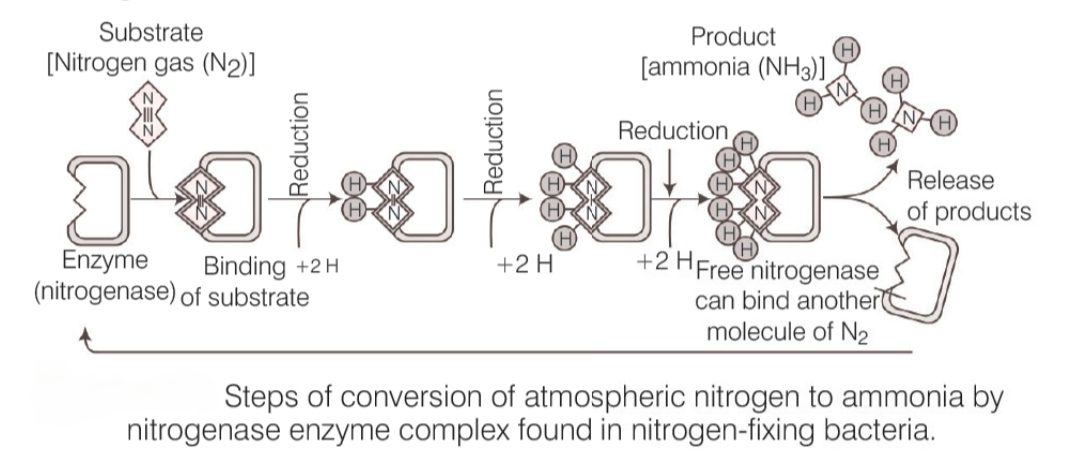
कुछ prokaryotic organisms ही N₂ को ammonia में reduce करने में सक्षम होते हैं। इस process को Biological Nitrogen Fixation कहते हैं।
Nitrogenase enzyme इस process को catalyse करता है और N₂ को NH₃ में convert करता है।
Equation: N₂ + 8H⁺ + 8e⁻ + 16 ATP → 2NH₃ + H₂ + 16 ADP + 16 Pi
Nitrogen Fixing Organisms
- Free-living nitrogen-fixing bacteria: उदाहरण – Azotobacter, Beijerinckia
- Symbiotic nitrogen-fixing bacteria: उदाहरण – Rhizobium (leguminous plants की roots में)
- Free-living nitrogen-fixing cyanobacteria: उदाहरण – Anabaena, Nostoc
Root Nodule Formation
Leguminous plants की roots में Rhizobium bacteria invade करके root hairs में infection thread बनाते हैं।
यह cortex तक पहुंचकर nodules develop कराते हैं।
Nodules में एक विशेष pigment Leghemoglobin होता है, जो oxygen को regulate करता है और nitrogenase enzyme को protect करता है।
Process of Nitrogen Fixation
- Entry of Rhizobium → Root hairs में infection thread बनाकर cortex तक पहुंचता है।
- Nodule formation → Cortical cells divide होकर root nodule बनाते हैं।
- Symbiotic association → Bacteria nodules में रहते हैं और nitrogen fixation करते हैं।
- Nitrogenase activity → N₂ को NH₃ में reduce करता है (ATP और reducing power के साथ)।
- Ammonia assimilation → NH₃ को amino acids में convert किया जाता है।
Fates of Ammonia
- Reductive Amination:
Ammonia, α-ketoglutaric acid के साथ react करके glutamate बनाता है।Equation: α-ketoglutaric acid + NH₃ + NADPH → Glutamate + H₂O + NADP⁺ - Transamination:
Amino group एक amino acid से दूसरे keto acid में transfer होता है।Example: Glutamic acid → Aspartic acid
Leghemoglobin nodules को pink रंग देता है और nitrogenase enzyme को oxygen से बचाता है, जिससे nitrogen fixation संभव हो पाता है।
MCQs – Mineral Nutrition
Q1. Which one of the following elements is not essential for plant growth?
Q2. The element essential for photolysis of water during photosynthesis is:
Q3. Nitrogen is a component of all the following except:
Q4. Which of the following is a micronutrient?
Q5. Deficiency of which element causes ‘whiptail’ disease in cauliflower?
Q6. Nitrification is carried out by:
Q7. Leg-haemoglobin present in root nodules is useful in:
Q8. Which one of the following is an example of a symbiotic nitrogen fixer?
Q9. The main role of magnesium in plants is in:
Q10. Which of the following is not a function of phosphorus in plants?
Read more about Mineral Nutrition:-
Read more chapters