
Photosynthesis in Higher Plants — उच्च पौधों में प्रकाश संश्लेषण
Photosynthesis वह biological प्रक्रिया है जिससे higher plants (ऊच्च पौधे) sunlight की energy को chemical energy में बदलते हैं। आसान भाषा में — पौधे सूरज की रोशनी, पानी और carbon dioxide लेकर glucose और oxygen बनाते हैं। यह न सिर्फ पौधों के growth और development के लिए जरूरी है, बल्कि पूरे ecosystem के लिए भी life-supporting है।
Key idea —
- Photosynthesis = Light energy → Chemical energy (glucose).
- मुख्य साइट: chloroplasts (chlorophyll वाले organelles)।
- सामान्य रूप से दो चरण: Light reactions (प्रकाश क्रियाएँ) और Calvin cycle / Dark reactions (कार्बन फिक्सेशन)।
- एरोबिक वातावरण में O2 release होता है — यह जीवन के लिए आवश्यक oxygen देता है।
इस chapter में हम समझेंगे — chloroplasts का structure, pigments (chlorophyll व accessory pigments), light और pigment interaction, absorption spectra, दो चरणों का biochemical विवरण (light reactions में ATP और NADPH कैसे बनते हैं; Calvin cycle में CO2 fixation कैसे होता है), और environmental factors (light intensity, CO2, temperature, water) जो photosynthesis को प्रभावित करते हैं। साथ ही C3, C4 और CAM pathway का comparative overview भी मिलेगा — practical importance और agricultural implications सहित।
पढ़ने का तरीका: पहले basic concepts और organelles clear कर लें, फिर step-by-step biochemical pathways पढ़ें — diagrams और labelled chloroplast images बहुत मदद करेंगे। अंत में environmental effects और adaptations (जैसे C4 व CAM plants) पर ध्यान दें — ये modern agriculture और climate response समझने में उपयोगी होंगे।
Half Leaf Experiment — आधा पत्ता प्रयोग
यह classic experiment सबसे पहले Sachs ने किया था ताकि यह prove किया जा सके कि CO2 is essential for photosynthesis.
इसमें पत्ते का आधा हिस्सा KOH solution (जो CO2 absorb कर लेता है) के contact में रखा जाता है और बाकी आधा atmosphere से CO2 ले सकता है।
Materials Required:
- Healthy green leaf (starch free condition में पहले keep करें)
- KOH (Potassium hydroxide) solution
- Split cork (पत्ते को आधा-आधा hold करने के लिए)
- Boiling water, alcohol (decolorization के लिए)
- Iodine solution (starch test के लिए)
Procedure (प्रक्रिया)
- Take a healthy potted plant और उसे dark में 24–48 hours रखें ताकि पत्तों से starch remove हो जाए।
- एक पत्ते को split cork में fix करें, ऐसा कि half leaf एक test tube में KOH solution के ऊपर हो (CO2 absorb हो जाएगी) और बाकी half बाहर normal air में रहे।
- Plant को sunlight में कुछ घंटों तक expose करें।
- Leaf को pluck करके उबालें (boiling water → stop metabolic activity, alcohol → remove chlorophyll)।
- अब iodine solution से test करें।
Observation (पर्यवेक्षण)
- Leaf का वह हिस्सा जो KOH solution के contact में था (CO2 नहीं मिली) → Iodine test में blue-black color नहीं देगा।
- Leaf का दूसरा हिस्सा जो open air में था (CO2 available थी) → Starch बनेगा और Iodine test में blue-black color दिखेगा।
Photosynthesis के लिए CO2 आवश्यक है।
जिस हिस्से को CO2 नहीं मिली उसमें starch नहीं बना, और दूसरे हिस्से में बना।
यह प्रयोग photosynthesis के fundamental requirements को समझने में बहुत महत्वपूर्ण है और exams में हमेशा पूछा जाता है।
Early Experiments
1. Joseph Priestley Experiment — जोसेफ प्रीस्टले का प्रयोग
Photosynthesis के discovery में Joseph Priestley (1771) का experiment बहुत महत्वपूर्ण है।
उन्होंने यह prove किया कि green plants produce oxygen और यह oxygen living organisms के survival के लिए essential है।
Materials Used:
- एक बंद glass jar (bell jar)
- जलती हुई मोमबत्ती (candle)
- एक चूहा (mouse)
- Green plant (पौधा)
Procedure (प्रक्रिया)
- Priestley ने एक closed jar में जलती हुई मोमबत्ती रखी। कुछ समय बाद candle बुझ गई → कारण: O2 समाप्त हो गई।
- फिर उन्होंने jar में एक mouse रखा। थोड़ी देर में mouse भी suffocate होकर मर गया → क्योंकि O2 खत्म हो गई।
- अब उन्होंने उसी setup में एक green plant रखा और इसे sunlight में रखा।
- कुछ समय बाद जब candle और mouse को फिर से jar में रखा गया, वे लंबे समय तक जीवित रहे।
Observation (पर्यवेक्षण)
- Without plant → candle बुझ गई और mouse मर गया।
- With green plant in sunlight → candle जलती रही और mouse जिंदा रहा।
Green plants purify the air by releasing oxygen in the presence of sunlight.
यह oxygen animals और human beings के respiration के लिए आवश्यक है।
इस तरह Priestley ने दिखाया कि plants और animals एक-दूसरे पर depend करते हैं।
Joseph Priestley का यह प्रयोग photosynthesis research की foundation है और हमें बताता है कि
“Plants are producers of oxygen, essential for life on Earth.”
2. Jan Ingenhousz Experiment — जान इनगेनहाउस का प्रयोग (1779)
Joseph Priestley ने prove किया था कि plants air को purify करके oxygen release करते हैं।
लेकिन Jan Ingenhousz ने 1779 में आगे research करके यह show किया कि
oxygen release केवल तभी होता है जब plant को sunlight मिले और केवल green parts ही oxygen release करते हैं।
Materials Used:
- Aquatic plant (जैसे Hydrilla)
- Beaker with water
- Inverted funnel & test tube
- Sunlight / dark setup
Procedure (प्रक्रिया)
- Ingenhousz ने एक aquatic plant को पानी से भरे beaker में रखा।
- Plant के ऊपर एक inverted funnel रखा और funnel की ट्यूब को water-filled test tube से connect किया।
- Setup को sunlight में रखा → test tube में bubbles collect होने लगे।
- जब उसी setup को dark में रखा गया → कोई bubbles नहीं बने।
- Collected gas को test किया गया → यह oxygen थी।
Observations (पर्यवेक्षण)
- Sunlight में bubbles release हुए → ये oxygen के थे।
- Dark में oxygen release नहीं हुआ।
- Oxygen release केवल green parts से हुआ।
Conclusion (निष्कर्ष):
- Sunlight is essential for photosynthesis.
- Only green parts of plants (chlorophyll containing) release oxygen.
- Plants not only purify air but also depend on light for this process.
Jan Ingenhousz का प्रयोग photosynthesis की light-dependency को prove करने वाला पहला scientific evidence था।
3. T.W. Engelmann Experiment (1843–1909)
TW Engelmann (1843–1909) ने prism का use करते हुए light को spectral components में अलग किया और फिर एक green algae Cladophora को illuminate किया, जिससे aerobic bacteria के suspension में रखा गया था।
Bacteria का उपयोग oxygen releasing site को पता लगाने के लिए किया गया था। Engelmann ने पाया कि bacteria मुख्य रूप से split spectrum के blue तथा red region में एकत्र हो गए थे।
इस तरह photosynthesis के first action spectrum को describe किया गया, यह chlorophyll-a और b के absorption spectra से मिलता-जुलता है।
19th Century Discoveries
19th century के मध्य तक plant photosynthesis के कई key features के बारे में पता चल चुका था जैसे कि पौधे CO2 तथा H2O से light की उपस्थिति में carbohydrate बनाते हैं।
CO2 + H2O → (Light) Cm(H2O)n + O2
यहाँ पर carbohydrate को प्रदर्शित करता है (e.g., Glucose six carbons का एक sugar है)।
Cornelius Bernardus van Niel (1897–1985)
A microbiologist, Cornelius Bernardus van Niel (1897–1985) ने experiment से photosynthesis को समझने में महत्त्वपूर्ण कार्य किया।
- Niel की study purple और green bacteria पर based थी।
- Niel ने दिखाया कि photosynthesis एक light dependent reaction है, जिसमें oxidisable compound से प्राप्त hydrogen, CO2 को carbohydrate में reduce कर देती है।
2H2A + CO2 → (Light) 2A + CH2O + H2O
- Green plants में H2O hydrogen donor है और यह oxidise होकर O2 देती है।
- कुछ organisms, photosynthesis के द्वारा O2 release नहीं करते हैं।
- Purple एवं green sulphur bacteria में hydrogen donor H2S होता है तथा organism के अनुसार इसका oxidation product sulphur या sulphate होता है।
बाद में radioisotopic techniques ने इसे prove किया।
Overall Equation of Photosynthesis
6CO2 + 12H2O → (Light) C6H12O6 + 6H2O + 6O2
इस प्रकार green plants में निकला हुआ oxygen, H2O से प्राप्त होती है न कि CO2 से।
यहाँ पर C6H12O6 glucose है तथा O2 water से release होती है जिसे radioisotope techniques से prove किया गया था।
Photosynthesis एक single reaction नहीं, बल्कि एक multi-step process है।
ऊपर दी गई equation में substrate के रूप में 12 molecule H2O का use क्यों करते हैं?
Where does Photosynthesis take place? — कहाँ और किस स्तर पर होता है प्रकाश संश्लेषण
Photosynthesis एक multi-level प्रक्रिया है — यह अलग-अलग स्तरों (organism → organ → tissue → cell → organelle → membrane) पर होती है। नीचे हर स्तर पर विस्तृत विवरण दिया गया है।
1. Organism level — कौन-कौन से organisms में होती है?
- Higher plants (ऊच्च पौधे): अधिकांश terrestrial plants— trees, shrubs, herbs में प्रमुख रूप से leaves photosynthesis करते हैं।
- Algae (शैवाल): aquatic environments में photosynthesis करते हैं (whole thallus या specialized cells)।
- Cyanobacteria (नियोबैक्टीरिया / blue-green algae): prokaryotic organisms — cell membrane और thylakoid-like membranes पर photosynthetic pigments और machinery होते हैं।
- Purple/green sulfur bacteria और other photosynthetic bacteria: कुछ bacteria H2S आदि donors का उपयोग करते हुए photosynthesis करते हैं (oxygen नहीं छोड़ते)।
2. Organ / tissue level — Plant parts where it mainly occurs
- Leaves (पत्ते): सबसे मुख्य site. Leaves का anatomy photosynthesis के लिए specially adapted होता है — thin, flattened structure to capture light, and large surface area for gas exchange.
- Green stems (हरे तने): कुछ plants में stems भी photosynthesise कर सकते हैं (e.g., cactus, young green stems)।
- Other green organs: green bracts, unripe fruits, sepals आदि में भी chloroplast मौजूद होते हैं और photosynthesis कर सकते हैं।
3. Leaf anatomy — किस tissue/cell में होता है?
Typical dorsiventral leaf में photosynthesis मुख्य रूप से mesophyll cells में होता है:
- Upper epidermis: transparent, light passes through — chloroplast कम होते हैं।
- Palisade mesophyll: tightly packed columnar cells, rich in chloroplasts — main site of light capture और primary photosynthesis in C3 plants.
- Spongy mesophyll: loosely arranged cells with air spaces — gas diffusion (CO2 movement) और chloroplasts भी होते हैं पर कम घनत्व में।
- Bundle sheath cells: vascular bundles के चारों ओर — C4 plants में यहाँ Calvin cycle सक्रिय रूप से होती है (spatial separation)।
- Stomata (guard cells): gas exchange के लिए aperture; guard cells में भी chloroplasts होते हैं पर सीमित मात्रा में।
4. Cellular / subcellular level — फोटोसिंथेसिस की सटीक साइट (chloroplast)
Chloroplast — Primary organelle of photosynthesis
Chloroplast एक double-membrane bound organelle है, जिसमें internal membrane system (thylakoids) और fluid-filled matrix (stroma) होता है।
Chloroplast structure (संरचना) — प्रमुख हिस्से
- Outer membrane: permeable to small molecules.
- Inner membrane: selective permeability; chloroplast envelope.
- Intermembrane space: between outer and inner membrane.
- Stroma: fluid matrix जहाँ Calvin cycle (carbon fixation) होता है; contains enzymes (Rubisco), DNA, ribosomes, starch grains.
- Thylakoid membranes: stacked (grana) and unstacked regions — जहाँ light reactions occur (pigments, photosystems, electron transport chain)।
- Grana (stack of thylakoids): stacked regions rich in Photosystem II (PSII) and light-harvesting complexes.
- Lamellae / stroma thylakoids: connect grana; Photosystem I (PSI) अधिकतर यहाँ पाया जाता है (unstacked)।
5. Biochemical localization — कौन से reactions कहाँ होते हैं?
| Reaction / Process | Location (Organelle / Subcompartment) | Key notes |
|---|---|---|
| Light reactions (Photochemical phase) | Thylakoid membranes (grana and lamellae) | Light energy → ATP (via photophosphorylation) + NADPH; water splitting (photolysis) at PSII releases O2. |
| Non-cyclic electron flow | Thylakoid membrane (PSII → Cyt b6f → PSI) | Produces ATP and NADPH; source of O2 is H2O. |
| Cyclic photophosphorylation | Thylakoid membrane (mainly PSI) | Produces ATP only (no NADPH, no O2); balances ATP/NADPH ratio. |
| Calvin cycle (Dark reactions / Carbon fixation) | Stroma of chloroplast | CO2 fixation via Rubisco, synthesis of triose phosphates → glucose. Uses ATP & NADPH from light reactions. |
| Photorespiration | Chloroplast (stroma), Peroxisome, Mitochondria | When Rubisco acts as oxygenase (O2 fixation) — leads to CO2 loss; multi-organelle pathway. |
6. Special cases: C3, C4 and CAM plants — site differences
- C3 plants (e.g., rice, wheat): CO2 fixation और Calvin cycle दोनों mesophyll cell में ही होते हैं (Rubisco directly fixes CO2 to 3-PGA). Photorespiration अधिक होता है under high O2/high temp.
- C4 plants (e.g., maize, sugarcane): Spatial separation — initial CO2 fixation by PEP carboxylase in mesophyll cells producing C4 acids → transported to bundle sheath cells where CO2 is released and Calvin cycle occurs (Rubisco). इससे photorespiration कम होता है और CO2 concentration Rubisco के पास high रहती है।
- CAM plants (e.g., cactus, Kalanchoe): Temporal separation — stomata रात में खुलते हैं, CO2 nocturnally fixed to malate (stored in vacuole) → daytime malate decarboxylated to provide CO2 for Calvin cycle in chloroplast stroma while stomata बंद रहते हैं।
7. Photosynthesis in prokaryotes (bacteria)
- Cyanobacteria: Lack chloroplasts (prokaryotic) पर उनके cell membrane और internal thylakoid-like membranes पर photosynthetic pigments और electron transport chain होते हैं — light reactions occur on these membranes और CO2 fixation in cytoplasm using Calvin-like enzymes.
- Purple/green bacteria: Different photosystems/pigments and often use H2S or organic compounds as electron donors (anoxygenic photosynthesis) — occurs on specialized intracytoplasmic membranes.
8. Cellular components & molecules involved (short list)
- Chlorophyll a, chlorophyll b, carotenoids — pigments located in thylakoid membranes (light harvesting complexes).
- Photosystems (PSII, PSI), Cytochrome b6f complex, ATP synthase — embedded in thylakoid membrane.
- Rubisco (Ribulose-1,5-bisphosphate carboxylase/oxygenase) — most abundant enzyme, located in stroma.
- Enzymes of Calvin cycle (e.g., phosphoglycerate kinase, glyceraldehyde-3-phosphate dehydrogenase) — in stroma.
9. Why thylakoid & stroma are ideal sites?
- Thylakoid membranes: Provide large surface area for embedding photosystems, electron carriers and ATP synthase; allow proton gradient formation in lumen for ATP synthesis.
- Stroma: Contains all enzymes, substrates (RuBP, NADPH, ATP) needed for CO2 fixation and carbohydrate synthesis; close proximity to thylakoid pores for metabolite exchange.
10. Practical / Exam points — short & precise
- Primary site of photosynthesis in higher plants = chloroplasts of mesophyll cells (especially palisade mesophyll).
- Light reactions = thylakoid membranes (grana); Calvin cycle = stroma.
- In C4 plants Calvin cycle mainly in bundle sheath cells (spatial separation).
- Cyanobacteria do photosynthesis on membrane systems inside prokaryotic cell (no chloroplasts).
- Photorespiration uses chloroplast, peroxisome and mitochondrion — multi-organelle pathway.
11. Summary (सारांश)
Photosynthesis primarily occurs in chloroplasts of mesophyll cells in leaves. Light dependent reactions occur on thylakoid membranes (grana) producing ATP, NADPH and O2 (from H2O), जबकि CO2 fixation (Calvin cycle) stroma में होती है। C4 और CAM plants में mechanisms spatial या temporal separation के जरिये photosynthetic efficiency बढ़ाते हैं। Cyanobacteria और other photosynthetic bacteria में यह whole-cell membrane systems पर होता है।
Photosynthesis Pigments (प्रकाशसंश्लेषण में रंगद्रव्य)
Photosynthesis में पौधों के chloroplast में अलग-अलग pigments होते हैं जो सूर्य की रोशनी को absorb करके energy में convert करते हैं। इन pigments की मदद से plants sunlight की अलग-अलग wavelength को absorb कर पाते हैं।
1. Chlorophylls (हरित रंगद्रव्य)
ये मुख्य pigments हैं जो light energy को capture करते हैं।
- Chlorophyll a: Primary pigment, नीले- बैंगनी और लाल light को absorb करता है। Photosynthesis में मुख्य भूमिका।
- Chlorophyll b: Accessory pigment, नीले और लाल-नारंगी light को absorb करता है। Chlorophyll a की मदद करता है।
2. Carotenoids (सहायक पिगमेंट)
ये pigments mainly light protection और accessory light absorption के लिए काम आते हैं।
- Carotene: Orange रंग का pigment, नीली और हरी light absorb करता है।
- Xanthophyll: Yellow रंग का pigment, मुख्य रूप से नीली light absorb करता है।
3. Phycobilins (कुछ algae में पाए जाने वाले pigments)
- Phycoerythrin: Red pigment, हरी light absorb करता है।
- Phycocyanin: Blue pigment, लाल और नारंगी light absorb करता है।
Higher Plants में मुख्य pigments: 4 (Chlorophyll a, Chlorophyll b, Carotene, Xanthophyll)
Key Points:
- Chlorophyll a → Main pigment for light absorption.
- Chlorophyll b, Carotenoids → Accessory pigments, light harvesting में मदद।
- Phycobilins → Mostly red algae और cyanobacteria में पाए जाते हैं।
- सभी pigments together sunlight की अलग-अलग wavelength को capture कर photosynthesis process चलाते हैं।
Photosynthetic Pigments (प्रकाशसंश्लेषण के रंगद्रव्य)
| Pigment / रंगद्रव्य | Type / प्रकार | Color / रंग | Light Absorbed / अवशोषित प्रकाश | Remarks / टिप्पणी |
|---|---|---|---|---|
| Chlorophyll a | Chlorophyll | Green | Blue-violet & Red | Main pigment, Photosynthesis का मुख्य pigment |
| Chlorophyll b | Chlorophyll | Green | Blue & Red-orange | Accessory pigment, Chlorophyll a को help करता है |
| Carotene | Carotenoid | Orange | Blue & Green | Accessory pigment, light harvesting & protection |
| Xanthophyll | Carotenoid | Yellow | Blue | Accessory pigment, mainly blue light absorb करता है |
| Phycoerythrin | Phycobilin | Red | Green | Mostly red algae में पाया जाता है |
| Phycocyanin | Phycobilin | Blue | Orange & Red | Mostly cyanobacteria में पाया जाता है |
Electron Transport Chain (ETC) in Photosynthesis – इलेक्ट्रॉन परिवहन श्रृंखला
Electron Transport Chain (ETC) photosynthesis और respiration का मुख्य process है जिसमें high-energy electrons का transfer होता है ताकि ATP और NADPH का निर्माण हो सके। Higher plants में यह process chloroplast के thylakoid membrane में होता है।
1. Overview / परिचय
Photosynthesis में ETC मुख्य रूप से Light Reaction के दौरान active होता है। Sunlight energy chlorophyll द्वारा absorb होती है और electrons excited होकर primary electron acceptor को pass होते हैं। इसके बाद electrons एक series of protein complexes और carriers के माध्यम से transfer होते हैं।
2. Key Components / मुख्य घटक
- Photosystem II (PS II / P680): Light energy absorb करता है। Water molecule split होता है (photolysis) → O₂ release + H⁺ ions + electrons।
- Plastoquinone (PQ): Lipid-soluble electron carrier जो PS II से Cytochrome b6f complex तक electrons transfer करता है।
- Cytochrome b6f complex: Proton gradient बनाने में मदद करता है। Electrons को Plastocyanin (PC) तक ले जाता है।
- Plastocyanin (PC): Copper-containing protein, electrons को PS I तक transfer करता है।
- Photosystem I (PS I / P700): Light energy absorb करके electrons को high-energy state में excite करता है।
- Ferredoxin (Fd): Small iron-sulfur protein, electrons को NADP⁺ तक transfer करता है।
- NADP⁺ Reductase: Electrons को NADP⁺ पर transfer करके NADPH बनाता है।
3. Steps / प्रक्रिया
- Light absorbed by PS II excites electrons → Primary electron acceptor को pass होते हैं।
- Water molecules split (Photolysis) → 2H₂O → 4H⁺ + 4e⁻ + O₂.
- Electrons move through PQ → Cytochrome b6f complex → PC → PS I.
- PS I absorbs light → electrons excited → transferred to Ferredoxin.
- Ferredoxin transfers electrons to NADP⁺ → Formation of NADPH (NADP⁺ + H⁺ + 2e⁻ → NADPH).
- Proton gradient across thylakoid membrane drives ATP synthase → ATP synthesis (Photophosphorylation).
4. Types of Electron Flow / इलेक्ट्रॉन प्रवाह के प्रकार
- Non-cyclic electron flow: Electrons from water → NADPH, O₂ release, ATP formed. Main process in light reaction.
- Cyclic electron flow: Only PS I involved → electrons cycle back → ATP formed but no NADPH or O₂.
5. Summary Table / सारणी
| Component | Function | Products |
|---|---|---|
| PS II (P680) | Light energy capture, water splitting | O₂, H⁺, electrons |
| Plastoquinone (PQ) | Electron carrier from PS II to Cytochrome b6f | – |
| Cytochrome b6f complex | Electron transfer, proton pumping | Proton gradient |
| Plastocyanin (PC) | Electron carrier to PS I | – |
| PS I (P700) | Light absorption, electron excitation | High-energy electrons |
| Ferredoxin (Fd) | Electron carrier to NADP⁺ | – |
| NADP⁺ Reductase | Reduction of NADP⁺ to NADPH | NADPH |
| ATP Synthase | Proton gradient drives ATP formation | ATP |
Key Points: Electron Transport Chain provides energy for ATP & NADPH formation, which are used in Calvin Cycle for carbon fixation. O₂ is released as a by-product from water photolysis.
Splitting of Water (Photolysis of Water) – जल का विघटन
Photosynthesis के Light Reaction में Photosystem II (PS II / P680) sunlight energy का उपयोग करके water molecules को split करता है। इसे Photolysis of Water कहा जाता है। इस process से O₂ release, H⁺ ions और electrons मिलते हैं।
1. Importance / महत्व
- Provides electrons to replace those lost by PS II chlorophyll.
- Generates H⁺ ions → contribute to proton gradient for ATP synthesis.
- Releases O₂ as a by-product → essential for atmosphere and respiration.
2. Site / स्थान
Thylakoid membrane, specifically PS II complex में होता है।
3. Reaction / रासायनिक प्रक्रिया
| Process / प्रक्रिया | Equation / समीकरण | Products / उत्पाद |
|---|---|---|
| Photolysis of Water | 2 H₂O → 4 H⁺ + 4 e⁻ + O₂ | Electrons → PS II H⁺ ions → Thylakoid lumen (ATP formation) O₂ → Released in atmosphere |
4. Stepwise Mechanism / चरणबद्ध प्रक्रिया
- Sunlight absorbed by PS II → Excites electrons in P680 chlorophyll.
- Electrons lost by P680 replaced by electrons from water.
- Water molecule splits → 2H₂O → 4H⁺ + 4e⁻ + O₂.
- H⁺ ions contribute to proton gradient → ATP synthesis via ATP synthase.
- Oxygen released as by-product.
5. Key Points / मुख्य बिंदु
- Photolysis occurs only in presence of light → Light-dependent reaction.
- Essential for non-cyclic electron flow in Photosynthesis.
- Maintains the supply of electrons for electron transport chain.
Cyclic & Non-Cyclic Photophosphorylation – प्रकाश संचारण के प्रकार
Photosynthesis की Light Reaction में ATP का निर्माण होता है। इस process को Photophosphorylation कहते हैं। यह दो प्रकार की होती है:
1. Cyclic Photophosphorylation (सायक्लिक प्रकाश संश्लेषण)
- Only Photosystem I (PS I / P700) involved।
- Electrons cycle back → Electron Transport Chain में पुनः PS I में आते हैं।
- ATP बनता है, लेकिन NADPH नहीं बनता।
- No oxygen is released।
- Occurs under low NADPH requirement or high ATP demand।
2. Non-Cyclic Photophosphorylation (नॉन-सायक्लिक प्रकाश संश्लेषण)
- Both PS II (P680) और PS I (P700) involved।
- Electrons move from water → PS II → PQ → Cytochrome b6f → PC → PS I → Ferredoxin → NADP⁺ → NADPH formation।
- ATP और NADPH दोनों बनते हैं।
- Water split होती है → O₂ released।
- Main process in light reaction for Calvin Cycle.
3. Comparison Table / तुलना सारणी
| Feature | Cyclic Photophosphorylation | Non-Cyclic Photophosphorylation |
|---|---|---|
| Photosystem Involved | PS I only (P700) | Both PS II (P680) and PS I (P700) |
| Electrons Flow | Electrons cycle back to PS I | Electrons move from water → PS II → PS I → NADP⁺ |
| Products | ATP only | ATP + NADPH |
| Oxygen Release | No | Yes, from photolysis of water |
| Purpose | ATP generation when NADPH not required | ATP & NADPH generation for Calvin Cycle |
4. Key Points / मुख्य बिंदु
- Cyclic → Electron returns to same photosystem; Non-Cyclic → Electron does not return.
- Non-Cyclic produces O₂ from water splitting; Cyclic does not.
- ATP generated in both; NADPH only in Non-Cyclic.
Chemi-osmotic Hypothesis – रासायनिक-आस्मिक सिद्धांत
Chemi-osmotic Hypothesis, Peter Mitchell (1961) द्वारा प्रस्तुत किया गया था, जो बताता है कि ATP synthesis किस तरह proton gradient (H⁺ gradient) के द्वारा होती है। यह hypothesis photosynthesis और respiration दोनों में लागू होती है।
1. Concept / सिद्धांत
इस hypothesis के अनुसार, electron transport chain (ETC) के दौरान electrons की movement के साथ protons (H⁺ ions) thylakoid lumen या mitochondrial intermembrane space में pump होते हैं। इससे proton gradient बनता है। Proton gradient → potential energy के रूप में stored होता है जिसे ATP synthase enzyme के माध्यम से chemical energy (ATP) में convert किया जाता है।
2. Steps / प्रक्रिया
- Light reaction में PS II और PS I के माध्यम से electrons excited होते हैं।
- Electrons ETC के माध्यम से transfer होते हैं → energy release होती है।
- Released energy का उपयोग करके H⁺ ions thylakoid lumen में pump होते हैं।
- H⁺ gradient बनता है (high H⁺ inside lumen, low H⁺ in stroma)।
- ATP synthase enzyme के द्वारा H⁺ ions stroma में वापस आते हैं।
- Flow of H⁺ ions के साथ ADP + Pi → ATP बनता है (Photophosphorylation)।
3. Key Points / मुख्य बिंदु
- ATP synthesis directly depends on proton gradient, not directly on electron energy।
- Explains mechanism of photophosphorylation in chloroplasts और oxidative phosphorylation in mitochondria।
- Supports idea कि chemical energy of ATP comes from movement of ions across a membrane (chemi-osmosis)।
4. Diagrammatic Summary / सारणी
| Process | Details / विवरण |
|---|---|
| Electron Flow | Electrons move through ETC (PS II → PS I → NADP⁺) |
| Proton Pumping | H⁺ ions pumped into thylakoid lumen creating high concentration |
| Proton Gradient | High H⁺ inside lumen, low H⁺ in stroma → Potential energy |
| ATP Synthesis | H⁺ ions flow back through ATP synthase → ADP + Pi → ATP |
| O₂ Production | From photolysis of water in PS II |
Use of ATP and NADPH – ATP और NADPH का उपयोग
Light Reaction में बने ATP और NADPH का उपयोग Calvin Cycle / Dark Reaction में होता है। यह cycle stroma of chloroplast में होती है और CO₂ को glucose में convert करती है।
1. Role of ATP / ATP की भूमिका
- ATP provides energy for the fixation of CO₂ into 3-phosphoglycerate (3-PGA)।
- Energy required for conversion of 3-PGA → G3P (Glyceraldehyde-3-phosphate)।
- ATP used in regeneration of Ribulose-1,5-bisphosphate (RuBP) for continuation of the cycle।
2. Role of NADPH / NADPH की भूमिका
- NADPH provides reducing power (electrons + H⁺) to convert 3-PGA into G3P।
- It reduces carbon intermediates → Formation of glucose and other carbohydrates।
3. Summary Table / सारणी
| Molecule | Function / कार्य | Where Used / उपयोग स्थान |
|---|---|---|
| ATP | Energy source for CO₂ fixation, 3-PGA → G3P conversion, RuBP regeneration | Calvin Cycle (Stroma) |
| NADPH | Provides electrons and H⁺ for reduction of 3-PGA → G3P | Calvin Cycle (Stroma) |
4. Key Points / मुख्य बिंदु
- ATP = Energy currency → fuels endergonic reactions in Calvin Cycle।
- NADPH = Reducing agent → provides H⁺ and electrons for carbohydrate synthesis।
- Both are produced in Light Reaction and consumed in Dark Reaction.
Primary Acceptor of CO₂ – CO₂ का प्राथमिक स्वीकारक
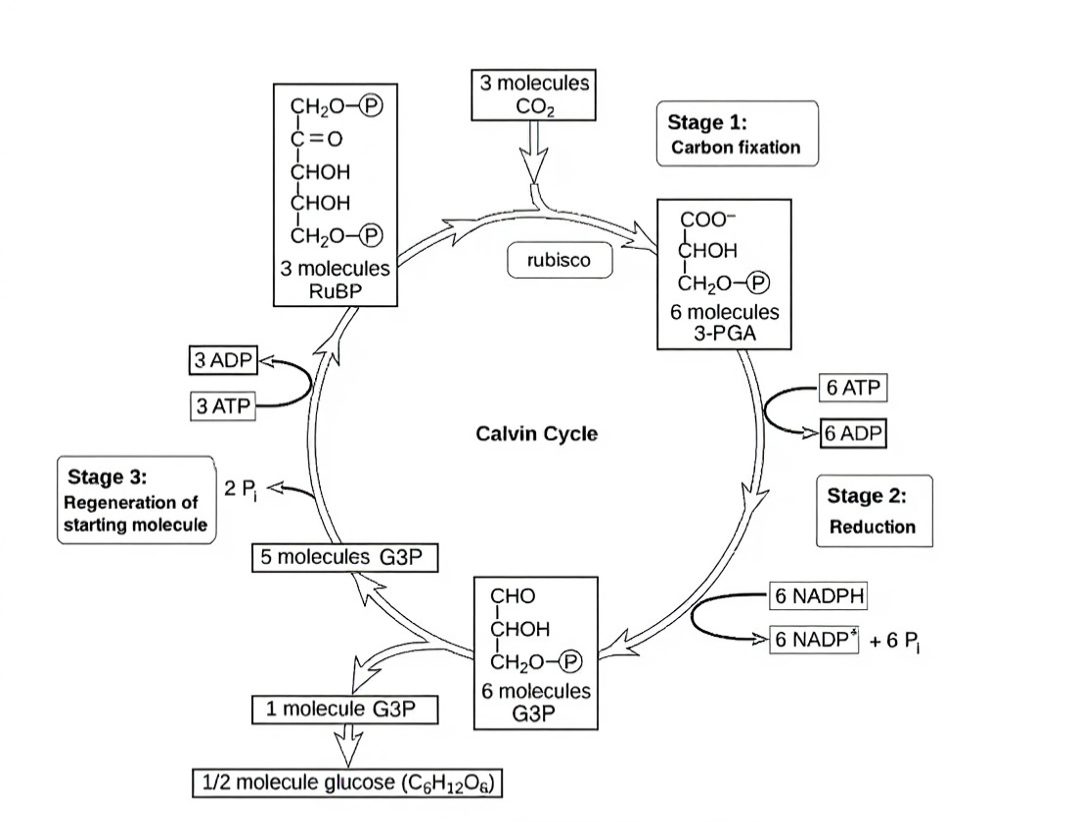
Photosynthesis की Calvin Cycle / Dark Reaction में CO₂ fixation के लिए सबसे पहला acceptor molecule होता है Ribulose-1,5-bisphosphate (RuBP)। यह 5-carbon sugar molecule होता है।
1. Reaction / प्रक्रिया
CO₂ + RuBP → [Enzyme: Rubisco] → 2 molecules of 3-Phosphoglycerate (3-PGA)
- RuBP: 5-carbon sugar, primary CO₂ acceptor
- Rubisco: Enzyme catalyzing CO₂ fixation
- Each CO₂ molecule fixed produces 2 molecules of 3-PGA (3-Phosphoglycerate)
2. Key Points / मुख्य बिंदु
- Primary acceptor = Ribulose-1,5-bisphosphate (RuBP)
- Reaction catalyzed by Rubisco, the most abundant enzyme on Earth
- CO₂ fixation is the first step of Calvin Cycle leading to carbohydrate synthesis
Calvin Cycle – प्रकाश-निर्भर नहीं प्रतिक्रियाएँ (Dark Reaction)
Calvin Cycle chloroplast के stroma में होती है और यह CO₂ को glucose और अन्य carbohydrates में convert करती है। यह cycle ATP और NADPH का उपयोग करती है जो Light Reaction में बनते हैं।
1. Main Phases / मुख्य चरण
A. Carbon Fixation / CO₂ का स्थिरीकरण
- CO₂ molecule को 5-carbon sugar Ribulose-1,5-bisphosphate (RuBP) के साथ combine किया जाता है।
- Enzyme Rubisco catalyzes reaction।
- Product → 2 molecules of 3-Phosphoglycerate (3-PGA)
B. Reduction Phase / अपचयन चरण
- 3-PGA molecules convert होते हैं Glyceraldehyde-3-phosphate (G3P) में।
- इस process के लिए ATP और NADPH का उपयोग होता है।
- G3P = 3-carbon sugar, यह glucose और other carbohydrates बनाने में प्रयोग होता है।
C. Regeneration of RuBP / RuBP का पुनर्निर्माण
- कुछ G3P molecules regenerate करते हैं RuBP ताकि cycle continue हो सके।
- इसके लिए भी ATP की आवश्यकता होती है।
2. Summary Table / सारणी
| Phase | Reactants / अभिकर्मक | Products / उत्पाद | Energy Source / ऊर्जा स्रोत |
|---|---|---|---|
| Carbon Fixation | CO₂ + RuBP | 2 × 3-PGA | Rubisco enzyme |
| Reduction | 3-PGA | G3P | ATP + NADPH |
| Regeneration | G3P molecules | RuBP | ATP |
3. Key Points / मुख्य बिंदु
- Calvin Cycle occurs in stroma of chloroplast.
- Uses ATP and NADPH from Light Reaction.
- Primary CO₂ acceptor = RuBP, catalyzed by Rubisco.
- G3P → Glucose, starch, sucrose, and other carbohydrates formation.
- Cycle ensures continuous regeneration of RuBP for CO₂ fixation.
C₄ Pathway (Hatch-Slack Pathway) – C4 कार्बन संश्लेषण मार्ग
C₄ plants (जैसे Zea mays, Saccharum officinarum, Sorghum) में CO₂ fixation Calvin Cycle से पहले एक अलग pathway से होता है, जिसे Hatch-Slack Pathway कहते हैं। यह pathway मुख्य रूप से **hot and dry conditions** में photosynthesis efficiency बढ़ाने के लिए विकसित हुआ है।
1. Key Features / मुख्य विशेषताएँ
- Occurs in mesophyll cells and bundle sheath cells.
- Initial CO₂ fixation → 4-carbon compound → transported to bundle sheath cells.
- Minimizes photorespiration → High efficiency under high temperature and light.
- Uses enzyme PEP carboxylase for initial CO₂ fixation.
2. Steps / चरण
- CO₂ fixation in mesophyll cells: CO₂ + Phosphoenolpyruvate (PEP) → Oxaloacetate (OAA, 4-carbon)
- Conversion: OAA → Malate (or Aspartate)
- Transport: Malate/Aspartate moves to bundle sheath cells
- Decarboxylation: Malate releases CO₂ → Calvin Cycle in bundle sheath cells
- Return: Pyruvate returns to mesophyll → converted to PEP using ATP
3. Summary Table / सारणी
| Step / चरण | Location / स्थान | Reactants / अभिकर्मक | Products / उत्पाद | Enzyme / एंज़ाइम |
|---|---|---|---|---|
| Initial CO₂ Fixation | Mesophyll Cells | CO₂ + PEP | Oxaloacetate (OAA) | PEP Carboxylase |
| Conversion | Mesophyll Cells | OAA | Malate or Aspartate | Malate Dehydrogenase |
| Transport | Mesophyll → Bundle Sheath Cells | Malate/Aspartate | Malate/Aspartate | – |
| Decarboxylation | Bundle Sheath Cells | Malate | CO₂ + Pyruvate | Malic Enzyme |
| Calvin Cycle | Bundle Sheath Cells | CO₂ + RuBP | 3-PGA → G3P → Glucose | Rubisco |
| PEP Regeneration | Mesophyll Cells | Pyruvate + ATP | PEP | Pyruvate Phosphate Dikinase |
4. Key Points / मुख्य बिंदु
- C₄ plants → Adapted to high temperature, intense light, and drought.
- Minimizes photorespiration → More efficient CO₂ fixation than C₃ plants.
- Spatial separation: Mesophyll (initial fixation) & Bundle sheath (Calvin Cycle).
- PEP carboxylase has high affinity for CO₂ → effective under low CO₂.
Photorespiration – प्रकाश-श्वसन
Photorespiration वह प्रक्रिया है जिसमें oxygen (O₂) RuBP के साथ react करता है, जिससे CO₂ release होती है और ATP/NADPH का नुकसान होता है। यह मुख्य रूप से C₃ plants में होती है और photosynthesis efficiency कम कर देती है।
1. Occurrence / स्थान
- Occurs in chloroplast, peroxisome, mitochondria in mesophyll cells.
- Triggered by high O₂ concentration, high temperature, and low CO₂ availability.
2. Process / प्रक्रिया
- O₂ competes with CO₂ for the enzyme Rubisco.
- Rubisco catalyzes O₂ + RuBP → 1 molecule 3-PGA + 1 molecule 2-phosphoglycolate (2-PG).
- 2-PG converted to glycolate → transported to peroxisome → converted to glycine.
- In mitochondria, 2 glycine → 1 serine + CO₂ + NH₃ (ammonia).
- Serine transported back to peroxisome → converted to glycerate → re-enters chloroplast → phosphorylated to 3-PGA.
3. Summary Table / सारणी
| Step / चरण | Location / स्थान | Reactants / अभिकर्मक | Products / उत्पाद | Notes / टिप्पणी |
|---|---|---|---|---|
| O₂ Fixation | Chloroplast | O₂ + RuBP | 3-PGA + 2-Phosphoglycolate (2-PG) | Rubisco enzyme → competes with CO₂ |
| Conversion to Glycine | Peroxisome | 2-PG | Glycine | Transported to mitochondria |
| Decarboxylation | Mitochondria | 2 Glycine | Serine + CO₂ + NH₃ | CO₂ lost → reduces photosynthetic efficiency |
| Return to 3-PGA | Peroxisome & Chloroplast | Serine | 3-PGA | Re-enters Calvin Cycle |
4. Key Points / मुख्य बिंदु
- Occurs in C₃ plants, especially under hot and dry conditions.
- Consumes O₂ and releases CO₂ → reduces photosynthetic efficiency.
- ATP and NADPH are consumed without producing sugars.
- C₄ and CAM plants minimize photorespiration using CO₂ concentration mechanisms.
C₃ vs C₄ vs CAM Plants – Plants Photosynthesis Comparison
Photosynthesis के तीन प्रमुख प्रकार के plants होते हैं: C₃, C₄ और CAM plants. इनका मुख्य अंतर CO₂ fixation, adaptation और efficiency में होता है।
1. Summary Table / सारणी
| Feature / विशेषता | C₃ Plants | C₄ Plants | CAM Plants |
|---|---|---|---|
| Primary CO₂ Acceptor / प्राथमिक CO₂ स्वीकारक | RuBP (Ribulose-1,5-bisphosphate) | PEP (Phosphoenolpyruvate) | PEP (Phosphoenolpyruvate) |
| Initial CO₂ Fixation Product / प्रारंभिक उत्पाद | 3-PGA (3-Phosphoglycerate, 3-carbon) | Oxaloacetate / Malate (4-carbon) | Malate (4-carbon, stored in vacuole) |
| Enzyme for CO₂ Fixation / CO₂ संश्लेषण के लिए एंज़ाइम | Rubisco | PEP Carboxylase | PEP Carboxylase (Night) |
| Site of Initial Fixation / प्रारंभिक CO₂ fixation का स्थान | Mesophyll cells | Mesophyll cells | Mesophyll cells (at night) |
| Calvin Cycle Site / कैल्विन चक्र का स्थान | Mesophyll cells | Bundle Sheath cells | Mesophyll cells (daytime) |
| Time of CO₂ Fixation / CO₂ fixation का समय | Daytime | Daytime | Nighttime (CO₂ stored as malate) |
| Water Loss / जल ह्रास | High (stomata open during day) | Low to moderate (efficient CO₂ fixation) | Very low (stomata open at night) |
| Adaptation / अनुकूलन | Cool, moist, temperate climates | Hot, sunny, tropical climates | Arid, desert conditions |
| Photorespiration / प्रकाश-श्वसन | High | Low | Very low |
| Examples / उदाहरण | Wheat, Rice, Barley, Soybean | Maize, Sugarcane, Sorghum, Amaranthus | Pineapple, Cactus, Opuntia, Aloe |
2. Key Points / मुख्य बिंदु
- C₃ Plants → Most common, simple Calvin Cycle, prone to photorespiration.
- C₄ Plants → Spatial separation: Mesophyll (CO₂ fixation) & Bundle sheath (Calvin Cycle), high efficiency under high temperature.
- CAM Plants → Temporal separation: CO₂ fixed at night, Calvin Cycle during day, minimizes water loss.
- Photorespiration is highest in C₃, lower in C₄, almost absent in CAM plants.
- Water use efficiency: CAM > C₄ > C₃
Factors Affecting Photosynthesis – प्रकाश संश्लेषण को प्रभावित करने वाले कारक
Photosynthesis की दर (Rate of Photosynthesis) कई environmental और internal factors पर निर्भर करती है।
1. Light / प्रकाश
- Intensity (तेज़ी) और Quality (रंग/ wavelength) of light affect photosynthesis.
- Low light → Rate decreases; Saturation point → Maximum rate reached.
- Red and Blue light most effective; Green light least effective.
2. Carbon Dioxide (CO₂) Concentration
- CO₂ is substrate for Calvin Cycle.
- Low CO₂ → Rate decreases; High CO₂ → Rate increases until saturation.
- Excess CO₂ has little effect once enzyme active sites are saturated.
3. Temperature / तापमान
- Photosynthesis is enzyme-mediated → temperature sensitive.
- Low temperature → Enzyme activity slow → Rate decreases.
- Optimal temperature → Maximum rate.
- Very high temperature → Denaturation of enzymes → Rate decreases.
4. Water / जल
- Water is source of electrons in photolysis → essential for light reaction.
- Water deficiency → Stomata close → CO₂ intake reduced → Rate decreases.
5. Oxygen / O₂ Concentration
- High O₂ → Competes with CO₂ for Rubisco → Increases photorespiration → Reduces net photosynthesis.
6. Minerals / Nutrients
- Nitrogen, Magnesium, Iron, Phosphorus → Essential for chlorophyll synthesis and enzyme activity.
- Deficiency → Reduced photosynthetic efficiency.
7. Summary Table / सारणी
| Factor / कारक | Effect on Photosynthesis / प्रभाव | Remarks / टिप्पणी |
|---|---|---|
| Light Intensity & Quality | Rate increases with light up to saturation | Red & Blue light most effective |
| CO₂ Concentration | Rate increases with CO₂ up to saturation | Excess CO₂ has little effect |
| Temperature | Rate optimal at moderate temperature | Very high or low temperature reduces rate |
| Water Availability | Essential for photolysis and electron supply | Deficiency → Stomata close → Rate decreases |
| Oxygen Concentration | High O₂ → Increases photorespiration → reduces net rate | Particularly affects C₃ plants |
| Minerals / Nutrients | Required for chlorophyll & enzymes | Deficiency reduces photosynthetic efficiency |
8. Key Points / मुख्य बिंदु
- Photosynthesis depends on both environmental (light, temperature, CO₂, water, O₂) and internal factors (chlorophyll, enzymes, minerals).
- Limiting factor concept → Rate is controlled by factor in shortest supply.
- C₃ plants are more sensitive to high O₂ and low CO₂ compared to C₄ and CAM plants.
Read more about Photosynthesis Chapter
- National Geographic – Photosynthesis
- Khan Academy – Introduction to Photosynthesis
- HHMI BioInteractive – Photosynthesis Animations
- University of Illinois – Photosynthesis Resources
- SAPS – Photosynthesis: A Survival Guide for Teachers
- ePathshala – NCERT Educational Resources
Read more chapters