
Transport in Plants
Plants में भी animals की तरह transport system की आवश्यकता होती है।
Roots soil से water और minerals absorb करती हैं और leaves में photosynthesis से बना हुआ food (sucrose)
पूरे plant body में पहुँचता है।
Animals की तरह plants में heart या blood circulation नहीं होता।
इसलिए plants में transport simple physical processes और special tissues के द्वारा होता है – जैसे:
Diffusion, Osmosis, Facilitated Diffusion, Active Transport और Bulk Flow.
Fact: बहुत ऊँचे पेड़ (जैसे Redwood – 100 m से भी ज्यादा) में भी roots से पानी leaves तक पहुँचता है।
यह process Transpiration Pull के कारण संभव होता है।
इस chapter में हम study करेंगे:
- Different means of transport in plants
- Xylem और Phloem की structure और function
- Diffusion, Osmosis, Active Transport जैसे processes
- Transpiration और Pressure Flow Hypothesis
Tall plants में water कैसे top तक पहुँचता है?
Substances एक cell से दूसरे cell में क्यों move करते हैं?
क्या सभी substances समान तरीके से और एक ही direction में move होते हैं?
क्या इस movement के लिए हमेशा metabolic energy की आवश्यकता होती है?
ये सभी सवाल इस chapter की शुरुआत में naturally आते हैं।
Plants को animals की तरह कोई circulatory system नहीं होता है, फिर भी उन्हें long-distance transport करना पड़ता है।
Root द्वारा absorbed water पूरे stem की tip तक और leaves द्वारा बनाया गया food पूरे plant body (including root tips) तक पहुँचता है।
इसी तरह hormones और growth regulators भी एक part से दूसरे तक travel करते हैं।
Short-distance transport: Cell के अंदर, membrane के across, या एक cell से दूसरे cell तक का movement।
Long-distance transport: पूरे plant body में vascular system (xylem & phloem) द्वारा होने वाला transport, जिसे translocation कहा जाता है।
Direction of Transport:
- Xylem: Water और minerals का unidirectional transport – root से stem और leaves तक।
- Phloem: Food (organic nutrients) का multidirectional transport – leaves से पूरे plant body तक और storage organs से re-export भी।
- Mineral nutrients: Roots → stem & leaves → growing regions तक।
- Senescence: Old parts से nutrients withdraw होकर new/growing parts तक जाते हैं।
- Hormones/Regulators: कुछ strictly polarised manner (unidirectional) में transport होते हैं।
Plants में एक complex और orderly transport system होता है, जिसमें हर organ substances को receive भी करता है और दूसरे parts को send भी करता है।
इसे समझने के लिए plant cells और उनकी anatomy का study करना ज़रूरी है।
Means of Transport in Plants
पौधों में पदार्थों (substances) का परिवहन दो प्रकार से होता है:
1. Short distance transport – एक cell से दूसरी cell तक।
2. Long distance transport – पूरे पौधे के अंगों के बीच।
Diffusion
Diffusion एक passive process है, जिसमें molecules अपनी
higher concentration वाली जगह से
lower concentration वाली जगह की ओर जाते हैं।
- यह energy (ATP) का उपयोग नहीं करता।
- Gas molecules (O2, CO2) और छोटे solutes diffusion द्वारा transport होते हैं।
- Diffusion cell membrane के पार भी हो सकता है।
- यह slow process है और केवल short distances के लिए effective होता है।
Factors Affecting Diffusion
- Concentration Gradient – Gradient जितना अधिक होगा, diffusion उतना तेज होगा।
- Permeability of Membrane – Semi-permeable membrane diffusion को नियंत्रित करता है।
- Temperature – High temperature diffusion की दर बढ़ा देता है।
- Molecular Size – छोटे molecules जल्दी diffuse होते हैं।
Facilitated Diffusion
Facilitated diffusion एक passive transport प्रक्रिया है, जिसमें
transport proteins (carrier proteins या channel proteins)
molecules को cell membrane के पार move करने में मदद करते हैं।
यह प्रक्रिया energy (ATP) का उपयोग नहीं करती।
Key Features
- यह high concentration से low concentration की ओर molecules को transport करता है।
- Transport proteins molecules की movement को तेज और specific बनाते हैं।
- ATP की आवश्यकता नहीं होती (passive process)।
- Polar molecules और ions के लिए आवश्यक है, जैसे – glucose, amino acids, Na+, K+, Cl–।
- Simple diffusion की तुलना में यह process कहीं अधिक तेज होती है।
Types of Facilitated Diffusion
- Channel proteins – Specific ions के लिए pores बनाते हैं (जैसे Na+, K+)।
- Carrier proteins – Molecule को bind करके conformational change से transport करते हैं (जैसे glucose transport)।
Characteristics
- Highly Specific – हर transport protein केवल कुछ molecules को ही allow करता है।
- Saturation Effect – Protein carriers की संख्या limited होती है, इसलिए ज्यादा molecules आने पर transport rate स्थिर हो जाता है।
- Competition – समान molecules transport के लिए आपस में compete कर सकते हैं।
- Faster than Simple Diffusion – क्योंकि इसमें helper proteins शामिल होते हैं।
Passive Transport: Symport और Antiport
Passive transport वह प्रक्रिया है जिसमें molecules बिना ATP energy खर्च किए
cell membrane के पार move करते हैं।
इस transport को proteins facilitate कर सकते हैं। इसमें कुछ खास modes होते हैं जैसे –
Symport, Antiport और Uniport।
1. Symport (साइमपोर्ट)
- इसमें दो molecules/ions एक ही direction में transport होते हैं।
- Transport proteins दोनों को साथ में carry करते हैं।
- Example – Glucose और Na+ का intestinal absorption।
2. Antiport (एंटीपोर्ट)
- इसमें दो molecules/ions opposite directions में transport होते हैं।
- एक molecule अंदर जाता है तो दूसरा बाहर निकलता है।
- Example – Na+/H+ exchanger और Na+/K+ pump (हालाँकि pump active transport है)।
Difference Between Symport and Antiport
| Feature | Symport | Antiport |
|---|---|---|
| Direction | Same direction | Opposite direction |
| Molecule Relation | दोनों molecules साथ में move करते हैं | एक अंदर, दूसरा बाहर |
| Example | Na+ और Glucose co-transport | Na+/H+ exchanger |
Comparison of Different Transport Processes
| Transport Process | Energy Requirement | Direction of Movement | Protein Involved | Example |
|---|---|---|---|---|
| Diffusion | No (Passive) | High → Low concentration | Not required | O2, CO2 diffusion |
| Facilitated Diffusion | No (Passive) | High → Low concentration | Carrier/Channel proteins | Glucose via GLUT proteins |
| Active Transport | Yes (ATP required) | Low → High concentration | Transport proteins + ATPase | Na+/K+ pump |
| Symport | May be passive or active | Two molecules → Same direction | Carrier proteins | Na+-Glucose transport |
| Antiport | May be passive or active | Two molecules → Opposite directions | Exchanger proteins | Na+/H+ exchanger |
| Uniport | May be passive or active | Single molecule, one direction | Carrier proteins | Glucose transport in RBC |
Plant Water Relation (पौधों में जल संबंध)
Water (जल) plants के लिए life-line है। यह न केवल solvent के रूप में कार्य करता है बल्कि
biochemical reactions, transport of minerals, photosynthesis, turgidity और growth में भी
important role play करता है।
पौधे के fresh weight का लगभग 70–90% भाग water होता है।
Water Potential (जल सामर्थ्य)
Water potential को Greek letter ψ (Psi) से दर्शाया जाता है।
यह उस potential energy को represent करता है जिसके कारण water molecules
movement करते हैं। Pure water (शुद्ध जल) का water potential हमेशा zero (0) होता है।
ψw = ψs + ψpजहाँ,
ψw = Water potential
ψs = Solute potential (osmotic potential)
ψp = Pressure potential
Solute Potential (ψs)
जब water में solute मिलाया जाता है तो free energy कम हो जाती है और water potential negative हो जाता है।
इसे osmotic potential भी कहते हैं।
More solute → More negative ψs.
Pressure Potential (ψp)
यह potential cell wall द्वारा exert किए गए pressure के कारण उत्पन्न होता है।
Living plant cells में यह usually positive होता है और turgidity बनाए रखता है।
Matric Potential (ψm)
Water molecules solid surfaces (जैसे cell wall या soil particles) पर adsorb होकर potential को और reduce कर देते हैं।
इसे matric potential कहते हैं और यह usually negative होता है।
Comparison Table
| Component | Symbol | Effect on Water Potential | Nature |
|---|---|---|---|
| Solute Potential | ψs | Decreases (negative) | Always Negative |
| Pressure Potential | ψp | Increases (positive) | Positive or Zero |
| Matric Potential | ψm | Decreases (negative) | Negative |
Water हमेशा higher water potential → lower water potential की ओर move करता है।
Osmosis in Plants
Osmosis is a special type of diffusion of water. It refers to the movement of water molecules from a region of
higher water potential (or lower solute concentration) to a region of
lower water potential (or higher solute concentration) across a
semi-permeable membrane.
Types of Osmosis
- Endosmosis: When a cell is placed in hypotonic solution (water enters the cell, it swells).
- Exosmosis: When a cell is placed in hypertonic solution (water leaves the cell, it shrinks).
| Condition | Solution Type | Water Movement | Effect on Cell |
|---|---|---|---|
| Endosmosis | Hypotonic | Water enters cell | Cell swells (turgid) |
| Exosmosis | Hypertonic | Water leaves cell | Cell shrinks (plasmolysis) |
| Equilibrium | Isotonic | No net movement | Cell remains normal |
Importance of Osmosis in Plants
- Maintains cell turgidity, essential for structural support.
- Drives water absorption by roots from soil.
- Helps in opening and closing of stomata.
- Plays a role in cell-to-cell movement of water.
Plasmolysis in Plants
Plasmolysis is the process in which the protoplasm of a plant cell shrinks away from the cell wall due to
exosmosis of water when the cell is placed in a hypertonic solution.
It is a visible demonstration of osmosis and occurs in living cells with a semi-permeable membrane.
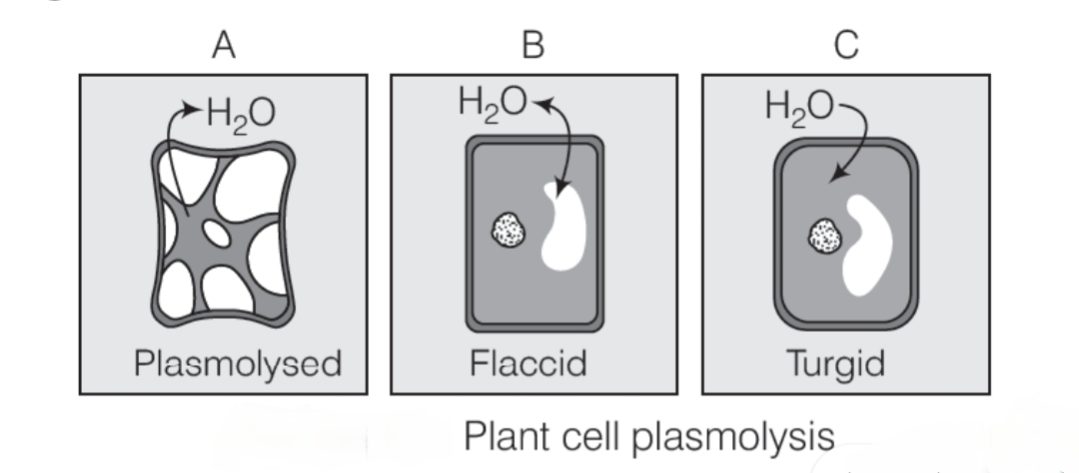
Stages of Plasmolysis
- Incipient Plasmolysis: Beginning stage when the plasma membrane just starts to detach from the cell wall.
- Complete Plasmolysis: Cytoplasm and plasma membrane are completely separated from the cell wall; protoplast shrinks.
- Deplasmolysis: If the plasmolysed cell is placed in a hypotonic solution, water enters the cell and the protoplast returns to its original position.
| Stage | Condition | Appearance of Cell |
|---|---|---|
| Incipient Plasmolysis | Early water loss | Plasma membrane just starts pulling away |
| Complete Plasmolysis | Maximum water loss | Protoplast fully shrinks; gaps between wall and membrane |
| Deplasmolysis | Placed in hypotonic solution | Cell regains turgidity |
Types of Plasmolysis
- Concave Plasmolysis: Plasma membrane detaches at some places but remains attached at others (reversible).
- Convex Plasmolysis: Plasma membrane completely detaches and protoplast shrinks (irreversible).
Importance of Plasmolysis:
- Demonstrates osmotic properties of living cells.
- Used to determine whether a cell is living or dead.
- Helps in preservation of food materials (pickling, salting, sugaring).
Enzyme Inhibition (एंजाइम अवरोध)
Inhibition का मतलब है किसी enzyme की activity को slow down या stop कर देना।
जब कोई molecule (inhibitor) enzyme के साथ bind करता है और उसकी catalytic activity को reduce करता है, तो इसे
enzyme inhibition कहते हैं।
🔹 Types of Inhibition (अवरोध के प्रकार)
- Competitive Inhibition (प्रतिस्पर्धी अवरोध):
Inhibitor, substrate जैसा दिखता है और enzyme के active site पर bind हो जाता है।
→ Example: Malonate inhibits Succinate Dehydrogenase. - Non-Competitive Inhibition (गैर-प्रतिस्पर्धी अवरोध):
Inhibitor enzyme के किसी allosteric site पर bind करता है और enzyme की shape बदल देता है,
जिससे substrate properly bind नहीं कर पाता।
→ Example: Heavy metals like Ag⁺, Hg²⁺. - Uncompetitive Inhibition (अप्रतिस्पर्धी अवरोध):
Inhibitor केवल enzyme-substrate complex से जुड़ता है और product बनने से रोकता है।
→ Example: Rare cases in multi-enzyme pathways. - Irreversible Inhibition (अप्रतिवर्ती अवरोध):
Inhibitor enzyme के साथ covalent bond बनाता है → enzyme permanently inactive हो जाता है।
→ Example: Cyanide inhibits Cytochrome oxidase.
| Type | Binding Site | Reversibility | Example |
|---|---|---|---|
| Competitive | Active site | Reversible | Malonate on Succinate Dehydrogenase |
| Non-Competitive | Allosteric site | Reversible | Heavy metals (Hg²⁺) |
| Uncompetitive | Enzyme-Substrate complex | Reversible (rare) | Special metabolic pathways |
| Irreversible | Strong covalent bond | Irreversible | Cyanide, Penicillin |
Importance of Enzyme Inhibition:
- Medicine में बहुत useful (e.g., antibiotics, drugs)।
- Metabolic pathways को regulate करता है।
- Toxins और poisons भी इसी process से काम करते हैं।
Imbibition in plants (विशिष्ट प्रकार का Diffusion)
Imbibition एक special type का diffusion है, जिसमें solids (colloids) water को absorb करते हैं और अपने volume में वृद्धि करते हैं।
यह process concentration gradient के along होती है और water potential gradient जरूरी होता है।
Key Points:
- Imbibition में water का movement solids के द्वारा होता है।
- Seeds और dry wood classical examples हैं।
- Water absorption से material swell करता है।
Classical Examples of Imbibition
- Dry seeds absorbing water और swelling करना।
- Dry wood द्वारा water absorption और swelling।
Importance of Imbibition
- Imbibition pressure के कारण seedlings मिट्टी से बाहर निकल कर grow करते हैं।
- Prehistoric man ने wood की swelling pressure का उपयोग rocks और boulders तोड़ने में किया।
- Plant tissues में initial water absorption का पहला step।
Note: Imbibition के लिए absorbent और imbibed liquid के बीच affinity होना जरूरी है।
Water potential gradient की वजह से water spontaneously absorb होता है।
Read more for Transport in Plants:-
Read more chapters:-